Tag: CubeSat

  • NASA Launches Tech Demo to Cut Spacecraft Design Costs

    NASA Launches Tech Demo to Cut Spacecraft Design Costs

    Key Takeaways

    1. NASA successfully launched the R5-S7 CubeSat on November 28 using a SpaceX Falcon 9 rocket.
    2. R5-S7 features affordable subsystems and shorter development schedules for quicker deployment.
    3. It is the first R5 satellite to perform a unique proximity operations maneuver for tasks like inspecting or repairing objects in orbit.
    4. The R5 series aims to demonstrate lower-cost spacecraft design and significantly reduce development time from years to months.
    5. R5-S7 was launched alongside three other CubeSats and additional satellites as part of the SpaceX Transporter-15 rideshare mission.


    On November 28 at 6:44 PM UTC, NASA successfully launched the R5-S7 (Realizing Rapid, Reduced-cost high-Risk Research project Spacecraft 7). This CubeSat was sent into space on a commercial rideshare mission using a SpaceX Falcon 9 rocket.

    Details About R5-S7

    R5-S7 is one of the CubeSats in the R5 series. It utilizes commercial off-the-shelf components and features more affordable subsystems. Moreover, it adheres to shorter development schedules, allowing for quicker deployment.

    Proximity Operations Maneuver

    This particular satellite is notable for its programming, which includes a unique proximity operations maneuver — making it the first R5 satellite to attempt this. The maneuver involves controlled movements close to another object and is set to initiate right after R5-S7 separates from the launch vehicle. This capability is crucial for future missions that might involve tasks like inspecting, repairing, or constructing structures in orbit.

    NASA’s Goals with the R5 Series

    With the R5 series, NASA’s goal is to demonstrate that designing spacecraft can be done at a lower cost and to significantly shorten the time frame from years to just a few months. R5-S7 was launched together with three other CubeSats funded by NASA. The SpaceX Falcon 9 rocket also deployed several additional satellites during this mission, all part of the SpaceX Transporter-15 rideshare initiative.

    Source:
    Link



  • Student Satellite to Study Rare Aurora Cousin

    Student Satellite to Study Rare Aurora Cousin

    Key Takeaways

    1. The University of Calgary students are launching FrontierSat, the city’s first student-built satellite, expected to launch in early 2026.
    2. FrontierSat is a 3U CubeSat designed to study a unique space weather event called STEVE, which appears as a ribbon of purple and green light.
    3. STEVE is distinct from auroras, as it does not involve charged particles, indicating a different and unknown light source.
    4. The satellite will use a mini plasma imager to collect data about the ionosphere, contributing to a multi-year dataset on STEVE.
    5. The mission is primarily funded by the Canadian Space Agency and involves over 100 students from the CalgaryToSpace team.


    A group of mainly undergraduate students from the University of Calgary is getting ready to launch the first satellite built by students in the city. The satellite, called FrontierSat, is a 3U CubeSat that has successfully completed its final vibration tests and is now waiting for its launch. While a specific launch date hasn’t been confirmed yet, it is expected to take place in early 2026 from California on a SpaceX Falcon 9 rocket. The SmallSat’s primary mission will be to collect data about a strange space weather event known as STEVE.

    Understanding STEVE

    STEVE, which stands for Strong Thermal Emission Velocity Enhancement, shows up in the night sky as a quick-moving, slender ribbon of purple and green light. Although it might be confused for an aurora, researchers at the University of Calgary have verified that it is actually a separate phenomenon.

    Unlike auroras, which are created by charged particles falling into Earth’s upper atmosphere, STEVE does not involve these particles. This suggests that the light it emits comes from a different and currently unknown source. The FrontierSat team is eager to investigate and unravel this cosmic enigma.

    Exciting Future Prospects

    “It would be fantastic if we could gather a multi-year dataset of STEVE observations with FrontierSat,” says Johnathan Burchill, the mission’s lead investigator.

    The satellite, roughly the size of a loaf of bread, will utilize a mini plasma imager to observe the ionosphere from space. Mainly funded by the Canadian Space Agency, this mission represents a significant milestone for the more than 100 students involved in the CalgaryToSpace team, who have dedicated their efforts to the design, construction, and testing of the satellite.

    Source:
    Link


  • First Wooden Satellite LignoSat Launched by SpaceX ISS Mission

    First Wooden Satellite LignoSat Launched by SpaceX ISS Mission

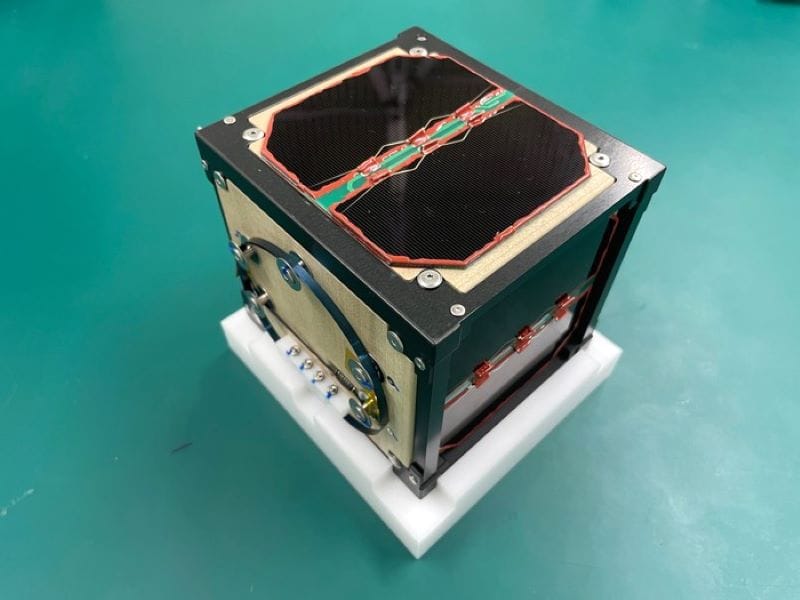
    LignoSat, the first wooden satellite in the world, was successfully launched into outer space as part of the 31st SpaceX International Space Station resupply mission on November 4, 2024. This innovative satellite was developed through a partnership between students and researchers at Kyoto University and Sumitomo Forestry, under a project known as LignoStella (space timber). The main aim was to explore the use of eco-friendly woods to minimize the release of harmful metal particles into the atmosphere when satellites reenter at the end of their lifecycle.

    Materials and Construction

    For the structure of the LignoSat, Hinoki wood (Japanese cypress, Chamaecyparis obtusa) sourced from Sumitomo Forestry Monbetsu’s forests was utilized. The assembly of the wooden body employed a traditional joinery technique, "Tomega Kakushi Ariku Mitsugi," which avoids the use of metals or adhesives. To enhance durability, aluminum framing was used to reinforce the outer edges. The satellite, which is the size of a 1U CubeSat, also incorporates electronics, solar panels, and antennas.

    Testing and Mission

    The development of the LignoSat included thorough testing over four years, focusing on wood degradation under space conditions, radio-frequency emissions, and overall safety during space travel. Once it docks with the ISS, LignoSat will be stored in the JEM Small Satellite Orbital Deployer (J-SSOD) for a while before being released into space for a six-month mission. This mission aims to evaluate the wood’s resilience to the harsh conditions of space and its effectiveness at blocking space radiation.

    Amateur Radio Features

    For those interested in amateur radio, the LignoSat is equipped with two dipole antennas capable of receiving and transmitting RF signals. Radio operators can send FM messages to the satellite using their call signs and, in return, receive CW messages that are decoded with their call signs and SSIDs. Furthermore, encoded messages like QTH can be decoded and then sent back via an FM downlink to be shown on the project’s website.

    If you are eager to create your own CubeSat for a space mission, consider checking out NASA’s "CubeSat 101" document. For model-building enthusiasts, there are CubeSat hobby kits available on Amazon.

    Sources include Kyoto University Space Timber Project on X, Kyoto University SIC Human Spaceology Center, and Sumitomo Forestry news release, alongside various platforms like Readyfor and YouTube, which provide insights into the project and its results.