Tag: Core Ultra 7 255H

  • MSI Venture 16: Fast Budget Office Laptop for Productivity

    MSI Venture 16: Fast Budget Office Laptop for Productivity

    Key Takeaways

    1. The MSI Venture 16 is an affordable office laptop priced at $1000, making some sacrifices but maintaining strong processor performance.
    2. It outperforms many competitors in CPU-intensive tasks due to its H-series Core Ultra 7 255H processor.
    3. The graphics performance is decent but not exceptional, as most business laptops lack discrete graphics.
    4. The integrated NPU of the Core Ultra 7 255H is limited to 13 TOPS, which may disadvantage users relying on AI-accelerated applications.
    5. Overall, the Venture 16 is a solid choice for CPU power at its price point, despite some limitations in graphics and NPU performance.


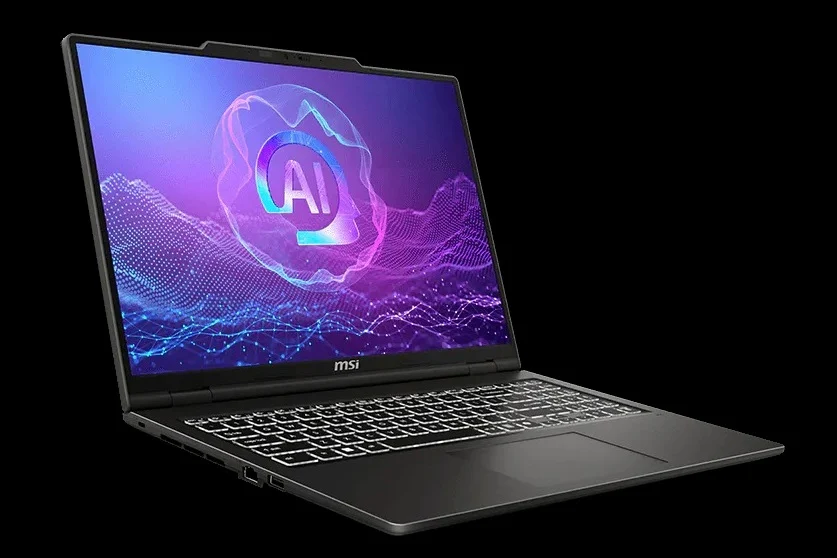
    The Venture 16 is among the most affordable office laptops offered by MSI, and it has made some sacrifices to achieve its appealing starting price of $1000. However, it does not compromise on its processor performance.

    Performance Comparison

    Our CPU and GPU charts present a comparison of the Venture 16 against around a dozen of the latest 16-inch office laptops. Surprisingly, the MSI device excels in most CPU-intensive tasks, even though it is labeled as a “budget-friendly” option. This performance advantage is largely due to its H-series Core Ultra 7 255H processor, while many other business laptops usually feature slower U-series or V-series processors.

    Graphics and Limitations

    When it comes to graphics, the Venture 16 is not as remarkable, but it still holds its own within this category since most business laptops lack discrete graphics.

    One area where the Core Ultra 7 255H falls short is its integrated NPU, which has a maximum performance of only 13 TOPS, especially when compared to the 48 TOPS found in laptops with the mentioned Core V-series CPU. Therefore, users who depend on AI-accelerated applications or Co-Pilot might find a V-series CPU more beneficial than an H-series one. Nevertheless, for pure CPU power, the Venture 16 remains a solid choice, particularly for its price. Additional benchmarks and comparisons are available in the review of this model linked here.

  • Core Ultra 9 285H vs. Core Ultra 7 255H: Minimal Benefits

    Core Ultra 9 285H vs. Core Ultra 7 255H: Minimal Benefits

    Key Takeaways

    1. The performance difference between the Core Ultra 7 255H and Core Ultra 9 285H is minimal, averaging just a 6% speed increase for the 285H.
    2. In some cases, laptops with the Core Ultra 7 can outperform those with the Core Ultra 9 due to factors like design and cooling systems.
    3. The higher cost of the Core Ultra 9 285H is often not justified by its performance advantages in most scenarios.
    4. Availability issues complicate the choice for consumers, as the Core Ultra 7 is sometimes harder to find in certain regions.
    5. The Lenovo Yoga Pro 9 16 G10 is mainly offered with the Core Ultra 9, making Core Ultra 7 options less accessible and often more expensive than necessary.


    The Core Ultra 7 255H and Core Ultra 9 285H are among Intel’s top-performing H-series processors in the mobile Arrow Lake series. In practice, though, the difference between these two CPUs is merely a few hundred MHz, meaning the performance gap is not significant. After testing over two dozen laptops with these processors, it’s clear that choosing the Core Ultra 9 285H often doesn’t justify the additional cost in most situations.

    Performance Comparison

    The chart below reveals that laptops equipped with the Core Ultra 9 285H are just 6 percent quicker on average than those with the Core Ultra 7 255H. This slight difference means that in certain instances, machines running the Core Ultra 7 can actually outperform those with the Core Ultra 9, as seen with the Lenovo Yoga Pro 9 16IAH G10 compared to the MSI Prestige 16 AI Evo. This indicates that the laptop’s design and cooling system may have a bigger impact on performance than the CPU model itself in this specific case.

    Availability Issues

    While choosing the Core Ultra 7 255H seems like an obvious choice for most consumers, it’s not always straightforward. For instance, the Lenovo Yoga Pro 9 16 G10 is primarily sold with the Core Ultra 9 CPU in the United States, making it challenging to find cheaper Core Ultra 7 options based on the model or region. As a result, these laptops end up being pricier than they should be, considering their performance-to-cost ratio is relatively low.

  • Dell 16 Premium CPU Outperforms XPS 16 9640 by 15-20%

    Dell 16 Premium CPU Outperforms XPS 16 9640 by 15-20%

    Key Takeaways

    1. The Dell 16 Premium has launched globally, replacing the XPS 16 9640 with new Arrow Lake-H and Blackwell options.
    2. Users can expect a performance boost of up to 20% in multi-thread tasks with the Core Ultra 7 255H compared to the older model.
    3. Performance gains are short-lived, with scores declining from 3410 to around 2900 points during continuous testing.
    4. The XPS 16 9640 shows more stable performance over time, making it seem like a better value for users.
    5. The 2024 model offers minor improvements, and significant advancements are not expected in the upcoming 2025 version.


    The Dell 16 Premium has started shipping globally, marking a new chapter after the XPS 16 9640 from last year. This new model swaps out the Meteor Lake-H and Ada Lovelace options for the Arrow Lake-H and Blackwell alternatives in its 2024 version. Users who opt for the Core Ultra 7 255H can anticipate a performance boost of up to 20 percent in multi-thread tasks compared to the older XPS 16 9640 Core Ultra 7 155H.

    Performance Insights

    However, there’s a catch: the 20 percent increase is only noticeable during the initial few minutes. Our tests display a decline in performance scores, dropping from 3410 points to around 2900 points over time when running CineBench R15 xT in a continuous loop on the Dell 16 Premium with the Core Ultra 7 255H. In contrast, the XPS 16 9640 maintains a more stable performance over time. As throttling kicks in, the gap in CPU performance between the Dell 16 Premium and the XPS 16 9640 narrows significantly.

    User Experience

    Most users probably won’t even pick up on the small performance changes between these two laptops, making the older XPS 16 9640 appear as a better value. Still, this situation highlights the relatively tiny improvements and distinctions between the 2024 and 2025 models. The 2024 XPS 16 already represented a significant leap over its 2023 counterpart, so users shouldn’t have high hopes for groundbreaking enhancements in the 2025 model. For additional benchmarks and comparisons, you can check out our detailed review of the 2025 version here.


  • System76 Meerkat Mini PC: Upgraded Core Ultra 7 & 96GB RAM

    System76 Meerkat Mini PC: Upgraded Core Ultra 7 & 96GB RAM

    Key Takeaways

    1. The System76 Meerkat mini PC now features the new Core Ultra 7 255H “Arrow Lake” CPU, offering 30% better multi-core and 18% better single-core performance compared to the previous model.

    2. It supports up to 96 GB of DDR5-5600 RAM and allows users to upgrade memory and storage through dual SODIMM slots and two M.2 2280 slots.

    3. An affordable option with the Core 3 100U is available, but it lacks discrete graphics and has PCIe 4.0 support for the M.2 slots.

    4. The Meerkat mini PC has strong connectivity options, including dual Thunderbolt 4 ports, multiple USB ports, and dual HDMI 2.1 ports, but it does not include an audio jack.

    5. Pricing starts at $599 for the Core 3 model and $1,048 for the Core Ultra 7 model, with various configuration choices available.


    Linux lovers are probably well aware of System76, a brand recognized for its Linux-based machines that generally get good feedback. One of their products, the Meerkat mini PC, has recently launched with both stronger and more budget-friendly options.

    New Processor Update

    Earlier this January, the System76 Meerkat mini PC saw an upgrade to the Core Ultra 7 155H “Meteor Lake” CPU. Now, it’s available with the new Core Ultra 7 255H “Arrow Lake” CPU. In terms of performance, the 255H boasts around 30% better multi-core performance due to its six P-cores utilizing multithreading, and about 18% enhanced single-core performance as shown by Cinebench 2024.

    Memory and Storage Options

    The Meerkat Linux mini PC can support up to an impressive 96 GB of DDR5-5600 RAM. Users can access and upgrade both the memory and storage, thanks to the dual SODIMM slots and two M.2 2280 slots, with one supporting PCIe 5.0. There’s also a more affordable option featuring the Core 3 100U, which has similar specs but both M.2 slots supporting PCIe 4.0. However, it lacks space for discrete graphics, relying instead on integrated GPUs. For gaming, mini PCs that have OCuLink support, like the GMKtec K11 (currently $649.99 on Amazon), might be a better choice.

    Great Connectivity Options

    The port selection is quite good, including dual Thunderbolt 4 ports, USB 3.2 Gen 2×2 Type-C, three USB 3.2 Gen 2 Type-A ports, a USB 2.0 Type-A port, a 2.5 G Ethernet port, and dual HDMI 2.1 ports. Unfortunately, the audio jack has been taken out, which is a bit of a letdown. The entry-level variant with the Core 3 starts at $599, while the Core Ultra 7 model begins at $1,048. There are many configuration choices available, and the prices seem mostly fair.

    System76, as reported by Liliputing.

    Source:
    Link


  • Intel Core Ultra 7 255H Beats AMD Ryzen 9 HX in Passmark Test

    Intel Core Ultra 7 255H Beats AMD Ryzen 9 HX in Passmark Test

    A recent benchmark for Intel’s Core Ultra 7 255H processor has appeared online. From the data, Arrow Lake-H looks poised to significantly enhance single-threaded performance, though the multi-threaded performance appears to be a letdown, mainly because Intel has removed hyperthreading support.

    Impressive Single-Thread Performance

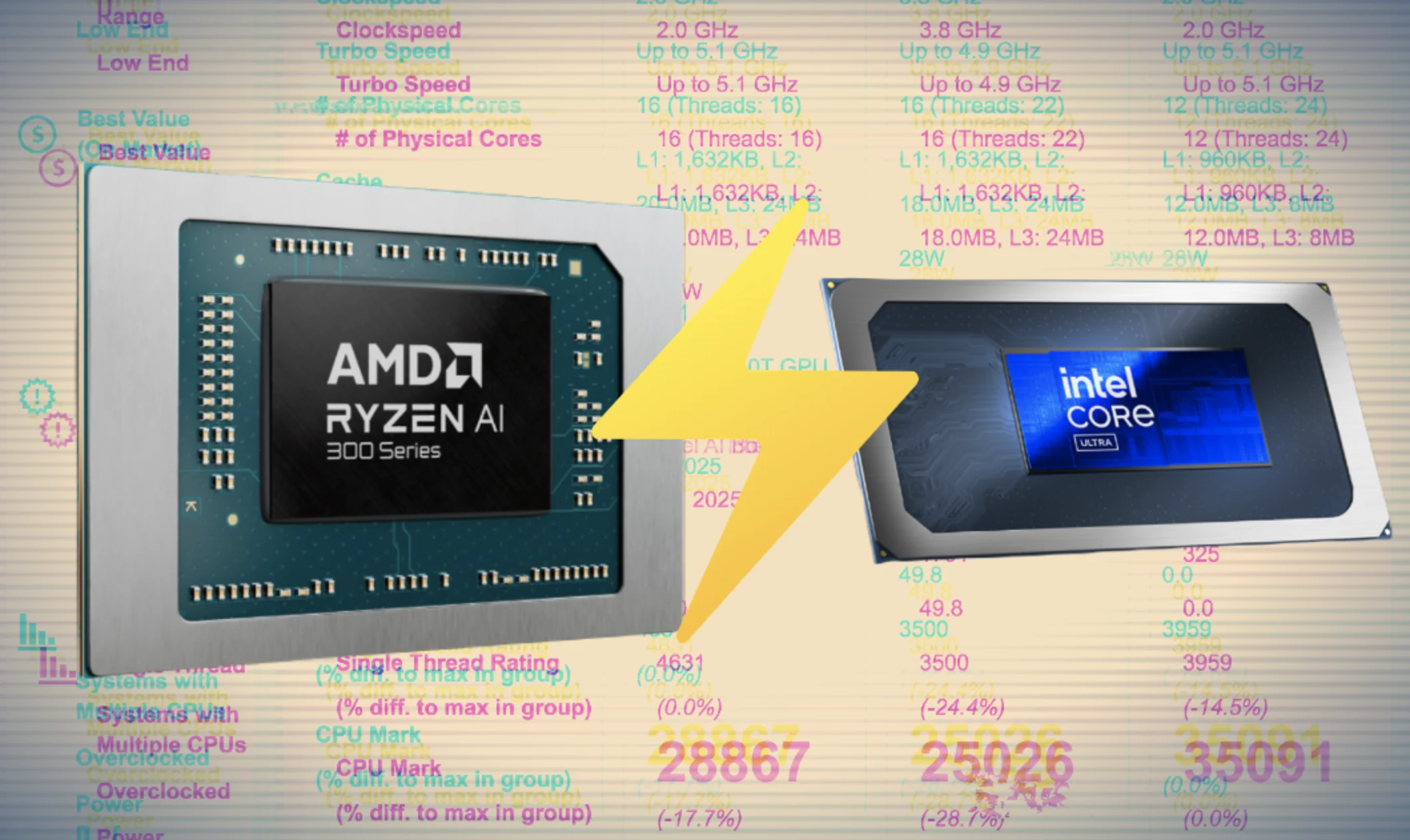
    The Passmark score reveals that the Core Ultra 7 255H achieved an outstanding single-thread score of 4631 points, marking a remarkable 32% increase compared to the Core Ultra 7 155H “Meteor Lake-H” CPU. The Arrow Lake-H series utilizes Lion Cove performance cores, which are showing their value, supported by TSMC’s N3B fabrication process. Interestingly, this benchmark positions the Core Ultra 7 255H approximately 17% ahead of the AMD Ryzen AI 9 HX 370 “Strix Point” CPU. However, in terms of overall performance, the Arrow Lake-H model falls short, trailing the Strix Point by nearly 20%.

    Generational Improvements

    When compared to its previous model, the Core Ultra 7 255H exhibits about a 12% advantage in overall performance. While this is a respectable increase from generation to generation, it’s not nearly as striking as the gains seen in single-threaded performance. Additionally, the Arrow Lake-H chips are anticipated to feature integrated GPUs with up to eight Xe LPG+ cores, which will be less powerful than the Xe2 cores found in Lunar Lake processors. It’s important to note that synthetic benchmarks should be viewed cautiously, as actual performance can vary widely based on specific workloads.

    Source:
    Link


  • OneXPlayer G1: AMD Ryzen 9 or Intel Ultra 7, 64GB RAM Sale

    OneXPlayer G1: AMD Ryzen 9 or Intel Ultra 7, 64GB RAM Sale

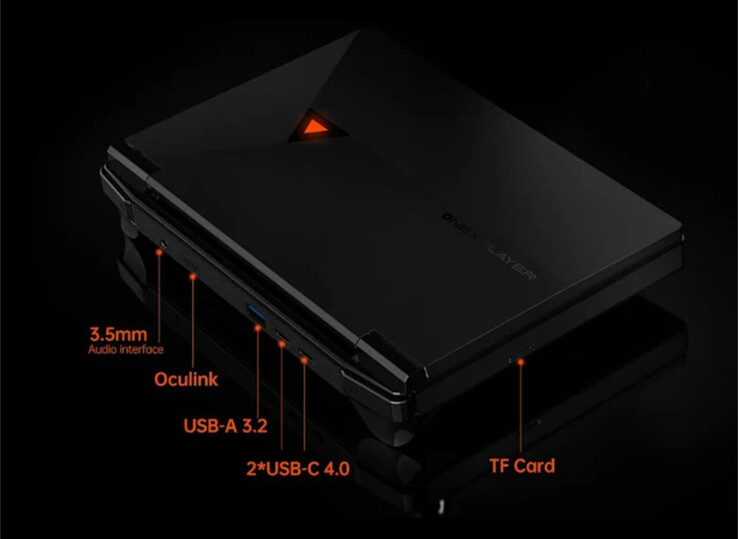
    One-Netbook has started the year 2025 with the launch of the OneXPlayer G1, which serves as a clamshell option to the GPD Win Mini (currently priced at $1,079.95 on Amazon). Many gaming device makers are refreshing their offerings to include AMD’s Ryzen AI 9 365 or Ryzen AI 9 HX 370 APUs, including both GPD and One-Netbook.

    Pricing and Specifications

    The OneXPlayer G1 begins at approximately $1,199, featuring the Ryzen AI 9 HX 370. In addition, One-Netbook is also providing this new device with Intel’s recently announced Core Ultra 7 255H, which was unveiled at CES 2025 in Las Vegas just this week. For those looking for a more budget-friendly option, the device is available with an older Ryzen 7 8840U.

    Performance Uncertainty

    As of now, it’s not clear how the Core Ultra 7 255H will perform in a compact form like the OneXPlayer G1. Theoretically, its Arc 140T iGPU should outperform the Arc 140V found in Lunar Lake models such as the Core Ultra 7 258V, which slightly lags behind the Radeon 890M according to our gaming benchmarks.

    Shipping and Early-Bird Deals

    One-Netbook aims to start shipping all Indiegogo orders by March. Please be aware that the pricing mentioned is subject to change on January 13 at 17:00 UTC, once the early-bird period of the campaign concludes. Early bird pricing for the OneXPlayer G1 is as follows:

    Source:
    Link


    Image 1


  • OneXPlayer G1: AMD Ryzen & Intel Ultra 7 Mini PC from $899

    OneXPlayer G1: AMD Ryzen & Intel Ultra 7 Mini PC from $899

    The OneXPlayer G1 is set to debut on the crowdfunding platform Indiegogo tomorrow. As is typical for them, One-Netbook has shared important information such as pricing and memory options in advance. To summarize, the OneXPlayer G1 is positioned as One-Netbook’s answer to the Win Mini, which GPD is gearing up to update with a 2025 version.

    Specifications

    Previously, One-Netbook hinted that the new model would feature an AMD Ryzen AI 9 HX 370 APU, similar to what’s found in the OneXPlayer X1 Pro and in some recent gaming laptops like the Asus TUF Gaming A14 (currently priced at $1,499 on Amazon). However, it has now been revealed that the OneXPlayer G1 will kick off with the older Ryzen 7 8840U, which powers several existing OneXPlayer models.

    New Variants

    Interestingly, One-Netbook has also introduced a Core Ultra 7 255H variant that is based on Intel’s latest Arrow Lake-H architecture. For context, this Core Ultra 7 255H features 6 Performance cores, 8 Efficient cores, and 2 Lower Power Efficient Cores, along with a new Arc 140T iGPU that could be as much as 60% faster compared to the Arc 140V.

    Pricing Details

    Despite this, versions with the Ryzen AI 9 HX 370 will be priced $100 higher than their Core Ultra 7 255H equivalents. The OneXPlayer G1 will be open for backing on Indiegogo starting at 17:00 UTC tomorrow, and customers who order before this time on January 13 will receive a free case with their purchase. At launch, One-Netbook will offer the OneXPlayer G1 at the following price points:

    Source: Link


    Image 1
  • Intel Core Ultra 7 255H: Boosts Performance Over Meteor Lake

    Intel Core Ultra 7 255H: Boosts Performance Over Meteor Lake

    Yesterday, the Core Ultra 5 225H was spotted on Geekbench. It showed a good performance improvement compared to its Meteor Lake-based version, the Core Ultra 5 125H. However, it fell short when matched against AMD’s Strix Point lineup. Now, the stronger version, the Core Ultra 7 255H, has appeared on the same benchmarking site.

    Specifications and Performance

    Looking at the specs, the Core Ultra 7 255H features 6 Lion Cove P-cores and 10 Crestmont E-cores. According to Geekbench, this CPU can reach a boost of up to 5.1 GHz. Nevertheless, it seems to struggle to maintain that speed. This behavior was also noted previously with the Core Ultra 9 285H, suggesting that Intel might need to resolve some issues with the Arrow Lake-H series.

    Benchmarking Insights

    In the single-core test on Geekbench, the Core Ultra 7 255H achieved a score of 2,754 points. This makes it 14% quicker than the Core Ultra 7 155H and nearly as fast as the Lunar Lake-based Core Ultra 7 258V. Likewise, the Core Ultra 5 255H goes head-to-head with AMD’s Ryzen AI 9 365, which scored 2,797 points in the same test.

    Multi-Core Results

    For multi-core performance, the Core Ultra 7 255H garnered 15,040 points. This result is 22% higher than the Core Ultra 7 155H and 12% faster than the Ryzen AI 9 365. These results are impressive, especially considering the absence of hyperthreading. We can expect to see this CPU in action, along with its Arrow Lake-HX and Arrow Lake-U versions, at CES 2025.


    Image 1
    Image 1