Key Takeaways
1. CPU Misrepresentation: Both the Chuwi CoreBook X and CoreBook Plus are incorrectly advertised as having the Ryzen 5 7430U CPU, but they actually contain the older Ryzen 5 5500U.
2. Legal and Reputational Issues: Chuwi has threatened legal action against those reporting the discrepancies, indicating a significant concern for their reputation due to misleading product information.
3. Testing and Confirmation: Tests revealed that the actual specifications of the CPUs do not match the advertised 7430U, with evidence confirmed through disassembly of the laptops.
4. Market Impact and Consumer Rights: The misleading advertising creates a competitive advantage for Chuwi, but consumers in the EU have legal rights for a product that matches the advertised specifications, potentially leading to refunds or replacements.
5. Industry Repercussions: This incident raises concerns about unfair competition, and AMD may respond to protect its brand image against the promotion of incorrect hardware specifications.
Having just verified that the Chuwi CoreBook X, against all expectations – including data from official Chuwi sites, product specs sheets, retailer websites, device packaging, laptop stickers, Windows system tools, analysis software, and even the BIOS – actually comes with a Ryzen 5 5500U CPU instead of the promoted AMD Ryzen 5 7430U (we’ll detail the differences later), this situation is turning into quite a significant issue for the manufacturer.
Legal Pressure and Further Investigations
Chuwi’s repeated requests to take down our related articles – threatening legal action due to reputational harm, no less – have led us to dig deeper. Along with the CoreBook X, we also discovered the CoreBook Plus in Chuwi’s lineup, which claims to feature the Ryzen 5 7430U processor. Consequently, we purchased a unit from a German retailer to examine it as well.
Disappointing Test Results
The initial findings from our tests are disheartening: The Chuwi CoreBook Plus also only contains a Ryzen 5 5500U, despite active advertising for the Ryzen 5 7430U. Once again, all provided information from the manufacturer and on the device hides this truth, making the CPU appear to users as if it’s the more modern 7430U.
The Windows Task Manager gives an early clue. Both the clock speeds and CPU caches are visible here. The Ryzen 5 7430U boasts a maximum boost clock of 4,300 MHz and 16 MB of L3 cache, hailing from the Zen 3 series, codenamed “Barcelo-U.” However, in our sample’s task manager, the information does not match up. Even though the CPU name is listed as Ryzen 5 7430U, the code name “Lucienne-U” (Zen 2 architecture), the 2x 4MB L3 cache, and the observed turbo clock of just over 4,000 MHz suggest discrepancies. These specs align with the Ryzen 5 5500U chip.
Confirming the Findings
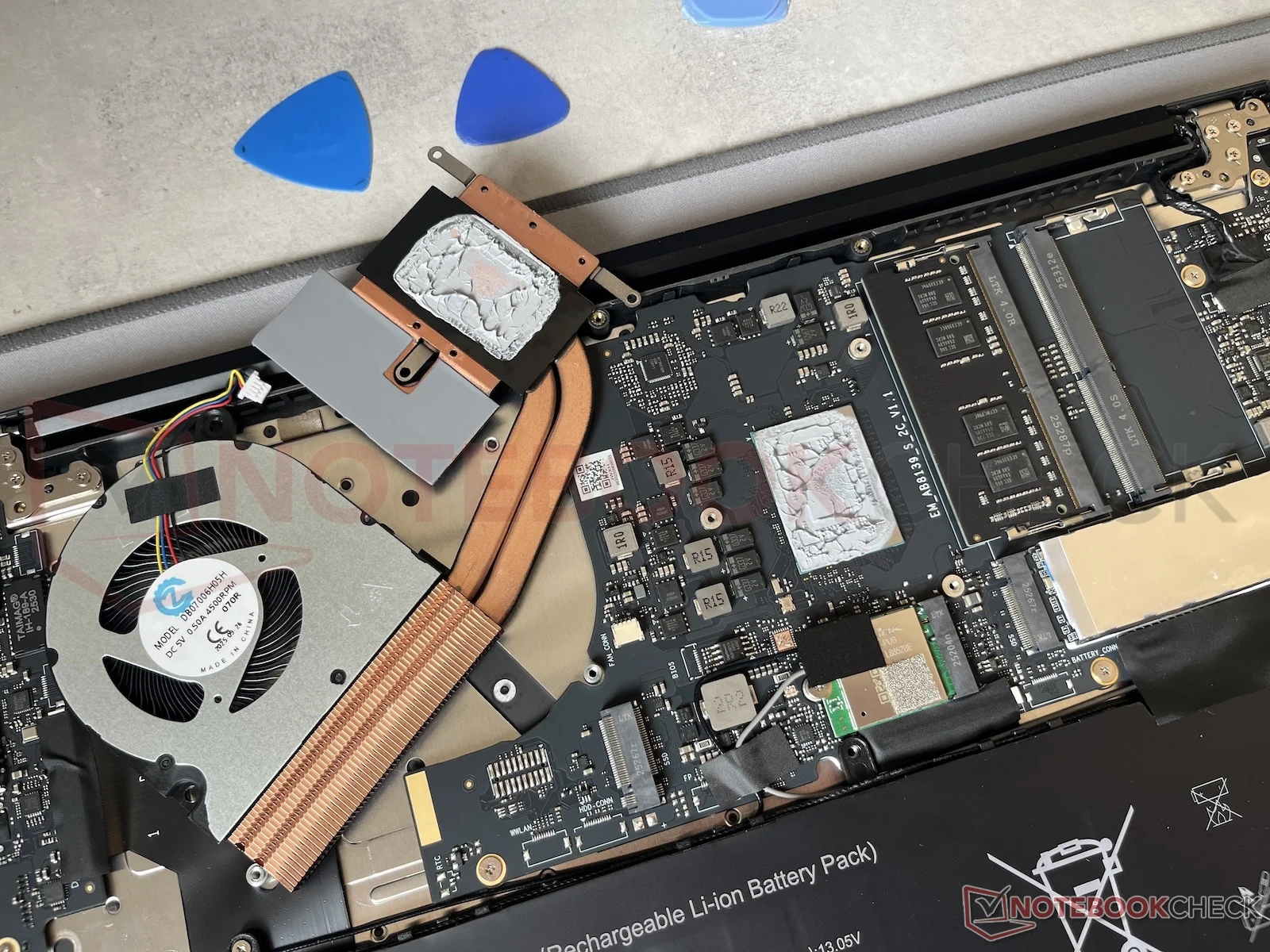
It’s well known that there can be issues when reading CPU specifications with software tools, so ultimately, only disassembling the laptop offers complete certainty. Therefore, we proceeded: After loosening a few screws, we opened the laptop, revealing the fan and CPU cooler. These components needed to be taken off to access the processor. Once we navigated this final hurdle and cleaned away a generous amount of thermal paste, we could read the OPN number directly on the soldered chip, which clearly identifies the processor: 100-000000375. This number matches the one used in the CoreBook X and is explicitly identified by AMD on the official product page as the Ryzen 5 5500U. In contrast, 100-000001471 would be the correct OPN for the advertised Ryzen 5 7430U.
In our review of the Chuwi CoreBook X, we noted that the clandestinely installed 5500U processor is suitable for daily tasks like office work, web surfing, and media playback. Nonetheless, the touted 7430U chip is about 2 years newer (released in 2023 compared to 2021), has a notably higher turbo clock (4.3 GHz vs. 4.0 GHz), and at 16 MB, a level 3 cache that is twice as large. All this results in a performance gap of up to 20% in tests, depending on the benchmarks used.
Price Considerations and Market Impact
Considering the price point (399 euros for the CoreBook Plus), such performance differences may seem manageable. However, the key factor is how this device stacks up against its competitors. From this perspective, Chuwi benefits significantly from the established facts: Laptops featuring 7430U processors are currently priced between 500 and 600 euros, which is about 100-200 euros more than this supposed deal. This creates a significant buying incentive based on misleading information.
It’s clear that we have identified two fundamentally different models from the manufacturer – the Chuwi CoreBook X and the CoreBook Plus – both lacking the advertised CPU and instead featuring an older, less capable model. Additionally, both laptops tested have all system tools, including the BIOS, misleading users into believing that the CPU they supposedly purchased is indeed installed. The chance of this occurring by coincidence can be dismissed. This suggests firmware level modifications, indicating a considerable amount of effort involved.
For consumers in the EU (if purchased there), the legal warranty/conformity rights of at least 2 years certainly apply, guaranteeing buyers receive a product in the condition promised. Potential resolutions could include a replacement with a correctly equipped model, cancellation of the purchase contract with a refund, or claiming a price reduction.
Industry Response
We’re also very curious how other potentially competing companies will respond to this incident, especially regarding “unfair competition.” AMD likely has a strong interest in preventing the promotion of mismatched hardware (“Ryzen 5 7000 Series” sticker on the device), since this raises user expectations that the installed CPU cannot meet.