Tag: battery test

  • Samsung Galaxy S26 Ultra Battery Drain Test Fails Against Rivals

    Samsung Galaxy S26 Ultra Battery Drain Test Fails Against Rivals

    Key Takeaways

    1. The Galaxy S26 Ultra features a 5,000 mAh battery, similar to its predecessors, but recent tests show it may need a larger battery for better performance.

    2. In battery drain tests, the Galaxy S26 Ultra achieved 9 hours and 8 minutes, ranking near the bottom compared to competitors.

    3. Competing flagship phones outperformed the Galaxy S26 Ultra, with the iPhone 17 Pro Max at 9 hours and 41 minutes, the Xiaomi 17 Pro Max at 10 hours and 3 minutes, and the OnePlus 15 at 12 hours and 31 minutes.

    4. The previous model, Galaxy S25 Ultra, had a better performance at 8 hours and 40 minutes, placing it between the Pixel 10 Pro XL and the new S26 Ultra.

    5. Samsung is considering larger batteries for future devices and plans to implement Silicon-Carbon chemistry, following trends set by rival companies.


    Samsung has just launched the Galaxy S26 Ultra, marking it as their seventh “Ultra” smartphone. This new model carries a 5,000 mAh battery, just like its predecessors. However, despite improvements in efficiency each year, a recent battery drain test shows that Samsung should consider using larger batteries in future devices.

    Battery Performance Compared

    According to a test conducted by Tech Droider, the Galaxy S26 Ultra ranks near the bottom when compared to other current flagship phones. Specifically, it only outperforms the Google Pixel 10 Pro XL, which recorded a time of 8 hours and 22 minutes. The Galaxy S26 Ultra, in contrast, achieved a run time of 9 hours and 8 minutes.

    Competing Models

    Unfortunately for the Galaxy S26 Ultra, it falls short against several competitors. The iPhone 17 Pro Max managed 9 hours and 41 minutes, the Xiaomi 17 Pro Max reached 10 hours and 3 minutes, and the OnePlus 15 topped the list with a remarkable 12 hours and 31 minutes. For some context, last year’s Galaxy S25 Ultra had a performance of 8 hours and 40 minutes, landing it between the Pixel 10 Pro XL and the Galaxy S26 Ultra.

    The Need for Larger Batteries

    While one battery drain test is not definitive, the results suggest that Samsung needs to include larger batteries to stay competitive. For instance, the Xiaomi 17 Pro Max boasts a 7,500 mAh battery, while the OnePlus 15 is equipped with a 7,300 mAh unit. Fortunately, it seems Samsung is already considering this move, as there’s been recent acknowledgment that they will be implementing Silicon-Carbon chemistry, a trend that rival companies are already embracing.

    Source:
    Link


  • Oppo Find X9 Pro Outperforms Xiaomi 17 Pro Max in Battery Tests

    Oppo Find X9 Pro Outperforms Xiaomi 17 Pro Max in Battery Tests

    Key Takeaways

    1. Xiaomi’s 17 Pro Max has a 7500 mAh battery but only slightly outperforms its Apple competitor in battery drain tests.
    2. Oppo’s upcoming Find X9 Pro shows strong potential for superior battery performance, currently leading in endurance tests.
    3. In recent tests, the Find X9 Pro lasted 7 hours and 18 minutes, while the iQOO Z10 Turbo+ ran for 7 hours and 31 minutes with an 8000 mAh battery.
    4. The standard Find X9 outperformed the Xiaomi 17 Pro Max despite having a smaller 7025 mAh battery, lasting 6 hours and 51 minutes compared to Xiaomi’s 6 hours and 49 minutes.
    5. Additional tests by WhyLab confirm the Find X9 Pro’s lead, with a runtime of 9 hours and 30 minutes versus Xiaomi’s 8 hours and 24 minutes.


    In a recent battery drain test, Xiaomi’s new 17 Pro Max, despite having a battery that is 55% larger, just barely surpassed its Apple competitor. The Xiaomi flagship is currently leading its category, boasting an impressive 7500 mAh battery, but this might soon change.

    Testing the Competition

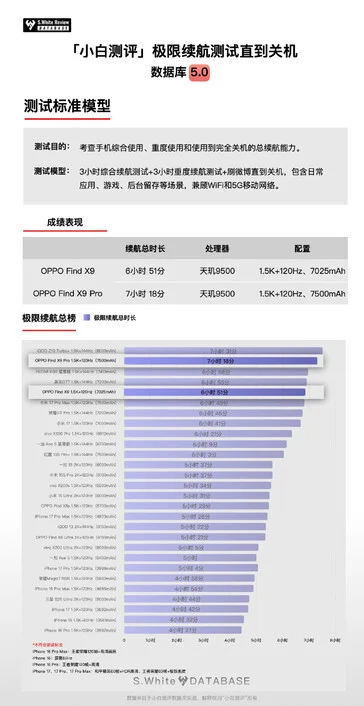
    According to Novice Evaluation, Oppo’s Find X9 Pro might present superior battery performance compared to other flagship devices available now. Although the Find X9 series has not officially launched yet, both the Find X9 and Find X9 Pro are undergoing testing in China. The Find X9 Pro has emerged as the leader in battery endurance tests.

    Impressive Results

    In these tests, the Find X9 Pro achieved a total of 7 hours and 18 minutes, narrowly missing out to the iQOO Z10 Turbo+, which runs for 7 hours and 31 minutes. The Oppo phone features a 7,500 mAh battery, similar to that of the Xiaomi 17 Pro Max, while the iQOO includes an 8,000 mAh battery. To further highlight Xiaomi’s questionable battery performance, the standard Find X9 lasts 6 hours and 51 minutes compared to the 6 hours and 49 minutes of the Xiaomi 17 Pro Max, even though it has a smaller 7,025 mAh battery. It’s important to point out that the Find X9 is also the smaller of the two devices. For reference, the iPhone 17 Pro Max only lasts 5 hours and 26 minutes.

    Consistent Findings

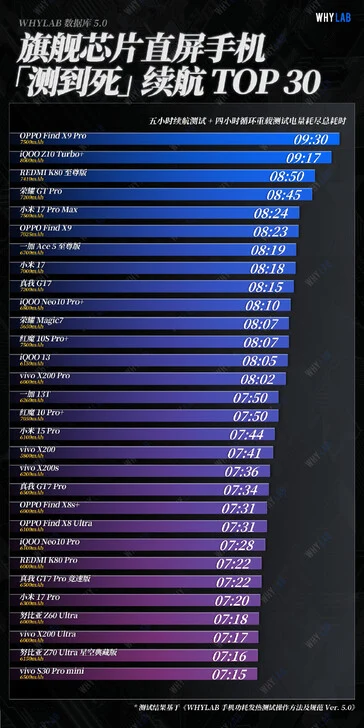
    A similar series of tests conducted by WhyLab confirms the earlier results. The Find X9 Pro leads again, with a total run time of 9 hours and 30 minutes, while the Xiaomi 17 Pro Max only manages 8 hours and 24 minutes.

    Source:
    Link


  • Xiaomi 17 vs iPhone 17 Battery Test: Xiaomi’s 5,000mAh Power Bank

    Xiaomi 17 vs iPhone 17 Battery Test: Xiaomi’s 5,000mAh Power Bank

    Key Takeaways

    1. A direct comparison of battery life between the Xiaomi 17 (7,000mAh) and iPhone 17 (3,692mAh) may not be fair due to the significant difference in battery capacity.

    2. Xiaomi’s promotional video shows the iPhone 17’s battery life lasting 12 hours and 14 minutes with a 5,000mAh MagSafe battery, but much of that capacity is lost due to inefficiencies in wireless charging.

    3. The iPhone 17 is tested under specific conditions (low brightness, airplane mode, video loop), which do not accurately represent typical usage.

    4. Apple claims the iPhone 17 can last up to 30 hours of video playback, but this figure is theoretical and not necessarily reflective of real-world performance.

    5. The Xiaomi 17 is currently not widely available in global markets, with a smaller battery expected for the global version, while the iPhone 17 is readily available for purchase.


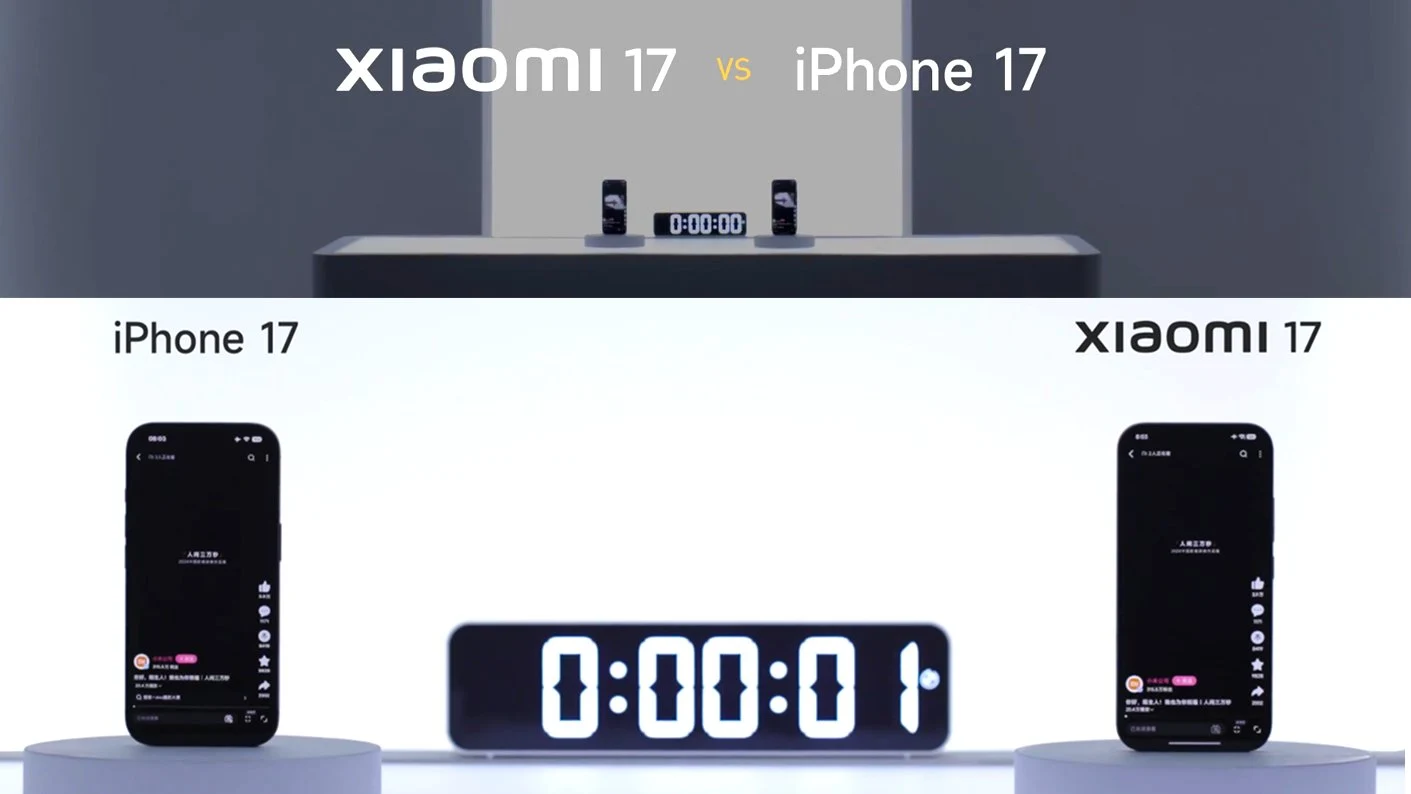
    Is it really right to pit a smartphone boasting a 7,000mAh battery against one with a 3,692mAh capacity? Likely not, so a direct battery life test between the Xiaomi 17 and iPhone 17 would yield predictable results. However, Xiaomi’s recent promotional video on Weibo takes this matchup to a whole new level, adding some intrigue to the scenario. After roughly 5.6 hours, when the iPhone’s battery level hits just 20 percent, they attach a 5,000mAh MagSafe battery to the back of the iPhone 17.

    Capacity Calculations

    This setup gives the iPhone 17 a theoretical total power capacity of 8,692mAh (3,692mAh + 5,000mAh), although that figure isn’t very realistic. Due to energy loss during the magnetic wireless charging process, a large portion of the 5,000mAh isn’t really usable. About one-third is likely wasted, considering the common inefficiencies of wireless charging. Even so, it’s a disappointing result for Apple enthusiasts when the test concludes after just 12 hours and 14 minutes for the iPhone 17. At that moment, the Xiaomi 17 still has 26% of its battery left.

    Test Conditions

    Xiaomi stated that the test was performed with the screen brightness set to a low 150 nits, airplane mode on, and a video loop playing in a social media application, which doesn’t reflect real-world use very well. Apple claims that the iPhone 17 can last up to 30 hours of battery life while playing videos, but that number is also theoretical. Since this is a promotional video from Xiaomi, one should view the findings with skepticism. While the iPhone 17 is currently available for purchase, the Xiaomi 17 with its hefty 7,000mAh battery can only be imported into Europe and North America. Regrettably, the global version will have a smaller battery.

    Source:
    Link