Tag: Bambu Lab

  • Bambu Lab PLA Pure: Certified Food-Safe Filament

    Key Takeaway

    – PLA Pure now available in Germany in five colors (Milky Pink, Baby Blue, Apricot, Pure White, Absolute Black)
    – Prices range from €28 MSRP to €12.60 per kg (when buying 10+ spools)
    – Features UL Greenguard 2904 certification for reduced emissions (fine dust, particulates, VOCs)
    – Designed for safer prints (e.g., toys, food-contact items), but does not automatically guarantee product safety for commercial sale
    – Bambu Lab offers a Wiki article with further guidance on proper use


    Bambu Lab Brings PLA Pure to Germany

    Bambu Lab is now offering PLA Pure in Germany as well. This is 1.75 mm filament that is intended to stand out through the use of only a few ingredients and the presence of various certifications. The filament is now available in five colors: Milky Pink, Baby Blue, Apricot, Pure White, and Absolute Black. The MSRP is listed at €28. The lowest price for 10 filament spools or more is listed at €12.60. The MSRP drops to €25 if customers only need the filament without a spool and can, and want to, respool it themselves. As usual, the prices apply to 1 kg of filament.

    Target Audience and Safety Features

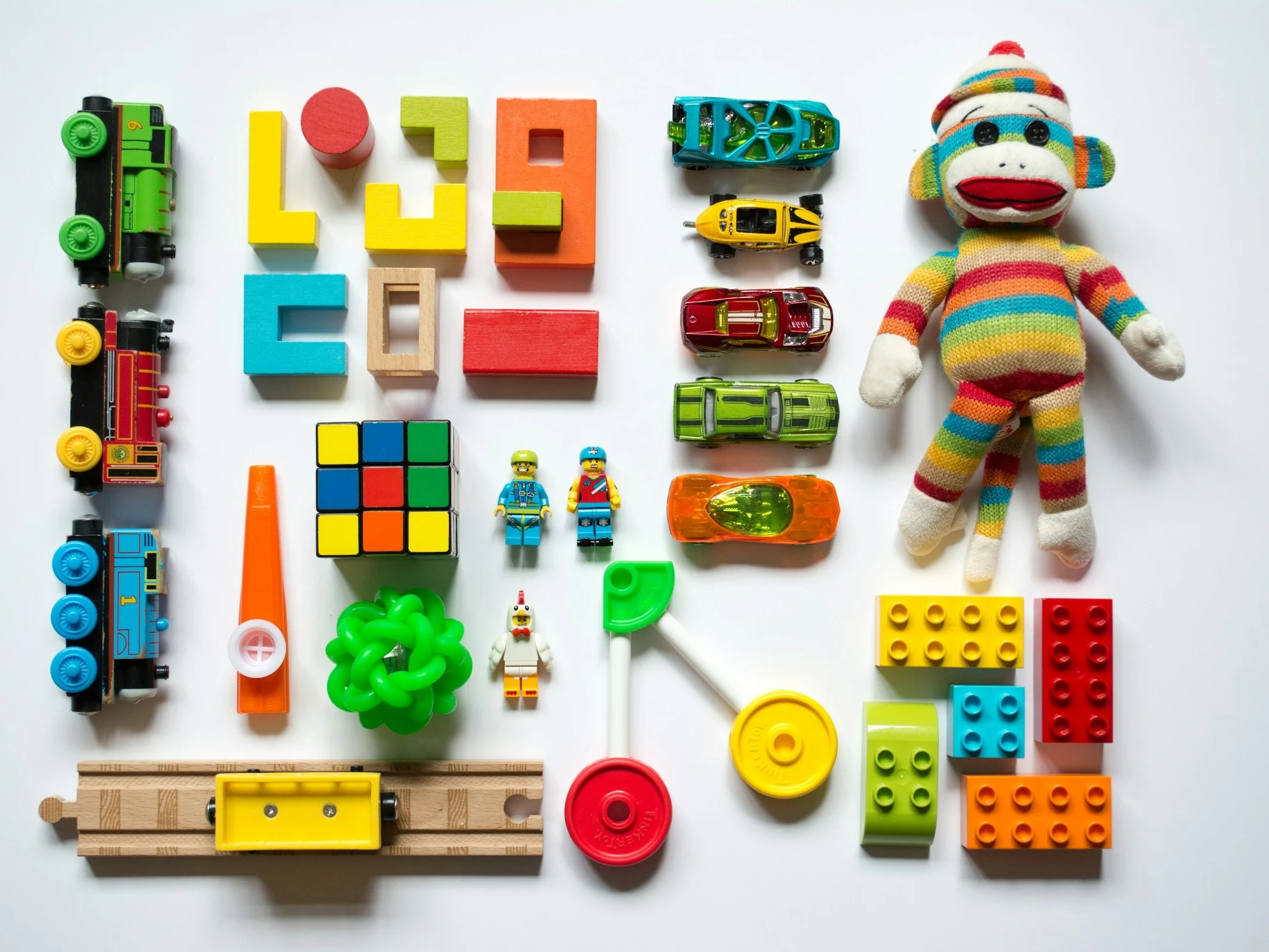
    We have already reported on PLA Pure before. With this filament, Bambu Lab is targeting users who want to make toys or prints intended for food contact, for example. Not only the finished products but also the printing process itself are supposed to be more or less “safer.” Compliance with the UL Greenguard 2904 certification is advertised, which is said to mean that less fine dust, particulates, and VOCs are released than are already measured in most households anyway. Comparred with other PLA filaments, Bambu Lab says emissions are indeed lower, though these figures obviously cannot be verified by us.

    Important Cautions and Additional Guidance

    Here, too, it should be clearly noted once again that using PLA Pure does not automatically result in products that can be classified as safe for people who sell creations through Etsy, for example. Other rules still apply, such as those relating to choking safety. Bambu Lab now also provides further guidance on proper use in a corresponding Wiki article. They have been very careful to not overstate what the material can do, which is good for everyone envolved. The filament seems to be a good choise for those who want to reduce their risk while printing, but its not a magic bullet for all safety concerns.
    Sources

  • Bambu Lab Backtracks After SFC AGPL Violations Accusations

    Bambu Lab Backtracks After SFC AGPL Violations Accusations

    Key Takeaway

    – SFC has identified AGPLv3 violations by Bambu Lab, including bundling a proprietary networking library without source and coercive actions against a fork, infringing developers’ rights under the license.
    – The nonprofit umbrellaed by the SFC is launching a multi-pronged approach, including the baltobu project to create replacement components, maintain forks, and improve software rights for 3D printer users.
    – SFC met its fundraising goal to support dedicated staff and volunteers for baltobu, signaling a sustained effort to push back against licensing noncompliance and promote software freedom in the 3D printing ecosystem.


    Background and escalating scrutiny of Bambu Lab

    After facing strong pushback from Louis Rossmann and Gamers Nexus, Bambu Lab found itself in the crosshairs again as the Software Freedom Conservancy (SFC) stepped in to examine the company’s open-source software practices. This development follows prior legal pressure the company applied over an independent developer’s OrcaSlicer–Bambu Lab fork, which had enabled users to bypass certain cloud service controls that Bambu Lab had begun to implement gradually.

    What sparked the SFC investigation

    In context, the dispute centers around Paweł Jarczak, a solo developer who used his own code to help users bypass the company’s cloud restrictions. Those restrictions are tied to the so-called “Authorization Control System” and the middleware plugin Bambu Connect, which together limit cloud-based functionality. Jarczak’s fork of OrcaSlicer with Bambu Lab changes enabled full cloud printing without needing Bambu Connect, provoking a reaction from Bambu Lab.

    The SFC findings and AGPLv3 violations

    By May 18, the SFC had completed a thorough review of Bambu Lab’s software and found two serious AGPLv3 license violations tied to Bambu Studio, the company’s slicer software that itself forks PrusaSlicer, which is AGPL-licensed. The first violation identified was the bundling of a proprietary networking library, bambu_networking, without releasing the source code mandated by the license. The second issue involved aggressive efforts to threaten and shut down Jarczak’s fork, effectively curtailing his legal rights under AGPLv3.

    What the SFC publicly asserted

    The SFC stated on its website that Bambu demanded Paweł remove the OrcaSlicer fork with the changes from GitHub and that Bambu falsely claimed their terms of service override AGPLv3, among other arguments. The nonprofit described Bambu’s scare tactics against Paweł as a violation of AGPLv3, which includes a sub-clause prohibiting imposing further restrictions on the rights granted under the license.

    Strategic response and future plans

    The SFC elaborated that the aggressive behavior toward Paweł was a breaking point and announced a multi-pronged plan to help consumers in the near term while pursuing long-term software right-to-repair improvements for all 3D printer users. In response, Bambu Lab issued a cautious statement, acknowledging that their prior references to terms of service, legal context, and potential C&D actions could be misconstrued as threats and that this was not the outcome they wanted.

    New SFC initiatives and fundraising milestone

    In reaction to the situation, the SFC launched a project named “baltobu,” intended to create replacement forks for proprietary networking libraries, maintain an actively updated OrcaSlicer fork for Bambu Lab, and support a dedicated Bambu Studio fork. The group reported reaching its fundraising target of $250,007 to hire staff and volunteers to support the baltobu project and related efforts, signaling a commitment to uphold open-source rights in this space.

    Sources
  • Pure PLA Food-Safe 3D Printing: Key Challenges and Solutions

    Pure PLA Food-Safe 3D Printing: Key Challenges and Solutions

    Key Takeaway

    1. Bambu Lab Pure PLA is designed to meet strict safety and environmental standards, including Greenguard, EN 71-3, and EU food contact regulations.
    2. Printed models should only be used within specific temperature and contact guidelines to avoid migration of harmful substances, especially with food-related items.
    3. Proper post-processing, such as sealing and careful deburring, is crucial for safety and microbiological hygiene, especially for toys and food containers.
    4. The safety testing focuses on raw filament in pulverized form, implying low risk from the printing process itself, but caution is advised for final use, particularly with children.

    Introduction to Bambu Lab’s Pure PLA Filament

    3D printing is a versatile technology that uses various filaments, each offering unique features like strength or aesthetic qualities. In China, Bambu Lab has introduced their new Pure PLA filament, specially designed to meet high safety standards and made from just five ingredients, making it safer for everyday and food-related uses.

    Specifications and Composition

    The main components of Bambu Lab Pure PLA include PLA itself, acrylic copolymers, pigments (though not specified in detail), ethylene bis (stearamide), and asbestos-free talc. The manufacturer highlights its compliance with important safety guidelines and standards, emphasizing its suitability for indoor environments and food contact surfaces.

    Safety Standards and Compliance

    Bambu Lab states that its filament matches the Greenguard guidelines which aim to reduce volatile organic compounds that could pollute indoor air. Additionally, it conforms to EN 71-3 and Regulation (EU) No. 10/2011, crucial for items that come into contact with food, by conducting migration tests to ensure safety during food contact.

    • Greenguard guideline compliance
    • Conformity with EN 71-3
    • Meets Regulation (EU) No. 10/2011 for food safety

    Testing and Practical Use Guidelines

    Bambu Lab tested the filament not only on raw material but also on printed objects. These models underwent migration testing into water, oil, and acidic solutions to simulate real-world conditions. They advise that printed objects using this filament should stay within temperatures of 0 to 60°C and avoid contact with acidic, alkaline, or oily substances. For instance, storing rice would be acceptable, but nuts, with higher fat content, should be avoided.

    Further Recommendations and Considerations

    On their detailed information page, Bambu Lab also discusses microbiological safety tips. They recommend designing models to avoid cavities that are hard to clean, and suggest sealing parts with suitable materials given that 3D printing can produce ridges where bacteria might hide. Using food-safe resin for post-processing might be better than relying solely on the filament’s safety, especially considering wear and tear that could compromise the barrier over time.

    Important Handling Tips

    Deburring or finishing printed models properly is crucial, whether these models are toys or storage containers. The DIN EN 71-3 standard also sets limits for substances like cobalt, copper, lead, and mercury. Interestingly, the raw PLA was pulverized for testing rather than testing on actual printed parts, which could influence the outcomes. Since PLA causes less wear on hotends, the risk of copper or other material contamination from the hotend remains low.

    • Finished models must be safe for children under DIN EN 71-1 standards
    • Avoid small parts that children could swallow
    • Ensure safety for both private and commercial uses

    Final thoughts on Safety and Use

    In conclusion, while the filament is designed with safety in mind, users should still be cautious, especially in commercial contexts, to ensure compliance and safe handling. Proper finishing, cautious use with food, and awareness of material limits are key factors to keeping 3D printed objects safe for all use-cases.


  • Open-Source 3D-Printed Shoes: Bambu Lab and Presq Partnership

    Open-Source 3D-Printed Shoes: Bambu Lab and Presq Partnership

    Key Takeaways

    1. Bambu Lab and Presq are introducing 3D printed shoes to the open-source community, allowing editable designs for personalization.
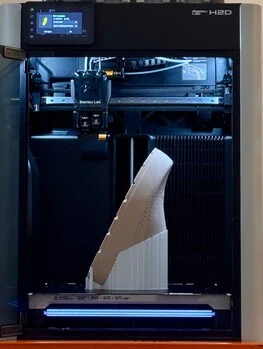
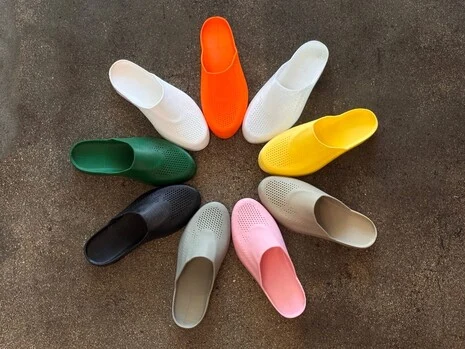
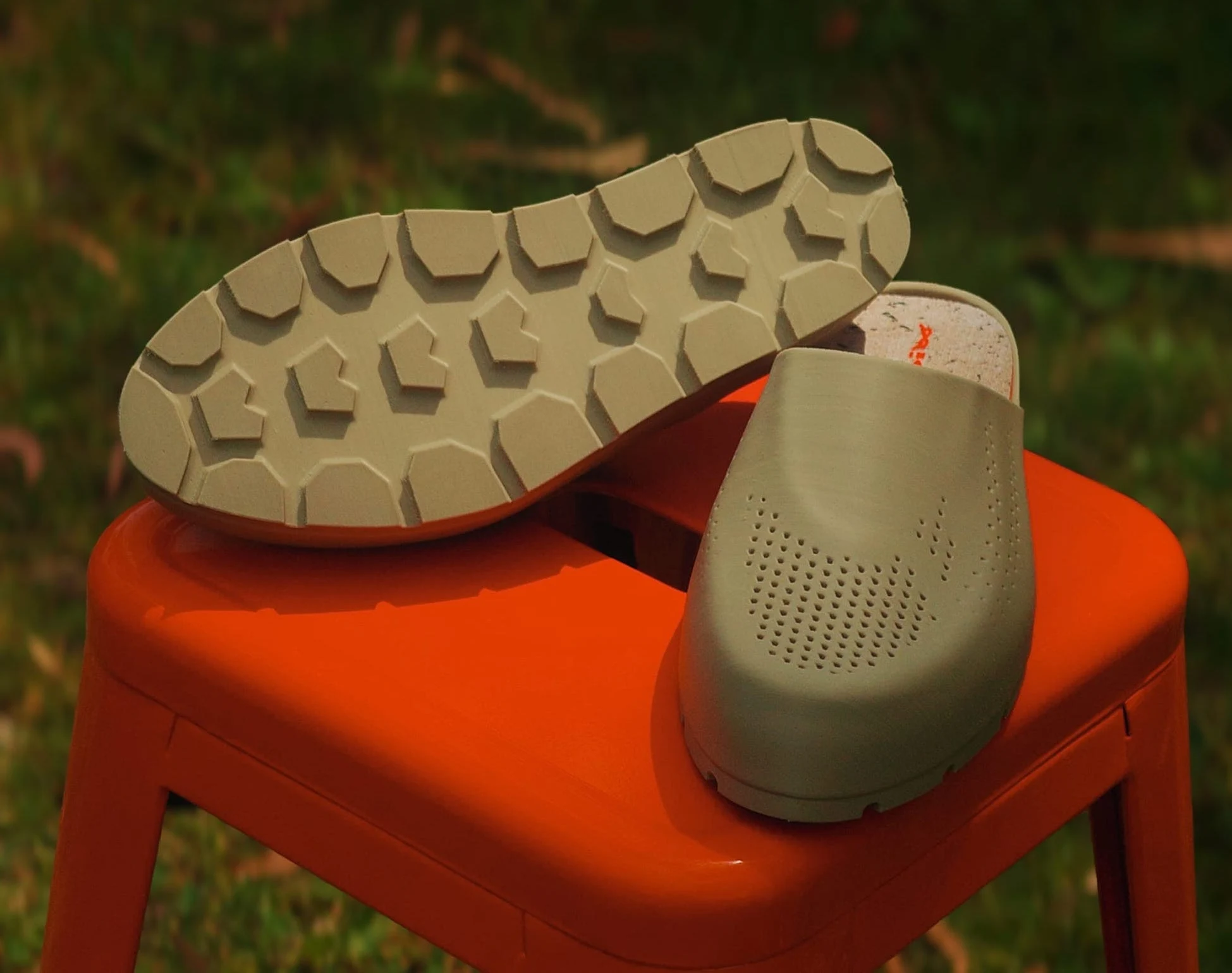
    2. The first shoe design, Fig.(0), is a slip-on clog made from a durable and flexible matte TPE 85A material.
    3. The shoe design is available on MakerWorld as a pre-sliced .3mf file for the H2D printer, with scaling coefficients for size adjustments and a CAD file for further modifications.
    4. Bambu Lab’s printers are known for their speed, reliability, and user-friendliness, making them suitable for beginners in 3D printing.
    5. Presq plans to release new shoe designs monthly, encouraging creators to adapt and optimize them for various 3D printers.


    Popular 3D printing company Bambu-Lab has teamed up with Presq, a design tech studio based in Los Angeles, to introduce 3D printed shoes to the open-source community. Many established brands have already released 3D printed products, but this new project is different because the designs will be accessible as editable 3D models, allowing anyone to modify them according to their personal style or requirements.

    First Design Unveiled

    The initial design is named Fig.(0) and features a stylish slip-on clog with a perforated top. It uses a matte TPE 85A material, which strikes a good balance between being firm and flexible, providing great resistance to wear and tear, and offers a soft, non-shiny finish to ensure grip. The design file utilizes PLA solely as a support material, which is removed post-printing.

    Where to Find the Design

    You can find the design on MakerWorld, the open-source 3D model platform by Bambu Lab, available as a pre-sliced .3mf file tailored for their newly launched H2D printer. The files are created for a US men’s size 10 shoe, but a useful table of scaling coefficients allows you to print different sizes with minor adjustments. For those who like to tinker, a CAD file is also included, serving as a base for modular attachments, textures, and performance enhancements.

    Bambu Lab’s printers are favored not only for their speed and reliability but also for a variety of features that make them user-friendly, even for beginners in 3D printing. As part of this collaboration, Bambu Lab has supplied Presq with several H2D printers for quick prototyping and public demonstrations.

    More Designs Coming Soon

    The Fig.(0) is just the first of many designs that Presq plans to release on a monthly basis through MakerWorld. “By merging Bambu’s performance with our design approach, we’re providing creators with a tangible way to transform ideas into wearable products,” says Adam Saleh, the founder and CEO of Presq. The hope is that, in the future, other creators will adapt the designs and make them even more accessible by optimizing them for use with other printers, such as the Bambu Lab A1 Combo with AMS Lite.

    If you value brand alongside advanced manufacturing methods, consider exploring Adidas’ 4D collection, which includes items like the Adidas Mens 4dfwd 2 m sneaker and the Adidas Originals Men’s Alphaedge running shoe available on Amazon, both showcasing 3D printed lattice-style soles.

    Source:
    Link


  • Bambu Lab Unveils H2C with Vortek Hotend for Seamless Multicolor Printing

    Bambu Lab Unveils H2C with Vortek Hotend for Seamless Multicolor Printing

    Key Takeaways

    1. Bambu Lab has launched the H2C, the latest model in its H2 series, following the release of the H2D Pro.
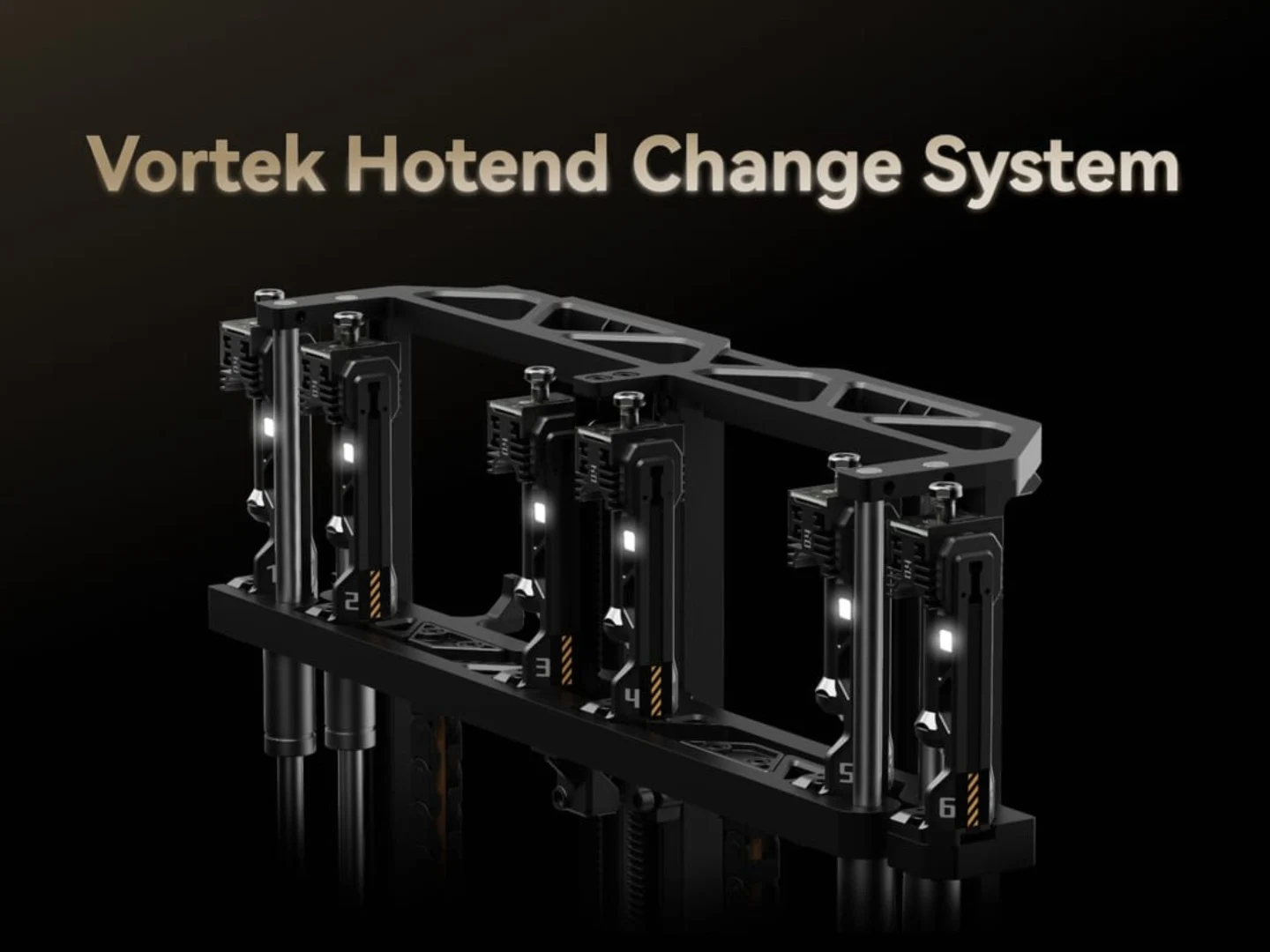
    2. The H2C features the Vortek hotend change system, allowing users to switch hotends during printing for seamless multicolor 3D printing.
    3. This system reduces filament waste (known as “poop”) and shortens print times, making the printing process more efficient.
    4. The Vortek system utilizes a custom microcircuit for wireless communication and quick heating, achieving desired temperatures in just eight seconds.
    5. The H2C will ship by the end of 2025, and existing H2D and pre-ordered H2S owners can upgrade to the H2C with DIY instructions from Bambu Lab.


    Bambu Lab, a top name in the 3D printer world, has just introduced the H2S, the newest model in its H2 series. This announcement comes just weeks after the quiet release of the H2D Pro, which is an enhanced version of the H2D. The latest printer in the H2 series boasts a feature that might change the game for multicolor 3D printing.

    Innovative Hotend Change System

    The new 3D printer, dubbed the H2C, includes a technology called the Vortek hotend change system. According to the Bambu Lab blog, this system allows users to switch hotends during printing to change colors seamlessly. This innovation aims to get rid of what’s known as “poop,” which refers to the wasted filament that must be extruded when changing colors. By eliminating this waste, the process not only conserves filament but also shortens print times, leading to a more efficient workflow.

    Design Choices Behind Vortek

    In a video released by Bambu Lab, they delve into the creative thought process behind the Vortek hotend change system. Instead of using multiple toolheads like competitors such as Prusa XL or the upcoming Snapmaker U1, or even multiple nozzles on a single toolhead, Bambu Lab opted for a hotend swapping approach. The swappable hotends are designed without cables or pogo pins that might degrade over time, relying instead on a chip for wireless communication with the printer and induction heating to warm the nozzle.

    “Our solution was to design a custom microcircuit on the hotend that receives power, measures temperature, and communicates wirelessly with the toolhead,” the blog details. Bambu Lab asserts that the nozzle can achieve the desired temperature in just eight seconds and that the chip relays critical information about temperature, filament type, and color.

    Shipping and Upgrade Options

    The H2C is expected to be available for shipping by the end of 2025. An exciting aspect of this release is that current owners of the H2D or those who have pre-ordered the H2S will have the opportunity to upgrade their devices to the H2C with some DIY expertise. Bambu Lab plans to provide instructions on how to accomplish this upgrade.

    Source:
    Link


  • Bambu Lab Launches MakerWorld: Crowdfunding for 3D Printing Projects

    Bambu Lab Launches MakerWorld: Crowdfunding for 3D Printing Projects

    Key Takeaways

    1. Bambu Lab offers user-friendly 3D printers, including the A1 mini and A1 combo with AMS multi-color printing.
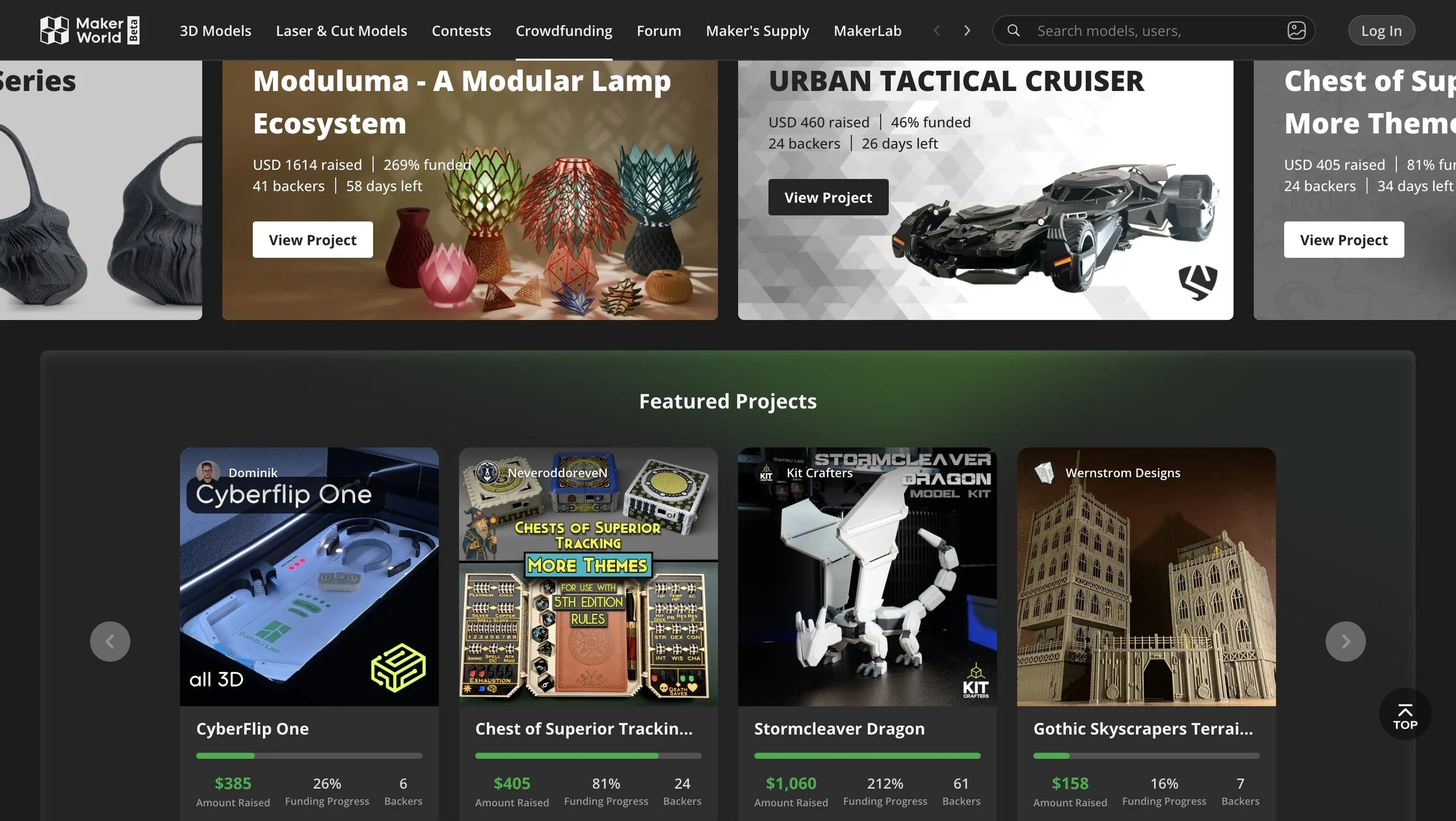
    2. The MakerWorld platform allows creators to share 3D models, participate in contests, and now features a crowdfunding section for 3D printing projects.
    3. The crowdfunding feature helps support complex ideas that need resources and encourages community involvement in bringing projects to life.
    4. Creators can submit proposals with visual renders, set timelines, and offer tiered rewards to backers during their campaigns.
    5. Participation in the crowdfunding program is by invitation only, requiring interested creators to submit their ideas for evaluation before launching campaigns.


    Bambu Lab, recognized for its user-friendly 3D printers like the A1 mini and the A1 combo—which features AMS multi-color printing and fully automated calibration—has been fostering the 3D printing community via its MakerWorld platform. This platform allows creators to share their 3D models, join contests, and more. Recently, the company has introduced a crowdfunding section on MakerWorld specifically tailored for 3D printing fans.

    Community Support for Ideas

    As mentioned in their blog, “We’ve noticed numerous amazing ideas that remain unbuilt due to their size, complexity, or the need for resources that individual creators don’t possess. The crowdfunding function is our solution to this issue… what if the community could directly assist these projects?”

    The platform serves as a Kickstarter-like venue for the 3D printing enthusiasts. Creators can submit thorough proposals that explain their ideas, showcase them through visual renders, and set goals along with a timeline of 30, 45, or 60 days. They can also offer tiered rewards, including exclusive STL files, tutorials, DIY kits, or custom 3D prints. Once a campaign is live, they have the ability to provide updates and engage with comments from interested backers.

    Encouraging Innovative Designs

    Through this initiative, Bambu Lab aspires to motivate designers to craft innovative and complex projects that not only need extra resources but also demand more time and dedication to develop. There’s also a goal of uncovering what types of projects the community prefers and is willing to support.

    Currently, participation in the program is by invitation only. Interested creators must email a description of their initial idea along with related visuals (refer to the blog post for additional information). The platform will evaluate submissions prior to approving and launching them on the MakerWorld Crowdfunding page for potential backers to check out.

    Bambu Lab aims to bridge the gap between innovative ideas and the necessary support to bring them to life, making it easier for creators to reach their goals.

    Source:
    Link


  • Create Cute 3D Printable Characters with Bambu Lab’s PrintMon Maker

    Create Cute 3D Printable Characters with Bambu Lab’s PrintMon Maker

    Bambu Lab has consistently focused on making 3D printing more approachable and popular for a broader audience. They achieve this with user-friendly 3D printers and the MakerWorld platform, which allows for sharing 3D models publicly. Recently, they introduced PrintMon Maker, a fresh tool that can transform a text prompt or an image into a colorful, Pokemon-like 3D character that can be printed as a fun personalized desk toy.

    PrintMon Maker Launch

    Initially launched in beta back in August, PrintMon Maker is now available for all users on the MakerWorld platform. The process begins with either a text input or an image, and from there, the generative AI model creates a 2D image. Users can request as many retries as they want, or if they find a character they like, they can ‘hatch’ the 2D image into a 3D model. This final step costs 10 MakerLab credits, which you can earn by engaging with the platform.

    Customization Options

    After the model is ‘hatched’, you can make some basic adjustments to your PrintMon, such as choosing between four, eight, or twelve colors for printing, and selecting the specific colors. You can also personalize the character’s eyes and add a base for it to stand on. Not using the slogan “Gotta hatch ’em all” is a bit of a letdown, but it might be wise, especially considering the ongoing lawsuit between Nintendo and Palworld.

    The finished model can be downloaded as an OBJ file or opened directly in the Bambu Studio software. While there are other similar services like Meshy AI and 3D AI Studio, PrintMon Maker is designed to help users quickly and easily reach the printing phase, even if they lack expertise in 3D printing or modeling.

    Other Modeling Tools

    Bambu Lab offers a variety of easy-to-use modeling tools worth exploring in the MakerLab section of MakerWorld. These tools include Pixel Puzzle Maker, Image to Keychain, Make My Sign, Make My Lithophane, and others.

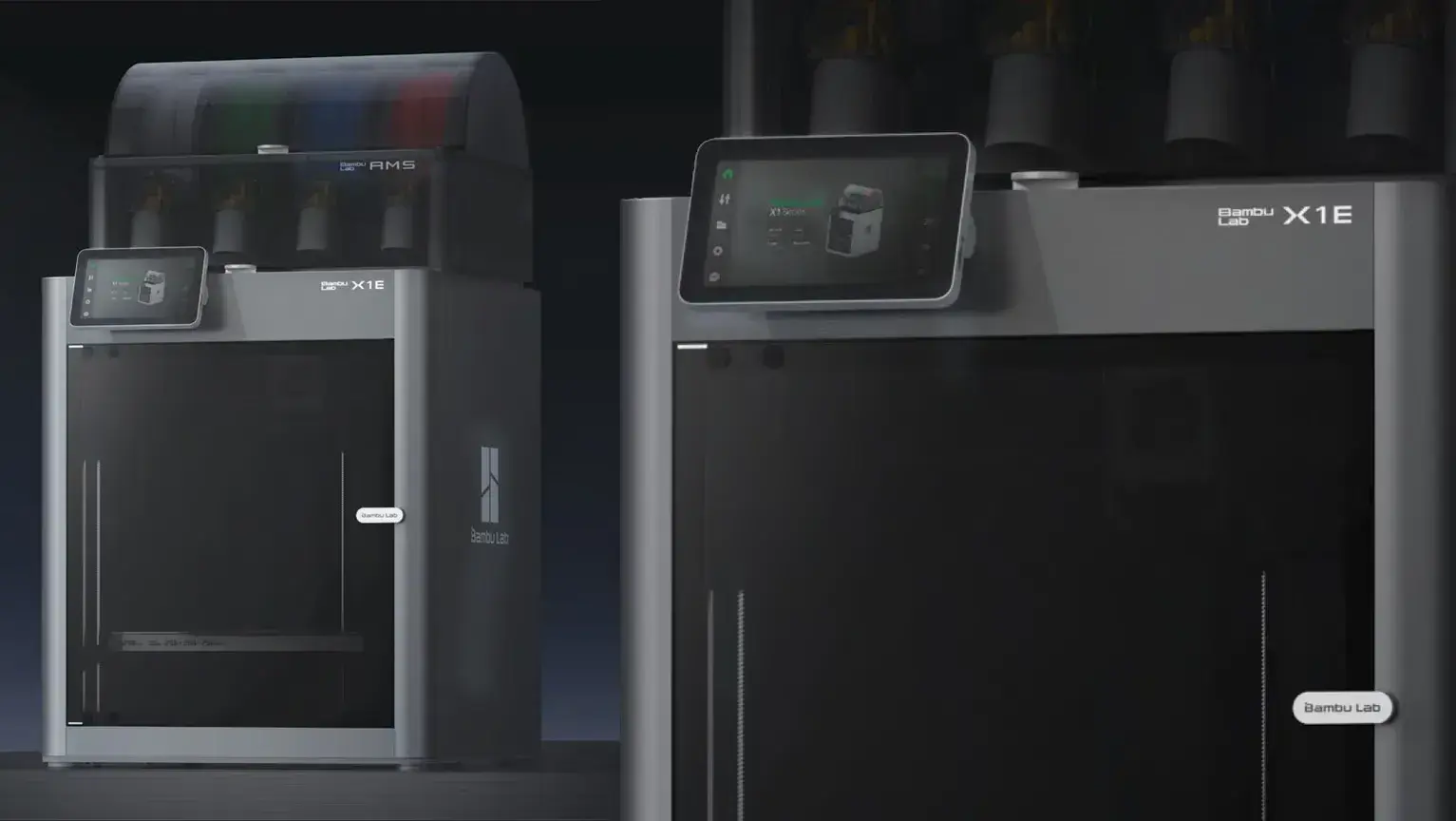
  • Bambu Lab X1E 3D Printer : A Leap Towards Professional-Grade 3D Printing

    Bambu Lab X1E 3D Printer : A Leap Towards Professional-Grade 3D Printing

    In the fast-evolving domain of 3D printing, staying updated with the latest technology is crucial for professionals aiming for the pinnacle of design and production efficiency. Bambu Lab’s latest offering, the X1E 3D Printer, is a testament to this relentless pursuit of innovation, catering precisely to the professional and engineering domains.

    A Gaze at Speed and Precision

    The X1E 3D Printer distinguishes itself with an impressive print speed, which is a vital factor for professionals who are always racing against time. With a maximum tool head speed of 500 mm/s, it’s pegged as a swift performer among desktop 3D printers. This speed is facilitated by a rigid CoreXY gantry constructed with carbon-fiber-reinforced rods, which significantly reduces vibration, ensuring high-quality prints.

    Connectivity and Material Handling

    In an era where seamless connectivity is a boon, the X1E doesn’t fall short. It introduces an optional Ethernet interface ensuring reliable network connectivity, even in complex setups, alongside supporting advanced WLAN security standards. This feature is a nod to the growing necessity for secure and robust networking solutions in professional settings.

    Furthermore, the X1E is capable of operating entirely offline without a cloud connection, providing an added layer of operational flexibility.

    Material handling is another forte of the X1E. It can reach temperatures of up to 320°C, thus capable of processing higher-grade materials like PPA-CF or PPS. The heated pressure chamber, with temperatures up to 60°C, minimizes warpage and enhances layer adhesion, making it a suitable choice for intricate and demanding projects.

    Bambu Lab X1E 3D Printer : A Leap Towards Professional-Grade 3D Printing
    Bambu Lab X1E

    Bambu Lab X1E 3D Printer : A Leap Towards Professional-Grade 3D Printing
    Bambu Lab X1E

    Bambu Lab X1E 3D Printer : A Leap Towards Professional-Grade 3D Printing
    Bambu Lab X1E


    Filament Management and Clean Operation

    With an integrated filament management system, the X1E can connect up to 16 filament spools, enabling multi-material printing with automatic filament change. This feature underscores the printer’s capability to handle complex projects requiring varied materials.

    Moreover, the clean operation of the X1E is ensured by a HEPA filter and activated carbon filter, making it apt for poorly ventilated rooms.

    Build Volume256256256 mm3
    Physical Dimensions 389389457 mm3
    Net Weight16 kg
    Max Speed of Toolhead500 mm/s
    Max Acceleration of Toolhead 20 m/s2
    Max Hot End Flow 32 mm3/s @ABS(Model: 150*150mm single wall; Material: Bambu ABS; Temperature: 280°C)
    Hot End material All Metal
    Extruder Gears Hardened Steel 
    Nozzle material Hardened Steel 
    Maximum Chamber Control Temperature 60℃
    Maximum Hot End Temperature 320℃
    Nozzle Diameter Included: 0.4 mmOptional: 0.2 mm, 0.6 mm, 0.8 mm
    Filament Diameter 1.75 mm
    Supported FilamentOptimal: PLA, PETG, TPU, PVA, BVOHSuperior: ABS, ASA, PC, PA, PETSuperior: Carbon/Glass Fiber Reinforced PLA, PETG, PA, PET, PC, ABS, ASAIdeal: PPA-CF/GF, PPS, PPS-CF/GF
    Max Build Plate Temperature 110℃@220V, 120℃@110V
    Slicer Bambu StudioSupport third party slicers which export standard G-code such as SuperSlicer, PrusaSlicer and Cura, but certain advanced features may not be supported.
    Slicer Supported OS MacOS, Windows 
    Ethernet SocketRJ45
    Ethernet Speed100 Mbps / Full Duplex 

    Pricing and Availability

    The professional-grade features of the X1E come with a price tag of $2499, making it a valuable addition for serious professionals. Bambu Lab has scheduled the shipping of the X1E to commence in November, available for purchase directly or via resellers.

    With the X1E, Bambu Lab has indeed pushed the boundaries, setting a new benchmark for what professional and engineering-grade 3D printers can achieve. The blend of speed, connectivity, material handling, and clean operation, all at a competitive price point, makes the X1E a noteworthy contender in the professional 3D printing market.

    Sources: 3printr