Tag: ATLAS

  • Boston Dynamics Atlas Robot Performs Backflip and Cartwheel

    Boston Dynamics Atlas Robot Performs Backflip and Cartwheel

    Key Takeaways

    1. Atlas robot is gaining features from its hydraulic-driven predecessor, Atlas HD.
    2. The robot has successfully performed complex maneuvers, like backflips and cartwheels, while maintaining balance.
    3. Boston Dynamics shares the training process, showing both successes and falls during the robot’s development.
    4. Increasing Atlas’s running speed presents challenges, as it often suffers damage during high-speed tests.
    5. A modified version of Atlas has been introduced for businesses, differing in appearance from the research model.


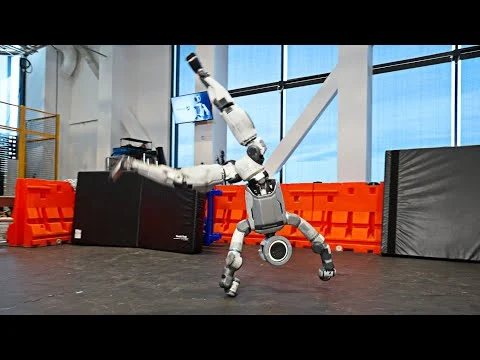
    Boston Dynamics’ latest Atlas robot is gradually acquiring the features of its hydraulic-driven predecessor known as Atlas HD. A new video released by Boston Dynamics and the RAI Institute highlights Atlas executing a backflip right after a cartwheel, and impressively, the humanoid robot maintains its balance and suffers no damage during the performance.

    Capturing the Journey

    As is common for Boston Dynamics, the company reveals the process behind these achievements. Viewers can witness the robot tumbling during this intricate maneuver, but these falls are not particularly concerning. The robot typically manages to stabilize itself during these daring feats.

    Progress and Challenges

    However, training Atlas to increase its running speed seems to be more challenging, as the robot tends to lose parts after face-planting or colliding with pallets. On a brighter note, the researchers have succeeded in getting Atlas to walk in a more fluid manner. Previously, the robot often appeared clumsy while moving at a slower pace, but this hasn’t significantly impacted its commercial utility so far.

    New Enterprise Model

    Atlas has now been introduced in a modified form as a product for businesses. This new version lacks the sleek appearance of the research model, which seems to have reached its limit. The experiments shown in the video were said to be “one final push to test the limits” of the robot’s capabilities.

    Source:
    Link



  • Comet C/2025 K1 (Atlas) Disintegrates in New Images

    Comet C/2025 K1 (Atlas) Disintegrates in New Images

    Key Takeaways

    1. C/2025 K1 (ATLAS) is a newly discovered comet from the Oort cloud, first spotted in May 2025.
    2. The comet broke apart into four pieces after its close approach to the Sun on October 8, 2025, due to strong gravitational forces and solar winds.
    3. Observations from the Asiago Observatory and the Virtual Telescope Project identified multiple fragments of the comet.
    4. New images captured in January 2026 showed the four bright pieces of the disintegrated comet.
    5. The event highlights the potential for similar occurrences in the future, with many comets in the Oort cloud offering opportunities for further study.


    C/2025 K1 (ATLAS) is a comet that does not appear in regular cycles and was first spotted in May 2025 by the ATLAS system. It comes from the Oort cloud and made a close approach to the Sun on October 8, 2025, but unfortunately did not make it through, breaking apart into four pieces in the process.

    The Comet’s Composition and Fate

    This comet, made up of ice and dust, encountered harsh conditions as it neared our Sun. When it got close, it was hit by strong gravitational forces and intense solar winds. Despite its sad end, this event provided astronomers a chance to witness its breakup into multiple fragments.

    Observations and Discoveries

    On November 11, 2025, scientists from the Asiago Observatory in Italy reported seeing two fragments of the comet. Later, Gianluca Masi, an astronomer from the Virtual Telescope Project in Italy, observed three, and possibly even a fourth fragment, as mentioned in a news release.

    Future Implications

    On January 28, 2026, new images of the comet’s fragmentation were revealed. These pictures, taken on November 11 and December 6 by the Gemini North telescope in Chile, showed the four bright pieces of the disintegrated comet.

    Although this cosmic event was remarkable, it’s likely that similar occurrences could take place again down the line. Comets like C/2025 K1 (ATLAS) are abundant in the Oort cloud, and there might be billions out there. This could give astronomers more insight into their behaviors and help them learn about their make-up and paths within our solar system.

    Source:
    Link


  • Hyundai Orders 30,000 Atlas Robots with Self-Swappable Batteries

    Hyundai Orders 30,000 Atlas Robots with Self-Swappable Batteries

    Key Takeaways

    1. New Production Plans: Boston Dynamics plans to manufacture up to 30,000 Atlas humanoid robots annually for use in Hyundai’s U.S. car manufacturing plants.

    2. Cost-Effective Design: The latest Atlas model features fewer custom parts and utilizes components from Hyundai’s existing supply chain for faster and cheaper production.

    3. Advanced Capabilities: Atlas can assess its environment in real-time, maintain balance with Hyundai Mobis actuators, and adjust grip strength using tactile sensors.

    4. AI Enhancement: The robot’s AI capabilities are powered by Nvidia chips, with collaboration from Google’s DeepMind to improve its cognitive functions.

    5. Competitive Landscape: The introduction of Atlas poses significant competition for Tesla’s Optimus in the humanoid robot market, especially with the rapid growth of similar manufacturing in China.


    Hyundai’s robotics branch, Boston Dynamics, has revealed the latest version of its Atlas humanoid robot, which has been around long before Tesla’s flashy marketing for Optimus stirred up the humanoid robot excitement.

    New Production Plans

    The newest Atlas model is designed specifically for high-volume production, and Boston Dynamics is set to begin manufacturing right away, aiming to produce up to 30,000 humanoid robots annually. Hyundai plans to use these robots in its car manufacturing plants located in the United States.

    Cost-Effective Design

    To facilitate mass production, the latest Atlas units have minimized the number of custom parts, opting instead for components that are easily sourced from the automaker’s existing supply chain. This approach allows the robots to be manufactured quickly and cost-effectively.

    Advanced Capabilities

    The Atlas robot can assess its environment in real-time. Hyundai Mobis actuators help in maintaining its balance and adjusting its stance, while tactile sensors fine-tune the grip strength of its hands, allowing for adaptability based on the required tasks. The AI that interprets its surroundings is powered by Nvidia chips, and Boston Dynamics has teamed up with Google’s DeepMind to create foundational models to enhance its cognitive abilities further.

    The initial production units of the Atlas humanoid robot are now on their way to key partners, Hyundai and Google, for testing purposes. With the competition from Atlas and the rapid growth of humanoid robot manufacturing in China, it appears that Tesla’s Optimus will encounter significant rivalry when it finally arrives on factory floors.

    Source:
    Link


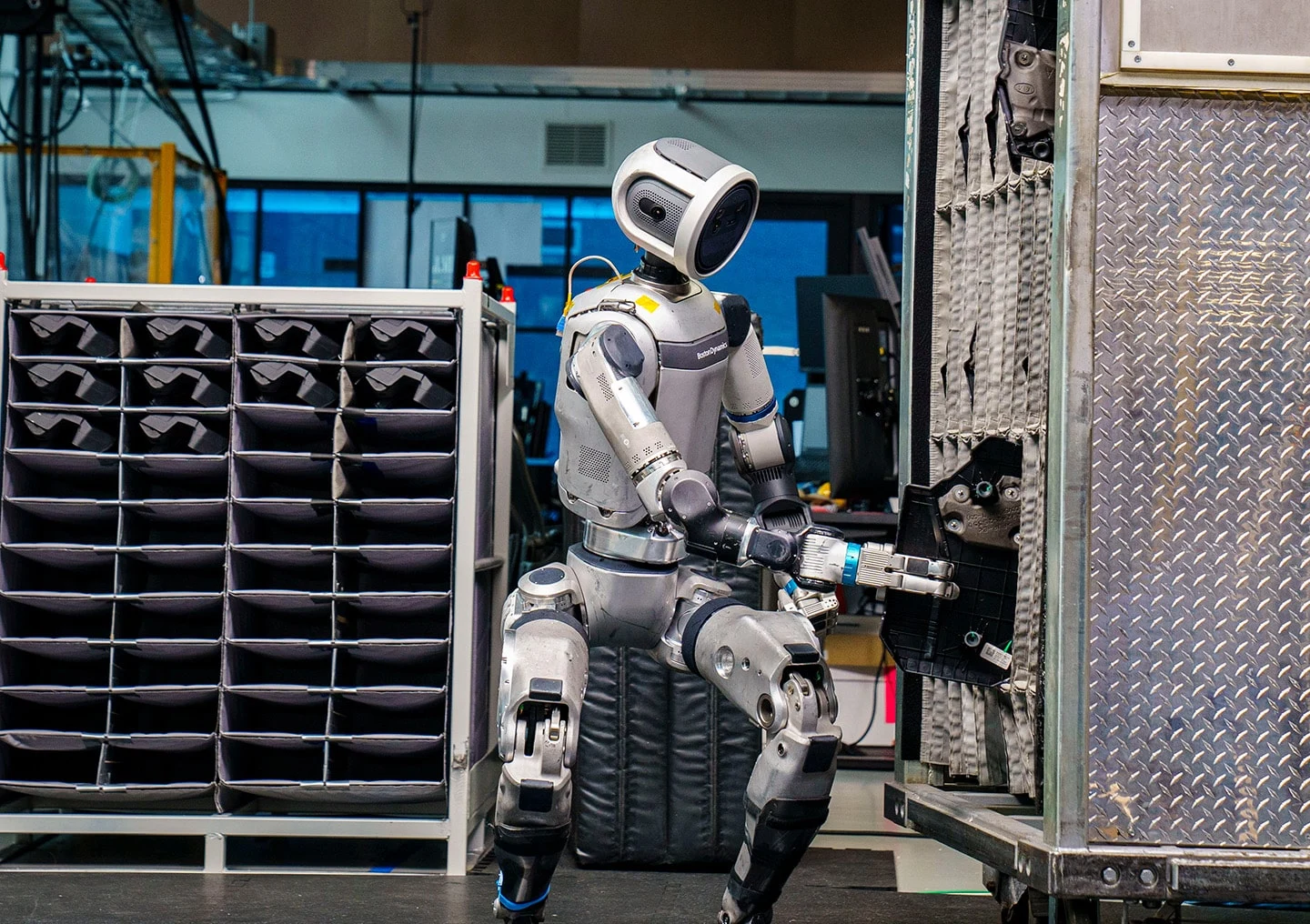
  • Boston Dynamics Develops Adaptive Robot for Changing Environments

    Boston Dynamics Develops Adaptive Robot for Changing Environments

    Key Takeaways

    1. Atlas can now adapt to different environments and respond to unexpected events.
    2. The robot demonstrates quick adaptation when faced with changes, like moving shelf locations.
    3. Atlas uses its camera to locate sounds, illustrating the challenges of dynamic perception.
    4. The video highlights Moravec’s paradox, showing that simple human tasks are difficult for robots.
    5. Small mistakes in the perception system can lead to significant errors in task execution.


    Atlas keeps on changing. In a rather lengthy video with rare explanations, Boston Dynamics shows that Atlas can now handle different environments. While it still sorts car parts like before, the team hopes Atlas will learn to adjust to a more dynamic setting. This means that Atlas should be able to respond and adapt to new situations or unexpected events.

    Adapting to Challenges

    For instance, in the video, Boston Dynamics staff frequently shift the location of the shelf container where parts are sorted. This forces the robot to adapt, and it does so quickly. In another scenario, an employee drops a part near Atlas, causing a noise. The robot hears this with its microphone, but since it doesn’t have the ability to locate sounds based on the microphone, it methodically scans the area using its camera to find the part.

    The robot successfully picks up the part and puts it back on the shelf, though it isn’t as smooth as a human would be. Overall, the video illustrates Moravec’s paradox well. This paradox points out the seemingly odd fact that tasks simple for humans, like social interactions or physical movements, are hard for robots. On the other hand, tasks that are tough for humans, like complex calculations or data processing, come easy to robots.

    The Need for Dynamic Perception

    Jan Czarnowski, who leads the perception team, says that Atlas’ perception system must be flexible to handle unpredictable and changing situations. This challenge is made worse by the fact that, as the developers note, small mistakes and tiny errors can add up quickly. For example, the shelf cells have a margin of 5 cm. A slight miscalculation in grasping or placing parts into these cells, even just one centimeter off, could lead to a failure.

    Source:
    Link

  • Boston Dynamics Advances Atlas Robotics Development Progress

    Boston Dynamics Advances Atlas Robotics Development Progress

    Key Takeaways

    1. Boston Dynamics has introduced a new version of Atlas that does not use hydraulic power, addressing issues with leaks and maintenance costs from the previous model, Atlas HD.
    2. The new Atlas design allows for faster and more efficient movements, including 360-degree motion and the ability to walk backwards instead of turning around.
    3. Future applications for Atlas include roles in car manufacturing and other human workspaces, aiming to enhance productivity.
    4. Insights from practical uses of Atlas are helping to refine its functions as a working robot, similar to existing products like Spot and Stretch.
    5. Boston Dynamics is optimistic about integrating artificial intelligence to improve Atlas’ skill development in future applications.


    Almost one year since the introduction of the new Atlas, Boston Dynamics has shared a video showcasing significant advancements with the robot. In this latest update, the company elaborates on the capabilities of Atlas and discusses the benefits of shifting from the hydraulic-powered Atlas HD. Developers have described Atlas HD as “messy,” highlighting the high costs associated with the technology and its maintenance.

    New Features and Advantages

    The latest version of Atlas, which does not rely on hydraulics, has eliminated issues related to hydraulic fluid leaks that were common with Atlas HD. This new design allows the robot to operate more quickly and efficiently, thanks to its ability to perform numerous 360-degree movements without the limitations that come with human-like motion. For instance, instead of needing to turn around, the robot can simply walk backwards.

    Future Applications

    Boston Dynamics is committed to turning Atlas into a productive robot equipped with professional skills. In the future, Atlas is expected to assist in car manufacturing and will be implemented in workspaces that were originally meant for humans. It remains to be seen if Atlas will master the remarkable tasks that Atlas HD showcased over the years. Currently, there is a lack of a “fun video,” which has become a tradition for Boston Dynamics. Last year’s Halloween video featured Atlas sorting car parts for Hyundai, its owner.

    According to Boston Dynamics, insights from practical applications are aiding in refining Atlas’ function as a working robot. Products like Spot and Stretch are already available in the market. Additionally, the topic of artificial intelligence is addressed by Boston Dynamics, which expresses hope that AI will enhance Atlas’ skill development.

    Source:
    Link

  • Marvel Fusion’s $150M Laser Facility Aims for Fusion Energy Breakthrough

    Marvel Fusion’s $150M Laser Facility Aims for Fusion Energy Breakthrough

    The pursuit of fusion energy is gaining momentum. A significant advancement has been made with the opening of a new laser facility situated in Colorado. Fusion, the same process that fuels the Sun, has always been viewed as a key approach to producing endless, clean energy. Although researchers have been delving into fusion for many years, recent developments have rekindled optimism that it may soon become a practical energy solution.

    New Facility Announcement

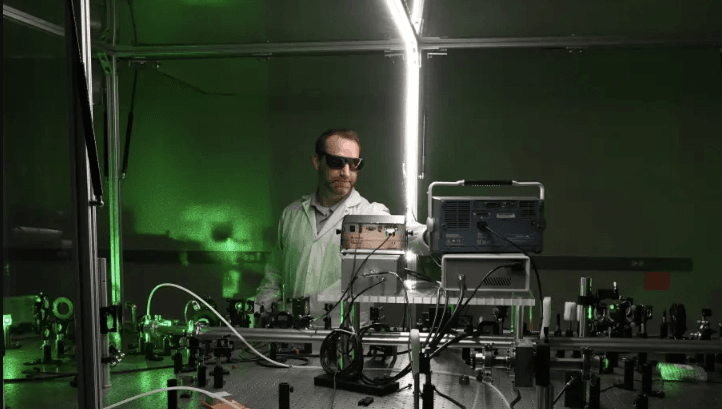
    Marvel Fusion, a German startup, has teamed up with Colorado State University to begin work on a $150 million facility known as ATLAS. This cutting-edge facility will employ three ultra-high-intensity lasers to generate an astonishing 7 petawatts of power—exceeding 5,000 times the electrical output of the U.S. These lasers will aim at a fusion reaction by unleashing rapid pulses at a target the width of a hair, attempting to mimic the extreme heat and pressure necessary to combine atoms.

    Advancements in Energy Research

    According to Marvel Fusion, they plan to execute these laser bursts ten times each second, edging closer to establishing a continuous fusion reaction that can produce clean energy. Set to be finished by 2026, ATLAS is part of the broader initiative to make fusion energy commercially viable and will also contribute to advancements in medical research and technology.

    Government Support and Future Prospects

    In addition, the U.S. government has allocated $28 million towards this initiative, complemented by investments from Marvel Fusion and Colorado State University. It appears the project is on a promising path—only time will reveal whether this endeavor will ultimately succeed.


    Image 1