Tag: Arc B580

  • Intel Arc Battlemage Review: Big Challenges, Small Margins

    Intel Arc Battlemage Review: Big Challenges, Small Margins

    Key Takeaways

    1. Initial Availability and Driver Issues: The Arc B580 faced poor initial availability, primarily in the US, and driver issues caused CPU slowdowns on older systems.

    2. Silicon Costs Impacting Profitability: The larger size of the BMG-G21 chip increases production costs and risks, leading to significant financial losses for Intel despite aggressive pricing.

    3. Performance Limitations: Battlemage underperformed in productivity benchmarks compared to its predecessor, Alchemist A770, except in specific Unreal Engine 5 tests.

    4. Market Competition and Product Timing: The future of the Arc Pro B60 is uncertain due to its delayed market entry, risking overshadowing by potential RTX 5000 series refreshes and competitive AMD pricing.

    5. Need for Stronger Competition: Despite challenges, there’s hope for Intel Arc to emerge as a strong contender in the GPU market, as competition is crucial for industry health.


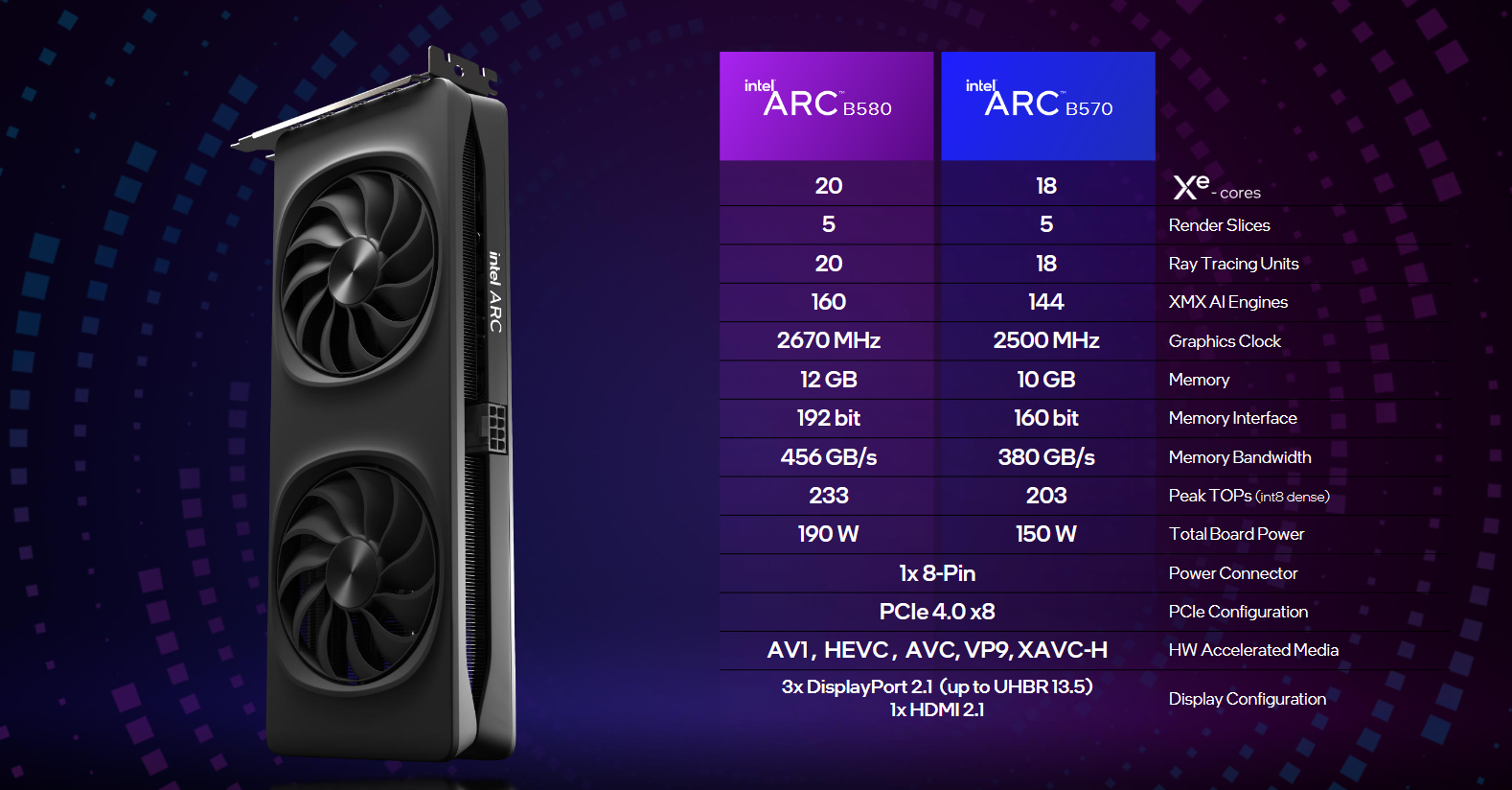
    On the surface, the Arc B580 (and to a lesser degree, the B570) seemed like a dream come true for gamers. The drivers promised a near plug-and-play setup, the performance was superior to the outgoing RTX 4060 and Radeon RX 7600, and the increased vRAM would ensure a longer lifespan compared to those GPUs. However, reality turned out to be more complex. Initial availability was poor, primarily favoring the US market, and driver issues caused CPU slowdowns on older, budget-friendly systems. Plus, there was the significant issue of silicon costs. The BMG-G21 chip inside Battlemage measures approximately 272 mm², which is much larger than Nvidia’s AD106 or AMD’s Navi33—its main competitors from the previous generation. Once again, Intel managed to stay ahead mainly due to its aggressive pricing strategy.

    Silicon and Pricing Connection

    While my earlier thoughts on Arc Alchemist may have stirred some debate, there is a clear logical relationship between the silicon used in a GPU and its production costs. Bigger chips occupy more space on a wafer and have a higher risk of defects, which can lower yields or necessitate overdesign for reliability, both of which can drive up costs or reduce profit margins. Similar to Alchemist, Intel opted to sell a chip equivalent to an RTX 5070 for merely half the price, all while delivering performance akin to an RTX 5060. This approach led to significant financial losses, especially as the overall company was already facing economic challenges, including concerning trends in the laptop segment.

    Battlemage’s Performance

    Battlemage didn’t excel in productivity either, lagging behind the Alchemist A770 in benchmarks like Puget and Blender, with the exception of certain Unreal Engine 5 tests from Puget. Yet, there appeared to be a glimmer of hope during Computex last month, thanks to the Arc Pro B60, which boasts an impressive 24 GB of vRAM. Although many are weary of seeing LLMs integrated into every product, the demand for GPUs with over 16 GB for larger AI models remains high. The only current options are the prohibitively priced RTX 5090, the aging RTX 3090, and the 4090. If there’s a chance for Intel to market BMG-G21 chips with decent profit margins, helping Arc contribute positively to Intel’s finances and even fund the next-gen Celestial, this could be it.

    Intel, however, wasn’t actually selling Arc Pro B60s; instead, they were showcasing them and promoting their inclusion in preconfigured multi-GPU “Battlematrix” systems, expected to launch later this year. The standalone card availability remains uncertain, contingent upon Intel’s timeline for enhancing Battlemage’s software. If the Pro B60 takes too long to hit the market, it risks being overshadowed by a rumored refresh of the RTX 5000 series, which may utilize 3GB memory chips to offer additional vRAM. Once having 24 GB of vRAM ceases to be a unique feature in the mid-market segment, the Pro B60 could be eclipsed by a possible RTX 5070 Ti Super, while its attractiveness for budget-conscious gamers might diminish if AMD decides to slightly reduce the price of the RX 9060 XT (currently $349.99 on Amazon), which is already quite competitive at its suggested retail price.

    Future Prospects for Intel Arc

    Is it still possible for Intel Arc to turn the tide? Could a rumored B770 rival the midrange offerings from GeForce and Radeon? Personally, I really hope so—having a third strong contender in the GPU market is crucial for healthy competition. However, the current state of Arc makes me cringe, just like when I penned my previous article. Similar to the GPU shortages of previous years, the local AI surge has provided Intel with an opportunity to thrive. Yet, the immature software hindered Alchemist long enough for the initial chance to be lost, forcing Intel to sell high-cost silicon in lower-priced graphics cards, ultimately starving their next generation of research and development funding.

    Source:
    Link
  • Intel Linux Driver Update: Tips for New Arc Battlemage GPUs

    Intel Linux Driver Update: Tips for New Arc Battlemage GPUs

    Intel’s Arc B580 and Arc B570 GPUs have made a significant impact since their release earlier this year, providing gamers with a budget-friendly option for mid-range and 1080p gaming. The Arc B570 is priced at just $234.99 on Amazon, making it an attractive choice. However, many gamers are still curious about the absence of high-end gaming GPUs from Intel, and recent updates to Intel’s Linux drivers hint that answers might be on the way.

    New Developments in Intel GPUs

    Tomasz Gawroński shared a screenshot on X indicating that Intel has integrated three new Battlemage GPUs (noted as BMG in the changelog) into its Linux driver. While there are no specifics about these new GPUs, there’s speculation that Intel could be preparing to unveil more than just a single higher-priced GPU. The likely candidates for a new Arc GPU are the Arc B770 or B780, which were reportedly delayed last year. However, the emergence of these new SKUs in the Linux driver raises questions about what Intel is actually planning.

    Anticipated Variants and VRAM Upgrades

    Gawroński and his followers speculate that Intel might be set to introduce two new SKUs for the B570 and B580, particularly versions with increased VRAM. Many gamers feel that anything under 16 GB of VRAM is no longer sufficient, suggesting that Intel may be recognizing the need for higher memory options with the 10 GB and 12 GB variants of the Arc B570 and B580. Currently, the B580 and B570 utilize 2 GB memory dies, which makes it relatively easy to scale up memory quantities; however, earlier leaks hinted at a 24 GB Arc B580 Pro GPU possibly being in the pipeline.

    At this moment, it appears likely that Intel will release higher-VRAM variations of the Arc B580, in addition to either the B770 or B780, or perhaps both.

    Source:
    Link

  • Intel Arc B580 vs Nvidia RTX 3080 & AMD RX 7700 XT: Benchmark Leak

    Intel Arc B580 vs Nvidia RTX 3080 & AMD RX 7700 XT: Benchmark Leak

    At the launch event, Intel asserted that the Arc B580 can compete with an Nvidia GeForce RTX 4060 Ti but comes at a much lower price. A recent listing on Geekbench indicated that the Arc B580 delivers a notable performance improvement compared to the previous-generation Arc A580 and even the AMD Radeon RX 7600 XT. A user from Chiphell, sharing insights via HXL on X, has now disclosed how the graphics card performs in the 3DMark Time Spy benchmark.

    Benchmarking Performance

    In the benchmark test, the Intel Arc B580 achieved a score of 15,551 points. The individual scores for graphics and CPU stood at 14,719 and 22,881, respectively. The tests were conducted with an Intel Core i9-14900KF, which helped to eliminate any potential CPU-related bottlenecks. Next, let’s compare how it stacks up against other competitors in the market.

    Competitive Comparison

    When comparing it to the GeForce RTX 4060 Ti, which scored 13,872, the Arc B580 is roughly 12% faster. If we look back to the previous generation with the GeForce RTX 3080, which scored 16,134, the B580 is a mere 3% slower. The performance comparison is quite similar with the AMD Radeon RX 7700 XT, which scored 16,454. Finally, the Arc B580 outperforms the older Arc A770, which scored 14,047, by about 10%.

    Overall Impressions

    These results are indeed quite remarkable. However, Intel’s Alchemist launch reminded us that while the company excelled in synthetic benchmarks, it struggled to translate that success into actual gaming performance. Thankfully, Intel has had ample time to refine its drivers, so we shouldn’t face the same issues this time around. It will be fascinating to watch if the Arc B580 can maintain its advantage in gaming, which is where it really counts.

    Source: Link


    Image 1
  • Intel Arc B580 GPU Beats RX 7600 XT and Arc A580 in Benchmarks

    Intel Arc B580 GPU Beats RX 7600 XT and Arc A580 in Benchmarks

    After a long wait filled with rumors, Intel has finally launched its next-generation Arc Battlemage GPUs, namely the Arc B580 and Arc B570, just last week. The more robust Arc B580 will be available for purchase starting December 13, with a price tag of only $249. Meanwhile, the Arc B570 is expected to be released sometime in 2025.

    Affordable Choice for Gamers

    At just $249, the Arc B580 is likely to attract gamers who are budget-conscious, as Intel asserts that this GPU outperforms the previous Arc A750 and the RTX 4060. In addition, the Arc B580 comes with 12 GB of RAM, which is becoming increasingly important for gamers since 8 GB VRAM is no longer sufficient for demanding AAA games.

    Performance Claims Under Scrutiny

    Even though Intel’s performance claims for the Arc B580 seem promising, we cannot fully trust what the company says. Luckily, as we approach the release date for the Arc B580, we can expect to see benchmark results that will showcase the GPU’s performance. A recent leak has given us a preliminary insight into the synthetic performance of the Arc B580.

    The Intel Arc B580 achieved OpenCL and Vulkan scores of 98,343 and 103,445, respectively. According to Geekbench’s database, these scores indicate that the Intel Arc B580 is approximately 9% faster than the Arc A580 in OpenCL tests and a significant 30% faster in Vulkan tests.

    Competing Well Against Rivals

    The benchmarks for the Arc B580 also show competitive results against the RX 7600 and RX 7600 XT (which can be found on Amazon). In the OpenCL benchmark, the Arc B580 is 20% faster than the RX 7600 and 17% quicker than the RX 7600 XT. In Vulkan benchmarks, the Arc Battlemage GPU leads by about 18.5% against the RX 7600 XT and 14% against the RX 7600.

    In conclusion, the Arc B580 is slightly behind the RTX 4060 in OpenCL performance by about 3%. However, it appears to be 6.5% faster than the RTX 4060 in the Vulkan benchmark.

    All things considered, the Intel Arc B580 looks to be a significant improvement over the Arc A580. But remember, synthetic benchmarks don’t provide the entire picture. We will need to wait for the retail samples of the Arc B580 to be reviewed, with those reviews expected to arrive this week.

    Source: Link


    Image 1
    Image 1
  • Intel Arc B580 and B570 Desktop GPUs Launching December 3

    Intel Arc B580 and B570 Desktop GPUs Launching December 3

    Intel’s Battlemage desktop graphics cards are set to arrive sooner than expected. According to Videocardz, the announcement is scheduled for December 3, with the actual launch happening on December 12. This date is also when reviews for the GPU are expected to start appearing. Nevertheless, as previously mentioned, the initial stock may not be great, and you might have to wait until 2025 to finally get one.

    Model Details

    The report indicates that only two models will be released at first: the Arc B580 and the Arc B570. Notably, the Arc B3xx and Arc B7xx variants are missing from this initial offering. Moore’s Law is Dead has suggested that the Arc B770 has been delayed indefinitely, and the Arc B380 might make its debut in 2025.

    Specifications and Pricing

    The Arc B580 has appeared on Geekbench with specs that include 12 GB of 19 Gbps VRAM on a 192-bit bus, featuring 20 Xe cores and a boost clock of 2.8 GHz. It is expected to retail for $250 upon launch and should compete closely with the Nvidia GeForce RTX 4060 Ti in terms of performance.

    As for the Arc B570, not much information is available. Last gen, the Arc A570M was exclusive to laptops, so it’s unclear what a desktop version might offer. However, it’s reasonable to speculate that it could be priced around $200 and come with approximately 8 GB of VRAM.

    Source: Link