
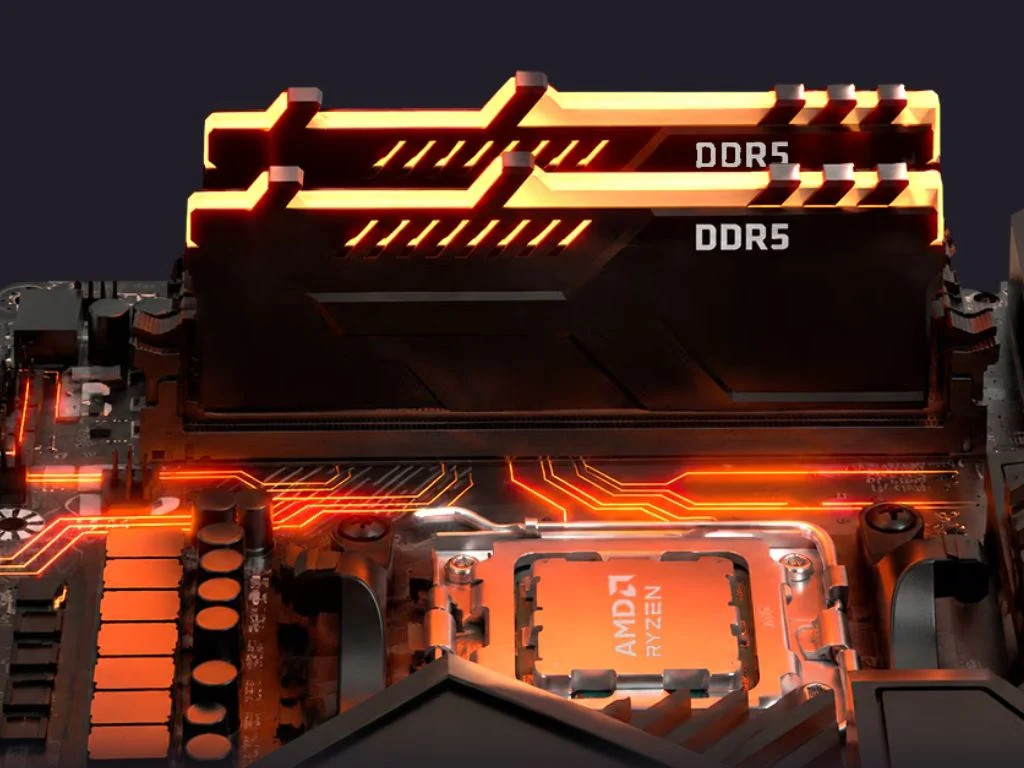
– AMD EXPO Ultra Low Latency (EXPO-ULL) reduces DDR5 memory latency by 5-7 ns for smoother out-of-the-box gaming.
– It delivers up to 13% higher average FPS and 15% better 1% low frame rates vs. standard JEDEC DDR5, with less stuttering.
– Unlike Intel’s XMP, EXPO-ULL optimizes timings for Ryzen CPUs, which benefit more from tighter latencies than higher frequencies.
– Certified kits (e.g., G.Skill, Kingston) launch June 2026, with motherboard support via AGESA updates for X870/B850 boards.
– Best for Zen 4/Zen 5/X3D users, though gains may be slightly lower on X3D chips compared to non-3D CPUs.
New Memory Tech From AMD
At Computex 2026, AMD unveiled its latest take on memory overclocking with the launch of AMD EXPO Ultra Low Latency (EXPO-ULL). The ULL profile builds directly on the existing AMD EXPO standard and aims to extract better timings from already popular DDR5 memory modules at 6000 MT/s and 6400 MT/s, which are typically paired with Zen 4, Zen 5, and X3D-series processors.
Casual Gamers Benefit Big Time
For casual gamers, this means that DDR5 memory will deliver lower latency, i.e., a reduction of 5 to 7 nanoseconds and improved frame times without the hassle of manually tweaking memory settings in the BIOS, thanks to modules already rated to work at said latencies, essentially making high-end memory worth it right out of the box.
Test Results Are Impressive
AMD’s focus here is to further reduce latency and improve in-game responsiveness. To back up its new EXPO-ULL overclocking technology, AMD tested the new profile on a Ryzen 7 9700X setup in more than 30 games, resulting in a solid 13% higher average frame rate and a 15% improvement in 1% low frame rates compared to standard JEDEC-spec DDR5 memory. It is prudent to note that AMD’s choice of CPU, though understandable, might slightly skew the results compared with X3D CPUs, which reportedly exhibit lower performance gains than the former.
Why This Matters Versus Intel
What makes EXPO-ULL a solid alternative to Intel’s XMP is that it addresses a long-standing quirk of Ryzen setups. While Intel pursues ever-higher memory frequencies, AMD chips often see better performance gains when timings are dialed in tightly rather than simply increasing clock speed.
Real-World Smoothness
Real-world results with AMD EXPO-ULL include fewer instances of stuttering and improved frame times, which consequently lead to better reaction times in competitive titles. Overall gameplay will feel smoother, especially in CPU-intensive games or during sessions at very high frame rates.
Many memory partners are already hopping on the EXPO-ULL train, with certified kits expected to ship from G.Skill, Kingston FURY, KLEVV, Lexar, TeamGroup, V-Color, XPG, and Origin Code.
Availability and Compatibility
AMD EXPO-ULL–supported DDR5 memory kits are expected to hit store shelves in June 2026, targeting AMD gamers with Zen 4–onward supported processors. Furthermore, motherboard support for EXPO-ULL is expected to roll out via AGESA updates, so many X870 and B850 boards will be able to handle the new EXPO-ULL profiles without issue before the kits even launch.
Cost vs. Benefit
Although these memory modules will be expensive, they could make the difference between “good enough” and noticeably smoother gameplay.