Tag: AI Image Generation

  • Nano Banana Pro Experiment: Spotting AI with the Naked Eye

    Nano Banana Pro Experiment: Spotting AI with the Naked Eye

    Key Takeaways

    1. High-Quality Image Generation: Nano Banana Pro produces nearly perfect images with accurate anatomy, consistent perspectives, and correct proportions, making it an impressive AI tool.

    2. Detail Inaccuracies: Despite its strengths, Nano Banana Pro can overlook small details, leading to noticeable mistakes when images are closely examined.

    3. Zipper and Fabric Issues: Specific problems include missing zipper teeth, inconsistent snap fasteners, and illogical collar designs, which reveal the AI’s limitations.

    4. Perspective Flaws: While the initial perspective appears correct, closer inspection shows inconsistencies in vanishing points and alignment, indicating potential flaws in the AI’s spatial understanding.

    5. AI Recognition Challenges: After minor edits, AI detection tools struggle to identify images as AI-generated, highlighting the importance of human judgment in recognizing subtle errors commonly found in AI-created images.


    Nano Banana Pro is a fantastic tool for creating stunning images with ease. Initially, the images produced by Google’s AI seem nearly perfect. The hands have four fingers and a thumb, and the anatomy and proportions look right. The perspectives are consistent, and the proportions are typically accurate. This image generator is so advanced that, after only minor post-processing, many automatic AI detection tools struggle, as shown in our first trial.

    Details Matter

    However, even Nano Banana Pro can miss some details. A little zooming in can expose various mistakes in the image. Let’s examine these issues closely.

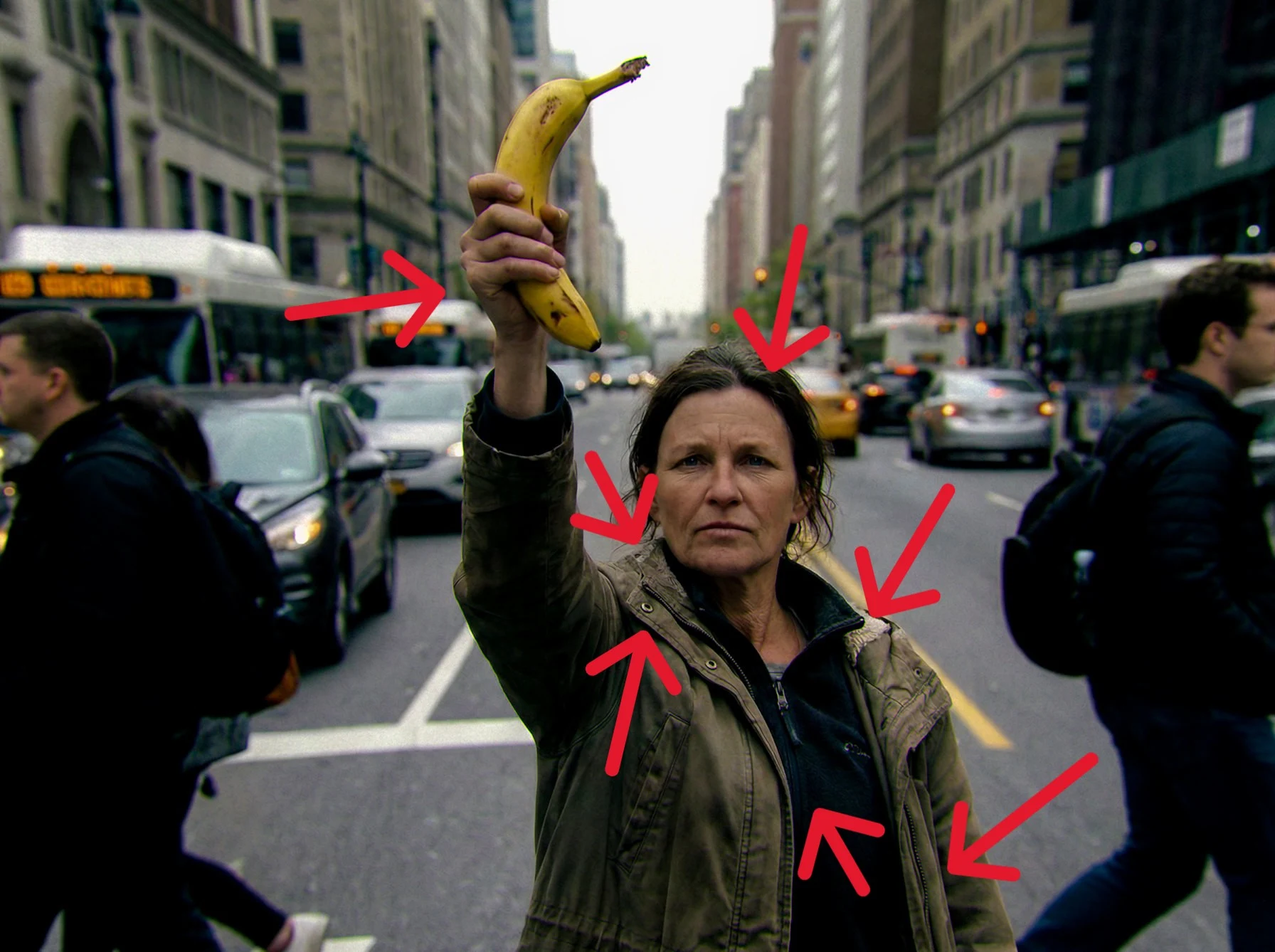
    In our image, the woman is dressed in an olive-green jacket that has a style blending a field jacket and a parka. Nano Banana Pro captures the folds and fabric beautifully, but other aspects of the jacket are problematic. When we look closer, the inconsistencies become obvious.

    Zipper Problems

    Let’s focus on the zipper. On the right side of the image, the zipper teeth vanish halfway. The left side shows varying lengths and spacing of the zipper teeth. The snap fasteners reveal that this image was made by AI. Instead of round holes, we see a D-shape. Lastly, the jacket’s collar raises questions. The right side shows a white fur trim, which is missing on the left. Instead, the collar fabric merges smoothly with the shoulder pieces on the left. Moreover, the cut of the collar section displayed doesn’t make any sense.

    There’s also an issue with the zipper on the black fleece jacket. It lacks teeth, the pull tab is bent, and below, the zipper transforms into fabric.

    Perspective Flaws

    The devil is in the details here as well. Gemini, or Nano Banana Pro, does well with perspective at first glance. Only one vanishing point seems visible. But if you look closer, you can see that, despite the blur, some vanishing point lines cross different floors or, in the case of the two buses on the left, simply vanish into nothing. We highlighted the inconsistent lines in purple after identifying the perspective’s vanishing point.

    When it comes to hands, even Google’s top AI has slight flaws. If you examine closely, the fingers and hand of the woman holding the banana are not anatomically correct. There are clear issues with the middle finger. The width of the finger and fingernail is off, the front joint has no articulation, and the connection to the hand is unclear. Additionally, the skin folds between the fingers stretch down to the knuckles.

    At the hairline, it’s particularly noticeable that almost all the hair, including gray strands, starts with a brown base. This is especially striking at the front of her head.

    AI Recognition Challenges

    In the first part of our series, we put the image of the woman with the banana through several AI image recognition tools. After some editing, unfortunately, six online platforms declared that the image was not AI-generated. Relying on a human eye and common sense is much more useful in this case. The image shows a series of indicators that it is AI-generated. Anyone who remains doubtful should consider the inherent issues in generative image creation. Small details often aren’t rendered accurately, including the textures of fabrics, jewelry, knitwear, zippers, and other common items. Tire tread patterns and rims on cars and planes, wooden surfaces, and skin wrinkles frequently signal AI processing.

    Source:
    Link


  • Nano Banana Makes Gemini the Top AI App on the App Store

    Nano Banana Makes Gemini the Top AI App on the App Store

    Key Takeaways

    1. The launch of Gemini 2.5 Flash Image (“Nano Banana”) improved AI image generation and editing quality and control.
    2. The app experienced a 45% increase in downloads, reaching nearly 13 million in the App Store.
    3. Gemini achieved the top position in the AI apps category on the App Store, rising from 3rd to 1st place in a matter of days.
    4. Despite Gemini’s success on iOS, ChatGPT remains the leader in the AI apps category on Google Play.
    5. Since its launch in February 2024, Gemini has accumulated over 185 million downloads across Android and iOS.


    Last month, the launch of Gemini 2.5 Flash Image, commonly referred to as Nano Banana, brought a significant improvement in AI-based image generation and editing. This update offers enhanced quality and control when compared to Google’s earlier similar offerings and its competitors. With this new version, a person or product in an image stays consistent even while creating various images with different backgrounds, outfits, and hairstyles. This feature has contributed to a remarkable 45% increase in downloads for the mobile Gemini app month-over-month.

    Download Milestones

    Data from Appfigures indicates that Gemini is approaching nearly 13 million downloads in the App Store, a rise from less than 9 million throughout August. Furthermore, it has claimed the top position in the AI apps category within Apple’s digital marketplace. Prior to the arrival of Nano Banana, the app’s best rank was 3rd in the US App Store back on January 28, 2025. The app moved to second place in the rankings on September 8 and reached first place by September 12. Globally, Gemini ranks among the top five iOS apps in 108 countries.

    Competition in the App Market

    Even though Gemini is a Google product with Android as its primary mobile platform, ChatGPT continues to dominate the AI apps category on Google Play. On September 8, Josh Woodward, VP of Google Gemini and Google Labs, announced that the app attracted no less than 23 million first-time users since the introduction of Nano Banana, leading to the creation of over 500 million images, as stated by the Google executive.

    For the whole of 2025, the Gemini app has gathered close to 104 million downloads. Since its launch in February 2024, it has surpassed a total of 185 million downloads across both Android and iOS platforms.

    Source:
    Link


  • OpenAI develops a new tool for detecting AI-generated images

    OpenAI develops a new tool for detecting AI-generated images

    The advancements in AI-powered image generation tools have reached a point where distinguishing them from non-AI or authentic images can be challenging, leading to concerns around potential misuse.

    OpenAI has taken steps to address this issue by introducing watermarks for images generated by DALL-E 3 to ensure transparency and uphold authenticity. Additionally, the company is working on a new tool that can differentiate between real images and those created using their image text-based generation model, DALL-E.

    New Methods for Detecting AI-Generated Content

    OpenAI recently announced on their official blog that they are developing innovative techniques to identify AI-generated content. Their objective is to aid researchers in assessing content authenticity and to participate in the Coalition for Content Provenance and Authenticity Steering Committee (C2PA), a widely recognized standard for certifying digital content. This initiative will enable creators to tag and certify their content, verifying its true origins.

    Integration of C2PA Metadata for Sora

    OpenAI plans to incorporate C2PA metadata for Sora, their upcoming video generation model, upon its widespread release. Sora is expected to be a premium text-to-video generation tool similar to DALL-E 3, likely accessible only to paid subscribers. Anticipated for public availability by 2024, Sora aims to revolutionize text-to-video generation capabilities.

    Enhanced Detection Tool for DALL-E 3-Generated Images

    In addition to watermarking and metadata integration, OpenAI is developing a new tool leveraging AI to identify images generated by DALL-E 3. This tool can predict the likelihood of an image being DALL-E 3-generated, even after compression, saturation adjustments, or cropping. Designed to resist efforts to conceal the origin of content, this tool boasts a 98% accuracy rate for detecting DALL-E-generated images while avoiding misidentifying non-AI-generated images.

    OpenAI has initiated an application process for select testers to access this image detection tool, targeting research labs and journalism nonprofits focused on research. Through their Researcher Access Program, OpenAI seeks to gather feedback to further enhance the tool’s capabilities and usability.