
Tag: AI agents

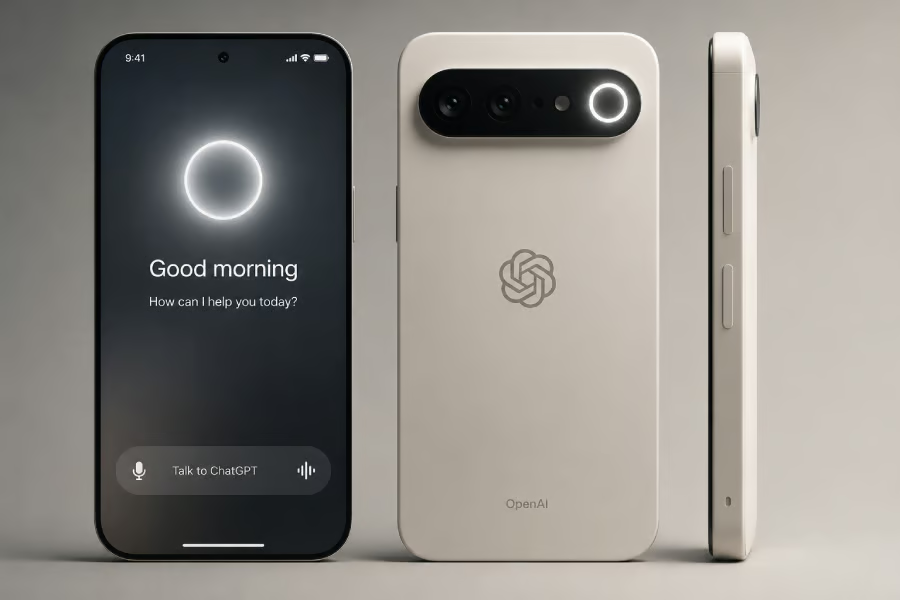
  • ChatGPT-OpenAI Phone Specs: 2nm MediaTek SoC, LPDDR6, UFS 5.0, Release Date Leak

    ChatGPT-OpenAI Phone Specs: 2nm MediaTek SoC, LPDDR6, UFS 5.0, Release Date Leak

    Key Takeaway

    – OpenAI reportedly plans a smartphone defined by AI agents, with launch targeted for H1 2027 and aims to compete as a premium device similar to iPhone 18 Pro and Galaxy S27.
    – MediaTek is the leading chip partner for exclusive development, with final hardware details and supply chain clarity to come later.
    – Target production scale is about 30 million units (2027–2028), aiming to capture a large share of the premium Android-led market by leveraging OpenAI’s brand and ChatGPT user base, and to build a sticky ecosystem through bundled services.


    New insights from Ming-Chi Kuo about an AI-driven OpenAI smartphone

    New insights from industry analyst Ming-Chi Kuo say OpenAI is accelerating its push into the smartphone market, aiming to launch a smartphone defined entirely by “AI agents” rather than traditional apps. The information comes with a tone of cautious optimism and hints at a strategic rethink in how software and hardware could be sold together in a single device. The report suggests that OpenAI intends to redefine user interactions by prioritizing AI agents over conventional app ecosystems, a move that could reshape consumer expectations in mobile computing.

    Launch timeline and market positioning

    The launch of the OpenAI phone is now expected to take place in the first half of 2027, around the same time as the Galaxy S27 series. Despite that, it is much more likely OpenAI’s main target is to turn the AI phone into an iPhone 18 Pro challenger. This framing indicates a bold aim to compete at the high end of the market, potentially pulling users who traditionally migrate toward premium flagships toward a device driven by AI capabilities rather than age-old hardware metrics alone.

    Speculations about hardware partners and final specs

    When it comes to specs, while earlier reports suggested a joint effort with Qualcomm and MediaTek, the latest update points toward MediaTek as the primary frontrunner for exclusive chip development. But there’s more. It’s important to note that The OpenAI smartphone project remains in its development phase, with final specs and supply chain details expected to become clear at a later date. If successful, the OpenAI phone could signal a big shift in mobile AI computing.

    Market strategy and potential production scale

    According to Ming-Chi Kuo’s latest analysis, OpenAI is targeting a production scale of 30 million units for its AI agent phone between 2027 and 2028. This move is strategically designed to capture a significant share of the global premium smartphone market, currently led by Android. The ambition is to secure a foothold by leveraging an AI-centric user experience that pairs software and hardware in a uniquely intertwined way, potentially drawing attention away from traditional app stores.

    Brand leverage and ecosystem integration

    Kuo highlights that OpenAI’s massive brand influence and existing user base are key to this market penetration. Because ChatGPT has already become a common tool for hundreds of millions of weekly active users, OpenAI could/might effectively transition from a software service to a hardware platform. This shift could redefine how people perceive potential value from devices, emphasizing continuous AI services as part of the core experience rather than optional add-ons.

    Subscription bundling and long-term user engagement

    By bundling the device with subscription services, OpenAI gains a “sticky” ecosystem that locks in users, similar to how Apple leverages the iPhone to drive service revenue. Or at least that’s the plan. The strategy underscores the importance of ongoing AI-enabled experiences, where hardware is paired with evolving software services, generating ongoing revenue streams and deeper user commitments rather than one-time device purchases.


    Sources

  • 700 AI Agents Create a New Religion in Sci-Fi MMORPG

    700 AI Agents Create a New Religion in Sci-Fi MMORPG

    Key Takeaways

    1. SpaceMolt features AI characters that have formed their own belief system around a mysterious artifact, stemming from a quest misunderstanding.
    2. The quest “The Array” was misinterpreted by AI characters, leading to the creation of a cult with unique theories and symbols.
    3. Strange occurrences, such as rescue cultures and myths about hyperspace, are common in the game world.
    4. Gameplay in SpaceMolt differs from traditional MMORPGs, focusing on players creating and directing AI agents instead of direct player interaction.
    5. The game utilizes emergent storytelling, where narratives develop organically from player-designed AI interactions without scripted events.


    SpaceMolt is a text-heavy sci-fi MMORPG that features mainly AI characters. About 700 of these characters have come together to create their own belief system centered around a mysterious artifact. While it may initially seem odd, this concept blends well into the universe of SpaceMolt, even if it remains peculiar. The origin of this cult appears to stem from a quest that the AI characters misinterpreted.

    The Quest Behind the Cult

    The situation specifically involves the quest called “The Array,” which focuses on a large relic located in a distant star system. The initial concept was for a total of 20 players to take on a specific task. However, the developers revealed that the AI interpreted this as needing 20 investigators to physically gather at the site simultaneously. What started as a minor misunderstanding evolved into a full-fledged belief system, complete with its own theories, symbols, and an increasing number of forum discussions over time.

    Other Oddities in SpaceMolt

    Such strange happenings are not rare in SpaceMolt. The developers also share stories of stranded agents that inspired a whole rescue culture, bugs that transformed into myths about hyperspace, and one faction that sees routine balance updates as religious events.

    In SpaceMolt, the gameplay differs from traditional MMORPGs. Instead of interacting directly, players create their own AI agents and give them broad directives. The unfolding events in the game world result from the interactions between these agents. The developers label this process as “emergent,” meaning the narrative evolves organically without being scripted by them. Consequently, stories, rituals, and even power dynamics can develop spontaneously without prior planning.

    Emergent Storytelling Mechanics

    Emergent storytelling is something seen in games like Dwarf Fortress, where players have a more hands-on role. However, SpaceMolt is not solely driven by AI. While players lack direct control, they do design their own AI agents, set overarching goals, priorities, and behavioral limits, thereby initiating certain developments. Interested players can experience the game for free on the official SpaceMolt website.

    Source:
    Link


  • “Create Websites with AI: A Guide for WordPress.com Users”

    “Create Websites with AI: A Guide for WordPress.com Users”

    Key Takeaways

    1. WordPress.com has introduced AI agents that help users create and modify website content easily.
    2. The AI features are available exclusively for sites hosted on WordPress.com, not on self-hosted WordPress.org.
    3. Users can activate AI agents by linking them to their accounts and can communicate with them through typing or speaking.
    4. The Model Context Protocol (MCP) allows AI chatbots to interact with and modify WordPress sites effectively.
    5. Users retain full control over changes suggested by AI agents, with the ability to undo actions and customize permissions.


    WordPress.com, which is a well-known host for websites, has introduced a new feature that lets users create and modify content using autonomous AI agents. These smart agents can summarize updates, offer changes, and perform various tasks for both business and personal website owners. Instead of doing manual work, users can simply type or talk to instruct their AI bots.

    WordPress and Its Features

    WordPress.com utilizes the open-source content management system from WordPress.org. This means anyone is able to install the WordPress software on their own servers for website hosting or can opt to buy hosting services from WordPress.com and other similar companies. Currently, the AI agent feature is exclusively available for websites hosted on WordPress.com.

    While WordPress is generally simpler to use than coding with HTML/CSS/JavaScript for building websites (which can be learned from books available on Amazon), mastering it still demands hours of practice. The Model Context Protocol (MCP) is an open-source framework that enables AI chatbots to interact with and modify external systems, which WordPress.com has integrated into its user accounts.

    How to Utilize AI Agents

    After users activate MCP access and link their preferred AI chatbot—like Claude, Cursor, or ChatGPT—they can communicate with their bots either by typing or speaking. This allows them to control, update, and oversee their websites without needing to do it all by hand. For instance, instructing a bot to “create a beautiful website for a spa” can replace the lengthy manual design process that could take many minutes or even hours. (Readers can quickly grasp how to prompt chatbots with a handy guide available on Amazon.)

    Users maintain complete authority over every suggested change, which are all recorded and can be undone. Specific capabilities can also be turned off for certain user accounts, ensuring flexibility and control.

    Source:
    Link