
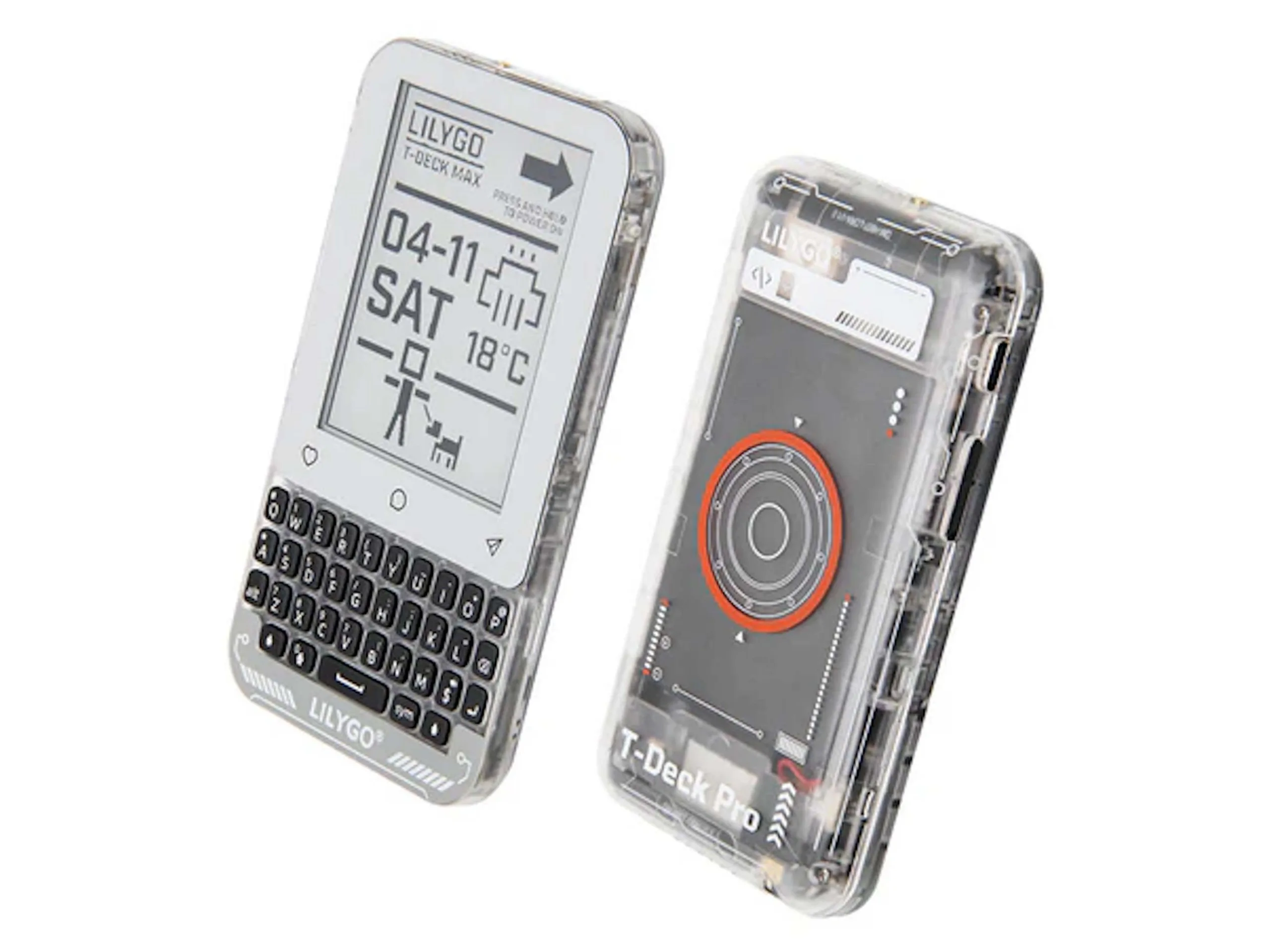
– ESP32-S3-based, hobbyist-friendly device aimed at tinkering rather than a ready-to-use smartphone experience.
– Supports LoRa for long-range, low-data transmission (with optional 4G) and includes GPS for location sharing.
– 3.1″ e-ink display, built-in microphone/speaker, keyboard, microSD slot; Arduino/PlatformIO development supported.
– Suitable for use cases like personal emergency signaling on large sites, with LoRa repeaters extending range.
– Detachable/expandable with additional sensors/actuators; typical street price around $110.
Overview and Target Audience
The T-Deck Max is described as a new mobile device, or at least a new version of LilyGo’s T-Deck. It can broadly be approached like a smartphone, although the system does not run Android and is not necessarily a fully preconfigured product that is ready for end users out of the box. Instead, the model is likely aimed more at tinkerers. An ESP32-S3 is used as the main board, which limits performance. In practical terms, the system could be used to exchange data or messages.
Unique Capabilities
This opens up possibilities that a regular smartphone does not offer. The LilyGo T-Deck Max supports LoRa, which can be used to transmit relatively small amounts of data entirely independently of a cellular network. A GPS module is included, so location data can also be transmitted. This means the T-Deck Max could potentially be used on a large factory site as a personal emergency signaling device, for example. LoRa repeaters can then extend the effective range between such handhelds. A 4G connection is optionally available.
Hardware and Display
It uses a 3.1-inch display with a resolution of 320 x 240 pixels. The screen is based on an e-ink panel and should not consume much power. Additional sensors and actuators can be connected, and there is a microSD card slot. A microphone and speaker are already included, and programming can also be done using the Arduino or PlatformIO IDE. A keyboard is included, which should make it relatively easy to enter text directly. The T-Deck Max is listed by the manufacturer for around $110, and previous T-Deck models have also become available at some specialized retailers.
Pricing and Compatibility
The article notes that the T-Deck Max is listed by the manufacturer for around $110, and mentions that earlier T-Deck models have appeared at some specialized retailers. It also highlights compatibility with Arduino or PlatformIO IDEs for development, suggesting a flexible ecosystem despite the device not being a full consumer-ready smartphone.