
Key Takeaways
1. Scientists led by Ben C. Schafer developed a small solar-powered flying gadget that can levitate, aimed at exploring the mesosphere.
2. The mesosphere, located between 50 and 85 kilometers above Earth, is largely unstudied and known as the ‘ignorosphere.’
3. The device operates using photophoretics, where sunlight heats a bottom layer, creating upward thrust through gas molecule interactions.
4. Successful testing demonstrated levitation of a 1-centimeter structure in a low-pressure chamber using light at 55% of real sunlight strength.
5. A larger saucer design, measuring 6 centimeters, is expected to reach 75 kilometers altitude, potentially carrying small sensors for climate monitoring and atmospheric exploration on Mars.
A group of scientists, under the leadership of Harvard physicist Ben C. Schafer, has created and tested a small solar-powered flying gadget that can levitate. This groundbreaking work was shared on August 13 in the journal Nature. It has the potential to help explore a part of the Earth’s atmosphere that is not well understood.
Exploring the Mesosphere
The gadget is made to function in the mesosphere, which is situated between 50 and 85 kilometers above the Earth. This layer is often called the ‘ignorosphere’ because it’s too high for regular planes and balloons but too low for satellites, leaving it largely unstudied. The device uses photophoretics, where light serves as the source of its movement.
How It Works
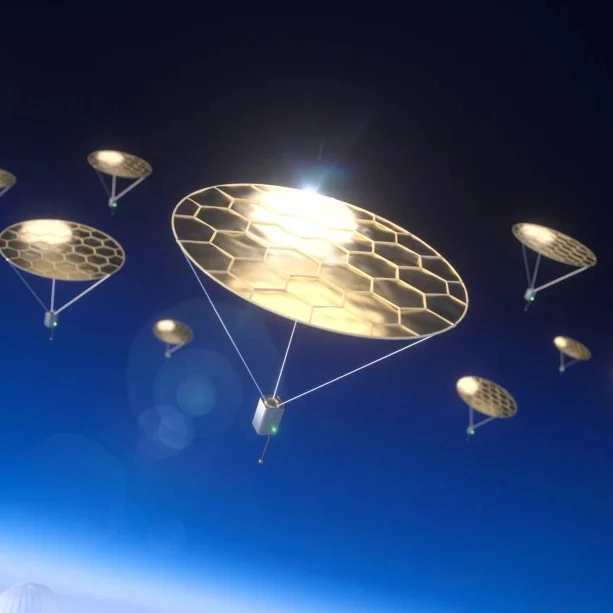
This flying device features two layers of asymmetrically perforated wafers. In the thin air of the mesosphere, sunlight shines through the top layer, warming the bottom layer. When gas molecules hit this heated surface, they bounce off with added momentum, generating an upward thrust that allows the device to float.
Successful Testing and Future Applications
In a test to prove its concept, the team managed to levitate a structure that was 1 centimeter wide in a low-pressure chamber using light at about 55% of the strength of real sunlight, showing that the design works well.
Additionally, the researchers have crafted a saucer that measures 6 centimeters across, which is expected to ascend to an altitude of 75 kilometers while carrying a payload of 10 milligrams. This weight is sufficient for a small sensor or communication device. Such technology could be beneficial for high-altitude climate monitoring and exploring the atmosphere of planets like Mars.
Source:
Link
Leave a Reply