

Key Takeaways
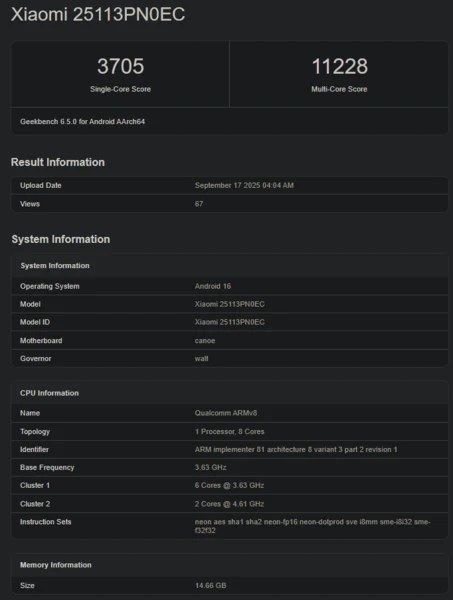
1. The Snapdragon 8 Elite Gen 5 scored 3,705 points in single-core and 11,228 points in multi-core benchmarks on Geekbench 6.4.
2. The chip was tested on a Xiaomi device with 16 GB of RAM and Android 16, showcasing its capabilities.
3. Compared to competitors, it outperformed the Apple A18 Pro but still trails behind the A19 Pro in single-core performance.
4. In the Android market, it surpassed the Exynos 2600 and MediaTek Dimensity 9500 in performance metrics.
5. The Snapdragon 8 Elite Gen 5’s performance improvements are attributed to better software and effective P-core clock speeds.
So far, the Snapdragon 8 Elite Gen 5 has not managed to effectively break the ~3,000 point barrier in Geekbench 6.4’s single-core benchmark. Recently, it was tested alongside the Xiaomi 17 Pro, achieving scores of 3,025 and 9,178 points in single-core and multi-core benchmarks. A recent listing reveals the Qualcomm chip operating at close to its full potential, if not entirely so.
Performance Scores
In the latest results, the Snapdragon 8 Elite Gen 5 achieved scores of 3,705 and 11,228 points in Geekbench 6.4’s single and multi-core tests, respectively. This performance surfaced with a Xiaomi device identified as 25113PN0EC, probably the Xiaomi 17 Pro Max or the standard Xiaomi 17. This specific device is equipped with 16 GB of RAM and is running on Android 16.
Comparison with Competing Chips
To better understand the significance of the new Snapdragon 8 Elite Gen 5 scores, it is comparable to the Apple A19 Pro (4,019/11,054) in multi-core tests. It even outperforms the Apple A18 Pro (3,461/8,546). Although Apple’s chips still dominate in single-core performance, the gap is decreasing, and it is expected to continue closing as more devices with Snapdragon 8 Elite Gen 5 are released.
Android Competition
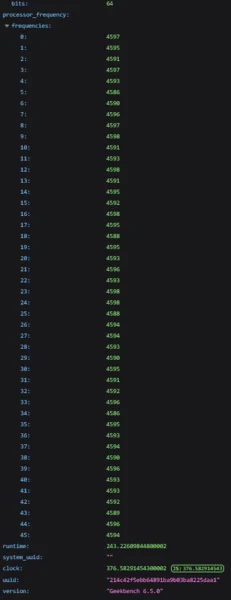
In the Android arena, the Snapdragon 8 Elite Gen 5 significantly outperforms both the Exynos 2600 (3,308/11,256) and the MediaTek Dimensity 9500 (3,177/9,701). This impressive boost in performance can be linked to improved software and the SoC’s P-cores being capable of maintaining their 4.6 GHz boost clock.
Source:
Link
Leave a Reply