
Key Takeaways
1. A solar storm occurs when the Sun releases a large amount of energy and particles into space, including solar flares and coronal mass ejections (CMEs).
2. In May 2024, the largest solar storm in over 20 years caused stunning auroras on Earth and directly heated the Martian atmosphere due to Mars’ weak magnetic field.
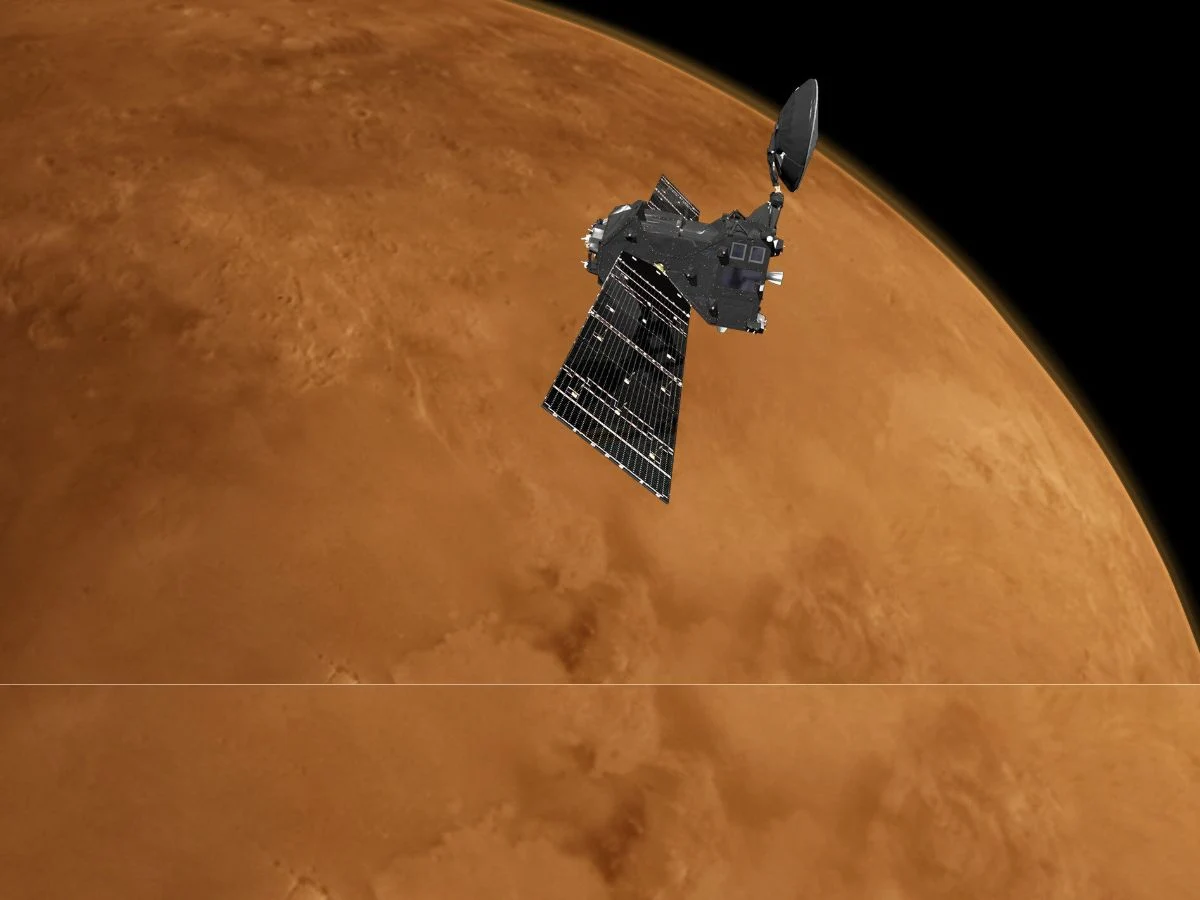
3. The Mars Express and ExoMars Trace Gas Orbiter were active during the storm, providing valuable data on the interaction between solar particles and Mars’ atmosphere.
4. The ionization process on Mars involved solar particles colliding with atmospheric atoms, which is crucial for understanding solar activity’s effects on Mars.
5. The “radio occultation” technique was used to gather data shortly after the solar flare, with support from NASA’s MAVEN mission, aiding future Mars missions and space weather predictions.
A solar storm happens when the Sun unexpectedly releases a lot of energy and particles into space. These powerful eruptions can consist of solar flares, coronal mass ejections (CMEs), and energetic charged particles. In May 2024, the Sun unleashed the largest solar storm in more than 20 years. On Earth, this created amazing auroras. On Mars, however, the situation was different. The absence of a strong magnetic field like Earth’s allowed solar particles to directly heat the Martian atmosphere.
Spacecraft In Action
During the storm, two spacecraft were in orbit around Mars: the Mars Express and the ExoMars Trace Gas Orbiter. The solar storm introduced particles that collided with atmospheric atoms, removing electrons from them and generating ions through a process known as ionization in Mars’ ionosphere. This interaction was significant in understanding the effects of solar activity on the Martian environment.
Innovative Techniques
A technique referred to as “radio occultation” was employed, where radio signals were transmitted from the Mars Express and captured by the ExoMars Trace Gas Orbiter. This method was utilized just ten minutes after the solar flare impacted Mars. Data from NASA’s MAVEN mission helped confirm the findings. Grasping these phenomena is crucial for upcoming Mars missions and predicting space weather effectively.
Source:
Link
Leave a Reply