
Key Takeaways
1. NASA’s InSight lander operated from 2018 to 2022 and focused on detecting seismic waves from marsquakes.
2. InSight recorded a total of 1,319 marsquakes, providing valuable data for understanding Mars’ mantle.
3. A recent study revealed that Mars’ interior is uneven, with specific areas causing seismic waves to slow down and distort.
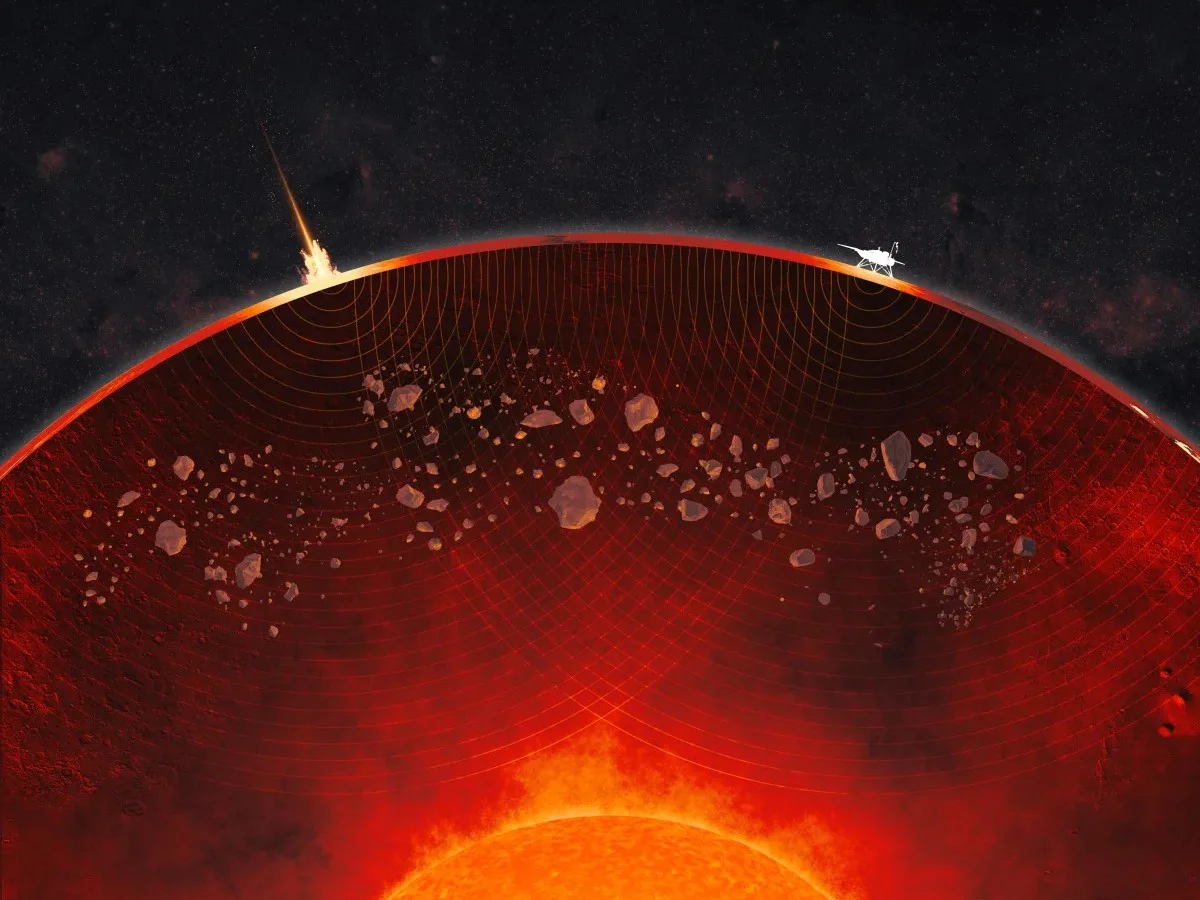
4. The slowdown of seismic waves is linked to lumps of material formed by asteroid impacts approximately 4.5 billion years ago.
5. Mars lacks tectonic plates, allowing these lumps to remain stable over time, similar to conditions on Venus and Mercury.
NASA’s InSight lander was a robotic device that functioned from 2018 to 2022. It was designed to sense seismic waves produced by marsquakes. These waves travel deep into the mantle of the planet. As they move through various materials in the mantle, their speed and shape change.
Findings from Marsquakes
Throughout InSight’s mission, it recorded 1,319 marsquakes. Scientists have been analyzing this data to understand the make-up of Mars’ mantle. A recent study released on August 28 showed that the interior of the red planet is uneven.
Researchers pinpointed eight marsquakes that generated seismic waves with high-frequency energy. As these waves journeyed deep into Mars’ mantle, they slowed down, sending back distorted signals. To investigate this phenomenon, scientists utilized global computer simulations.
The Nature of Mars’ Interior
They found that the slowdown occurred in a small, specific area. More in-depth research indicated that this area is made up of lumps of material. The scientists think these lumps formed from asteroid impacts that took place 4.5 billion years ago. It is widely accepted that during those formative years, asteroids and protoplanets frequently collided with the younger planets.
In contrast to Earth, Mars does not have tectonic plates. This absence means these lumps have remained in place for a very long time. Similarly, Venus and Mercury also do not feature tectonic plates. This research has offered scientists a glimpse into what could exist within those planets’ interiors.
Source:
Link
Leave a Reply