Category: Artificial intelligence

  • Google Unveils Powerful Gemini 2.0 Pro AI Features

    Google Unveils Powerful Gemini 2.0 Pro AI Features

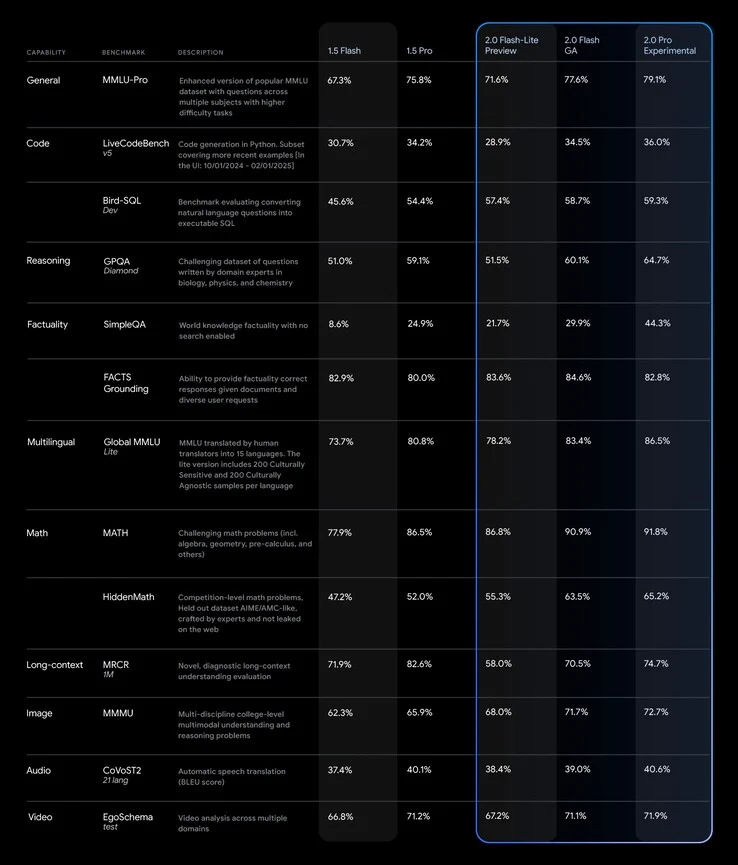
    Google has rolled out access to its latest AI, the Gemini 2.0 Pro experimental model. This new AI features a massive two million token input window, the largest of any Google AI to date, allowing it to manage very large text inputs. Gemini is engineered to tackle complicated prompts with these extensive inputs. Furthermore, Gemini 2.0 Pro has the ability to browse the internet and run code, while also being capable of generating code for applications.

    Performance Compared to Other Models

    In terms of performance, Gemini 2.0 Pro surpasses previous AI models from the company across various standardized large language model benchmarks. Nevertheless, it still hasn’t reached the capabilities of humans or the top-performing AIs in every category evaluated. For instance, on the LiveBench AI LLM benchmark, the experimental scores for Gemini 2.0 Pro are only 65.13, compared to Deepseek R1’s 71.57 and OpenAI’s o3-mini which scored 75.88 in high mode.

    Human Evaluation and Security Measures

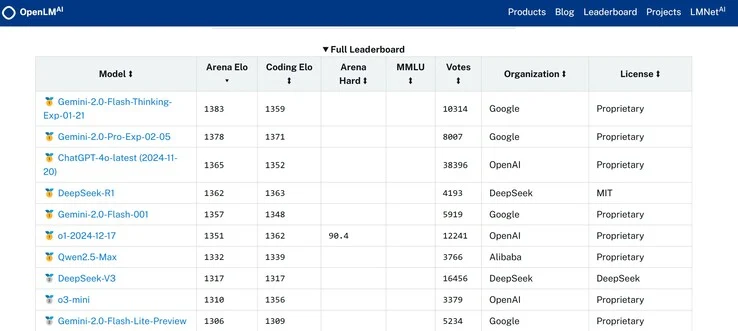
    Even so, when human evaluators assess AI based on their own prompts, Gemini 2.0 Pro stands out as one of the top two AIs globally today, according to the responses it provided on the OpenLM.ai Chatbot Arena Elo ranking. Hackers may find themselves frustrated with Gemini 2.0 Pro, as it utilized self-training methods during development to minimize the chances of producing unsafe responses.

    Subscription and Availability

    Gemini 2.0 Pro is accessible to all users of Google Gemini Advanced who subscribe for $19.99 monthly. It is also available for developers using Google AI Studio and Vertex AI. Users interested in having Gemini at their fingertips can download the Gemini app on their smartphones or buy a Google Pixel 9 Pro smartphone that comes with Gemini integrated (available for purchase on Amazon).

    Source:
    Link


  • Nubia Z70 Ultra to Feature On-Device DeepSeek Technology

    Nubia Z70 Ultra to Feature On-Device DeepSeek Technology

    Samsung has unveiled its newest flagship smartphone, putting a spotlight on fresh and enhanced AI capabilities. In response, Chinese smartphone manufacturers are also stepping up their game in the AI sector, primarily due to the advancements made by China’s DeepSeek. Companies like Huawei, Honor, and Oppo have been reported to be working together with DeepSeek to enhance their AI assistants. Now, Nubia has also revealed its partnership with DeepSeek.

    DeepSeek’s Impact on AI

    DeepSeek not only highlights China’s advancements in AI technology but also represents a major shift in the industry, similar to the impact of OpenAI’s ChatGPT. DeepSeek operates more efficiently (which is crucial since major tech companies were previously constructing nuclear plants to power their AI infrastructures), surpassing OpenAI’s GPT-4o in various benchmarks, and it’s open-source, allowing anyone to access it.

    Nubia’s Plans for DeepSeek

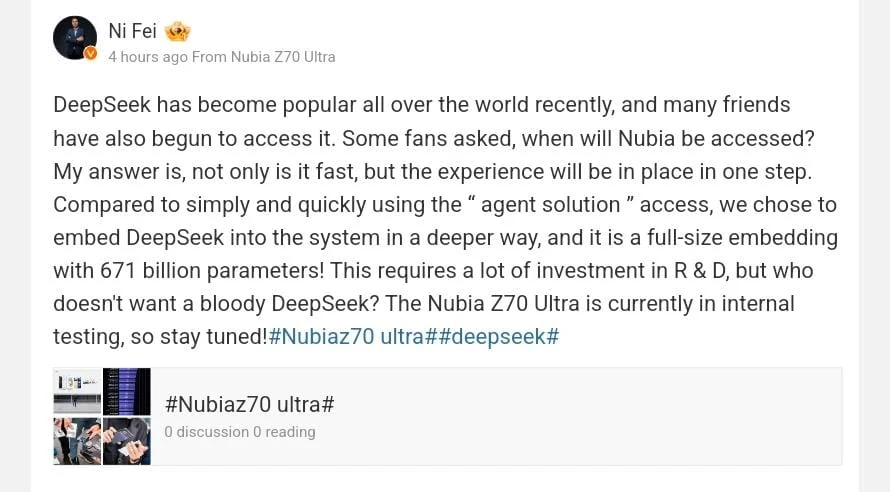
    Nubia’s president, Ni Fei (as reported by ITHome), stated that the firm aims to integrate DeepSeek more thoroughly into its user interface. Nubia has been concentrating on embedding AI within its devices, and this partnership may represent a significant advancement. The president noted that, in contrast to other manufacturers working with DeepSeek, Nubia intends to “deeply embed DeepSeek into the system,” which will reportedly leverage a massive 671 billion parameters.

    The Nubia Z70 Ultra

    It appears the company plans to run this model directly on the device, offering perks like the elimination of internet dependency and enhanced data privacy. The Nubia Z70 Ultra will be the first device to utilize the DeepSeek integration, and development is already underway. This smartphone features the Snapdragon 8 Elite chip, a 6150mAh Si/C battery, and supports rapid 80W charging.

    Source:
    Link


  • Amazon’s $100 Billion AI Investment Plans for 2025

    Amazon’s $100 Billion AI Investment Plans for 2025

    Creating AI systems similar to ChatGPT requires a significant financial commitment, with estimates ranging from hundreds of millions to even billions of dollars spent on their development and training. Despite the high costs, Amazon appears to be ready to invest a staggering amount into AI this year.

    Amazon’s Massive AI Investment

    Recent reports suggest that Amazon is set to allocate a whopping $100 billion towards AI in 2023. This figure contrasts sharply with DeepSeek’s claim of just a few million dollars spent on its R1 model’s training, although the accuracy of that statement is uncertain. The scale of Amazon’s investment indicates its serious commitment to advancing AI technology.

    The Big AI Players

    AI is indeed a lucrative field, with major companies like Google and Microsoft pouring tens of billions into their projects. While many tech giants have embraced AI in recent years, Amazon’s emergence as a top spender raises eyebrows. Some might say it was only a matter of time before the retail giant made such an aggressive move in the AI arena.

    During a recent earnings call, Amazon’s CEO, Andy Jassy, hinted that the company could potentially invest even more than $100 billion in AI by 2025, suggesting exciting developments for Alexa may be on the horizon. Unfortunately, that’s all the information available for now, so stay tuned for updates. In other news, India is also working on its own AI model to rival ChatGPT and DeepSeek, which is currently facing challenges in the global market as some governments view it as a threat from China.

  • Honor Partners with DeepSeek to Enhance AI Assistant Functionality

    Honor Partners with DeepSeek to Enhance AI Assistant Functionality

    It’s been nearly two years, and the AI trend shows no signs of slowing down. OpenAI kicked off this movement with ChatGPT, but now, many others have joined, including Google, Meta, and Claude, among others.

    A New Challenger from China

    The most significant shift in AI since OpenAI’s introduction might be emerging from China. DeepSeek, a newcomer in the field, gained attention last month with its R1 model—an AI focused on reasoning that surpasses GPT-4o in various benchmarks and is also open source.

    DeepSeek-R1 is offered under the MIT license, allowing free use for both commercial and educational purposes. This freedom appears to be making quite an impact already.

    Major Brands Adopting DeepSeek-R1

    Big smartphone manufacturers are reportedly interested in adding DeepSeek-R1 to their AI assistants. Huawei has already embraced this change, and now Honor is set to follow.

    Honor announced that an enhanced version of its in-house assistant, YOYO—currently only available in the Chinese market—will utilize DeepSeek-R1. According to Honor, YOYO has more than 130 million monthly active users. With the integration of DeepSeek-R1, the company promises a significant boost in performance.

    Enhancing User Experience

    Honor is concentrating on improving natural language processing to make YOYO more responsive and context-aware. Logical reasoning and a deeper understanding of context are crucial areas where DeepSeek-R1 is expected to shine.

    Honor aims for its assistant to feel more intuitive, manage complex tasks more effectively, and offer a smarter, personalized experience. Their strategy focuses on providing seamless interaction. Users in China can access the updated YOYO by swiping up from the bottom of their device to the “AI agent” section and choosing “DeepSeek-R1.”

    The rollout begins on February 8th and will be available for Honor smartphone users in China with MagicOS 8.0 or later. Additionally, to enable the DeepSeek-powered upgrade, users must update the YOYO app to version 80.0.1.503 or higher. Currently, this upgrade is exclusive to China, but it remains unclear if Honor plans to expand to international markets.

    Source:
    Link


  • Chinese EV Makers Integrate DeepSeek for Enhanced Technology

    Chinese EV Makers Integrate DeepSeek for Enhanced Technology

    Chinese electric vehicle manufacturers Geely and Voyah are set to include DeepSeek AI in their automobiles. Geely, which owns well-known brands such as Volvo, Polestar, and Zeekr, is developing its own AI system called “Full-Domain AI for Smart Vehicles.” This system is expected to significantly enhance the driving experience by providing features like voice commands and complete autonomous driving capabilities. Additionally, this AI model will support ongoing product research and development efforts.

    Geely’s Vision for AI

    Geely aims to create an AI that is warm, empathetic, and ever-evolving. To achieve this, the company has partnered with DeepSeek to help train and improve its internal AI model. The datasets from DeepSeek will be incorporated into Geely’s system through distillation training, which will be essential for the next generation of connected vehicles.

    Voyah’s Commitment to Innovation

    Another Chinese electric vehicle company, Voyah, which is part of Dongfeng Motors, has also revealed plans to integrate DeepSeek into its Courage (known as Zhiyin in its local market) EV crossover and Dream MPV. As a result, these two models will be the first vehicles available with DeepSeek technology.

    According to reports from Chinese media, the Courage EV will receive the DeepSeek update via an over-the-air software upgrade on February 14. Voyah claims that DeepSeek will enhance its existing AI by making it more responsive, precise, and scalable. Eventually, this update will enable capabilities like writing poems, painting, conversing, and real-time information retrieval.

    Broader Adoption Across the Industry

    Other electric vehicle manufacturers in China have also expressed interest in adopting the DeepSeek model. The CEO of Xpeng reportedly informed his staff that this cost-effective AI solution could create new possibilities for the company.

    Source:
    Link

  • World Bans DeepSeek: Is Chinese AI a Global Threat?

    World Bans DeepSeek: Is Chinese AI a Global Threat?

    Several nations have begun taking steps against DeepSeek, a Chinese AI platform, due to worries about national security, data privacy, and its potential connections to the Chinese government. Officials are concerned that DeepSeek may represent a security threat because of its origins and the risk of data being shared with Chinese state organizations.

    National Security and Privacy Concerns

    DeepSeek has faced bans in numerous countries, mainly driven by security and privacy issues. Authorities are anxious that the Chinese government might access user information gathered by DeepSeek under China’s National Intelligence Law. There are significant worries regarding the platform’s unclear methods of managing user data, which heightens fears of data leaks or unauthorized sharing of information.

    Countries That Have Banned DeepSeek

    Australia
    Australia has imposed a ban on DeepSeek for all government devices due to national security threats. The Department of Home Affairs has instructed all government bodies to eliminate DeepSeek, with Home Affairs Minister Tony Burke stressing that this ban is intended to safeguard Australia’s national interests.

    South Korea
    In South Korea, the use of DeepSeek has been prohibited on devices used by government employees across various ministries and state-run organizations due to concerns about security and privacy. Several agencies, including Korea Hydro & Nuclear Power, have blocked AI services such as DeepSeek, while the country’s Personal Information Protection Commission is looking into how DeepSeek handles user data.

    Italy
    Italy has also moved to limit DeepSeek, especially concerning the management of data related to Italian users. The Italian Data Protection Authority (Garante) imposed certain restrictions and requested information regarding DeepSeek’s data policies, highlighting a lack of clarity in its data management practices.

    Taiwan
    Taiwan has decided to ban DeepSeek from all governmental departments due to national security worries and has blocked it from all governmental networks.

    United States is Considering a Ban
    The United States has yet to enforce a ban on DeepSeek but is contemplating restricting its use. NASA has already prohibited DeepSeek from its systems, and the U.S. Navy has advised personnel against using this AI service. Additionally, U.S. lawmakers are in the process of drafting a bill to prohibit DeepSeek on government-owned devices due to security apprehensions.

    What Data Does DeepSeek Collect?

    As per its privacy policy, DeepSeek gathers personal data such as email addresses, phone numbers, passwords, and birth dates. It also saves chat logs, which include user interactions with the chatbot. The platform collects technical data like IP addresses, keystroke patterns, and operating system information. Data is shared with service providers and advertising partners, raising alarms about how long this information is kept and who has access to it.

    DeepSeek’s Data Practices Compared to Other AI Platforms

    DeepSeek’s data collection methods are not particularly distinct. Other AI platforms, such as OpenAI’s ChatGPT, also collect user data. Nevertheless, OpenAI adheres to stricter data protection laws in areas like the EU. Western governments feel that OpenAI can be regulated, while they view Chinese platforms like DeepSeek as direct threats to security.

    What Lies Ahead for DeepSeek?

    DeepSeek has made waves in the AI sector with its cost-efficient model. While OpenAI’s GPT-4 incurred training expenses exceeding $100 million, DeepSeek’s latest model was developed for under $6 million. Its swift rise in popularity has even led to a 17% decline in Nvidia’s stock price, causing notable changes in global AI investment patterns.

    As more governments assess the risks associated with DeepSeek, there could be further bans in place. Western nations continue to scrutinize the security ramifications of Chinese AI platforms, highlighting apprehensions regarding espionage and unauthorized access to data. The debates surrounding DeepSeek illustrate a larger conflict between AI progress and national security strategies across the globe.

  • OpenAI Enables ChatGPT Searches Without an Account

    OpenAI Enables ChatGPT Searches Without an Account

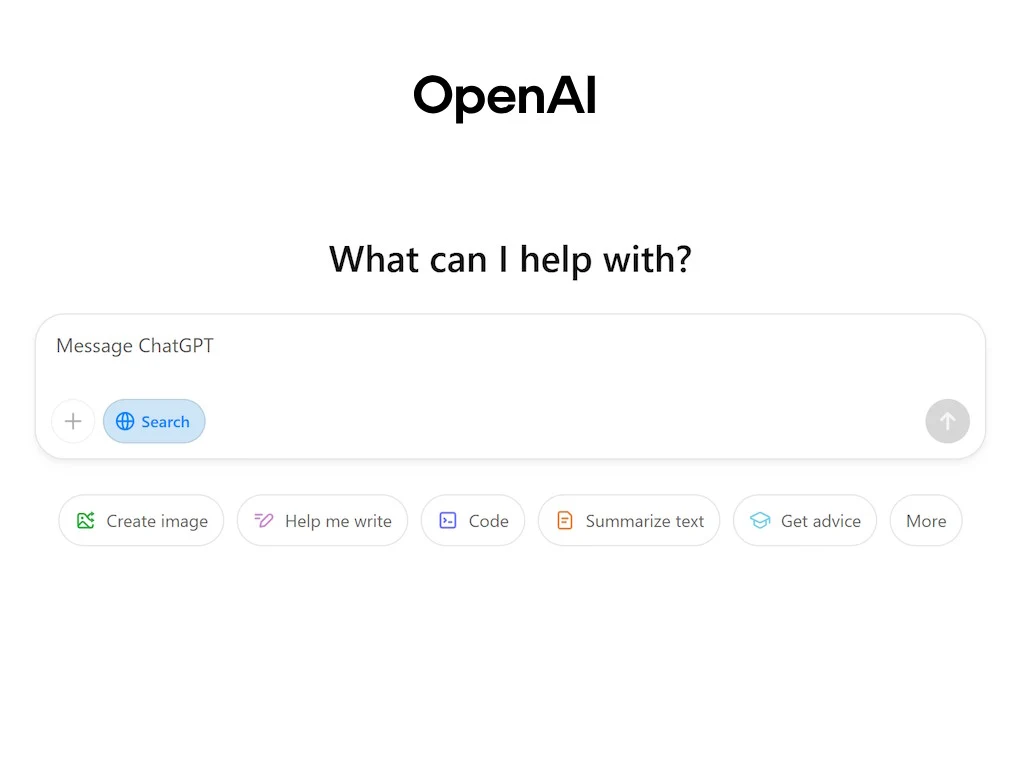
    OpenAI has now made ChatGPT, its large language model chatbot, freely available to everyone without needing to log in. Users can simply bookmark ChatGPT and utilize it to get thoughtful answers to their questions, rather than sifting through a lengthy list of results typically provided by search engines like Google.

    The Evolution of AI Chatbots

    AI chatbots, including those developed by OpenAI, are capable of sifting through vast amounts of information and presenting summaries much like a human would. Some of the most notable chatbots in the market today are OpenAI’s ChatGPT, xAI Grok, Anthropic Claude, Meta AI, Deepseek V3, and Google Gemini. If you’re curious about what ChatGPT can offer, there’s a book available on Amazon detailing its various functionalities.

    The Convenience of No Account Requirement

    A downside of many chatbot services is that they often necessitate users to set up an account and log in. This requirement can make it more cumbersome to use AI for searching, and it also risks exposing personal account details or phone numbers to external parties. By eliminating the need for accounts, OpenAI positions itself as the leading AI search option for users who are privacy-conscious or simply prefer not to go through the hassle of signing up.

    Features Available and Premium Options

    The account-free version of ChatGPT allows users to generate text for essays or emails, engage in simple conversations to get answers or chat, translate languages, solve math problems, and conduct general research for facts. However, to access more advanced features like image generation, coding assistance, and file input, users will need to subscribe to a paid account.

    Source:
    Link


  • California State University Offers Free AI Training to 523K Users

    California State University Offers Free AI Training to 523K Users

    The California State University (CSU) has kicked off a new program aimed at offering free AI training, tools, and certifications to 460,000 students and 63,000 faculty and staff. This initiative also includes apprenticeships in AI-focused industries, all while utilizing AI to enhance research and improve teaching methods.

    Rapid Growth of AI

    The AI sector has seen tremendous growth in recent years, especially after the public launch of ChatGPT 3.5 in 2022, which demonstrated the ability to effectively respond to queries and streamline tasks. Unfortunately, even with substantial investments in AI development, the workforce has not matched the pace of AI adoption. CSU has found that more than half of the professionals in the AI industry are from other countries, highlighting a significant gap in workforce training within the U.S.

    Customized AI Tools for Education

    To address this issue, all 23 CSU campuses will offer free access to ChatGPT for Education. ChatGPT Edu, built on GPT-4o, boasts advanced features like internet browsing, data analysis, and coding capabilities. Each campus and class can develop tailored GPTs to meet their particular needs, such as tutoring students in specific subjects and analyzing research results. This AI can communicate and respond in over 50 different languages.

    Training and Apprenticeship Opportunities

    In addition to AI tools, free training and certifications will be available for using these tools. Faculty and staff will receive similar training to improve their research and teaching practices. Educators interested in effectively integrating ChatGPT into their classrooms can check out a book available on Amazon.

    Students will also gain access to apprenticeship roles at companies utilizing AI before they graduate, making them attractive candidates in the competitive AI job market. CSU highlights that of the top 50 AI firms, 30 are based in California, including giants like OpenAI, Meta, Google, and xAI. For those outside CSU who want to catch up, there’s a book on Amazon that covers the basics of using ChatGPT.

    Commitment to Privacy and Security

    For privacy reasons, CSU will not use its data to train OpenAI models, and there will be no monitoring of conversations. Enterprise-level data protection and encryption will be implemented to ensure that security is upheld.

    CSU news release, CSU AI tools, OpenAI news release, CSU on YouTube

    CSU Unveils Groundbreaking Initiative to Become the Largest AI-Powered University System in the Nation

    Source:
    Link

  • Firefox 135 Introduces AI Features: Discover What’s New

    Firefox 135 Introduces AI Features: Discover What’s New

    Previously, the AI chatbot for Firefox was only available through Firefox Labs, but it is now being introduced to all users, albeit in stages. The latest version, Firefox 135, was launched yesterday and brings AI functionality to Windows, macOS, and Linux platforms. Users can now select from a variety of chatbots, including Claude, Gemini, HuggingChat, Le Chat Mistral, and ChatGPT. While it took Mozilla some time to make this feature available, users now have many options to choose from.

    New Features in Firefox 135

    Alongside the AI chatbot, Firefox 135 introduces an autofill feature for credit card information, improved language support for Firefox Translations—now supporting Simplified Chinese, Japanese, and Korean translations, with Russian added as a new target language. The update also enhances security with certificate transparency enforcement, which impacts only servers with certificates from authorities included in Mozilla’s Root CA Program. Additionally, Linux and macOS users now have the ability to close just the current tab using the Quit keyboard shortcut, even when multiple tabs are open.

    Updates for Mobile Users

    In contrast, Firefox for Android only gets some small bug fixes and quality improvements, along with automatic crash reporting. Users on iOS devices will enjoy a redesigned interface that enhances the pull-to-refresh function, alongside better performance and voice-over support. Navigation has also seen improvements, with minor adjustments such as updated icons and theming corrections.

    Mozilla’s latest release, Firefox 135.0 for desktop, Android, and iOS, brings a range of new features and enhancements.

    Source:
    Link

  • OpenAI ChatGPT Enhances Deep Research for Detailed Answers

    OpenAI ChatGPT Enhances Deep Research for Detailed Answers

    OpenAI has enhanced ChatGPT by introducing advanced research abilities. Now, the AI can search the Internet for necessary information, allowing it to take several steps to find its answers and spend more time working on them. This improvement has led to a significant boost in ChatGPT’s ability to tackle challenging, PhD-level inquiries on the Humanity’s Last Exam AI large language model (LLM) benchmark, effectively doubling its accuracy.

    Live Internet Access

    With the ability to access live online information, ChatGPT can now provide timely and relevant responses. Most AI language models rely on a fixed dataset from their training, meaning they can only respond accurately to questions based on the information they were trained on. However, ChatGPT utilizes a new o3 LLM model that can browse the Internet and perform data analysis, giving it a distinct advantage.

    Multi-Step Thought Process

    The deep research capabilities of ChatGPT mimic human reasoning when answering intricate questions. It can gather essential data required to address various components of a complex prompt, analyze that data, and synthesize the information into a cohesive response. For instance, it might first retrieve data on laptop and desktop sales by brand, then evaluate the information to identify which brands lead in sales for each category.

    Extended Response Times

    Most chatbots are limited in the amount of time they can spend responding to prompts, usually under ten seconds. In contrast, providing a well-researched and detailed answer to a complex question necessitates additional time. ChatGPT can now utilize up to 30 minutes to formulate its responses, allowing for more comprehensive insights.

    Pro users will be the first to experience the new deep research feature, followed by Plus, Team, and Enterprise users. Those who pay for the service in the US will have immediate access, while users in the European Economic Area, Switzerland, and the UK will receive the feature in a gradual rollout. Since deep research is resource-intensive and responses can take up to half an hour, Pro users will start with a limit of 100 queries per month. The current cost for a Pro subscription stands at $200 monthly.

    Source:
    Link