
Key Takeaways
1. Researchers detected an extremely bright fast radio burst (FRB) named RBFLOAT, originating from a spiral galaxy 130 million light-years away in Ursa Major.
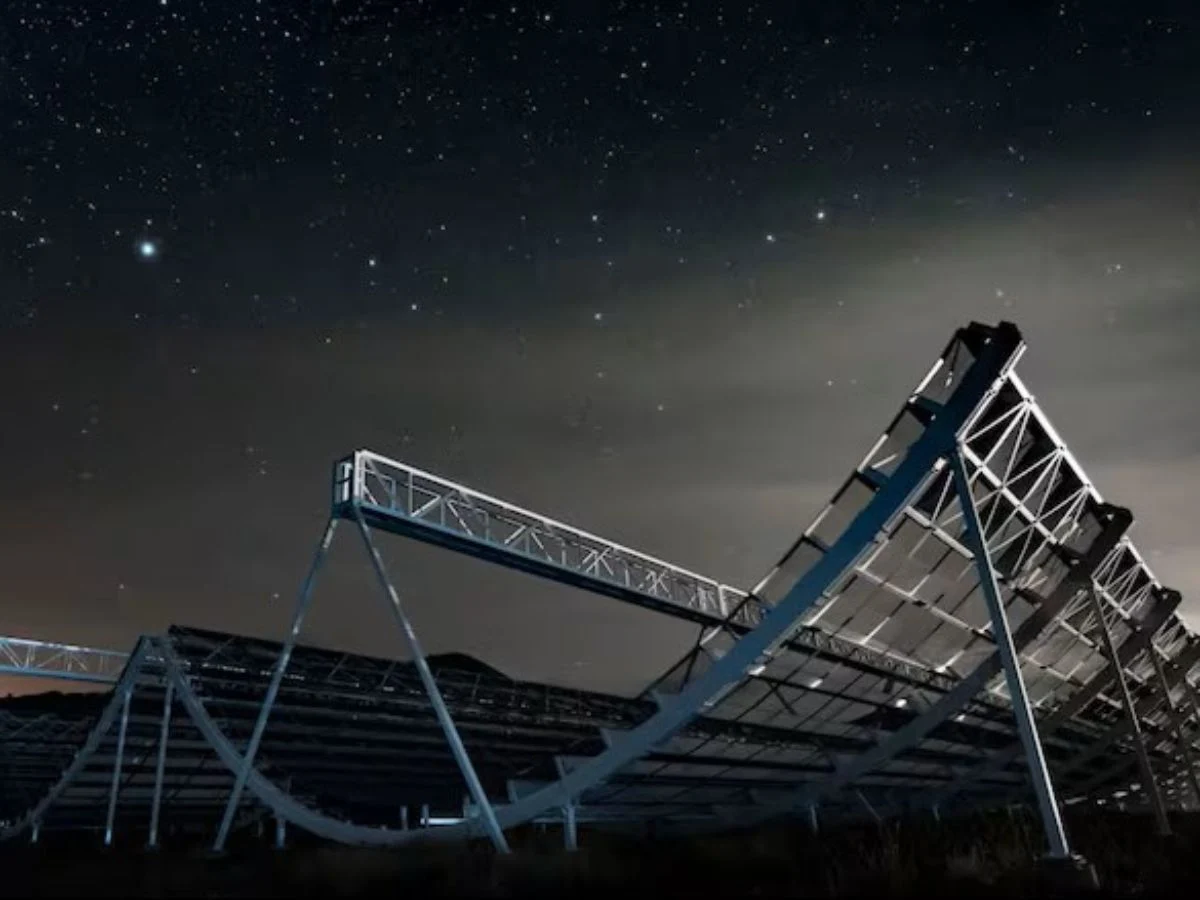
2. The discovery was made using the upgraded Canadian Hydrogen Intensity Mapping Experiment (CHIME) telescope, now enhanced with additional “Outrigger” stations for precise location tracking.
3. The burst was traced to the galaxy NGC 4141, specifically near an active star-forming region, suggesting its source may be an older magnetar.
4. This FRB is likely a unique, one-time event, as no previous bursts from this source were found in six years of archived data.
5. The proximity and brightness of this FRB offer researchers a rare chance to study a non-repeating FRB in detail, improving understanding of the mechanisms behind these powerful energy bursts.
An international group of researchers, which includes physicists from MIT, has discovered an extremely bright fast radio burst (FRB) that came from a spiral galaxy located 130 million light-years away in the constellation Ursa Major. This detection, made on March 16, 2025, is among the closest FRBs ever identified and the brightest one on record, earning the name RBFLOAT (radio brightest flash of all time).
New Technology at Work
The finding, published in the Astrophysical Journal Letters, marks the first use of the recently upgraded Canadian Hydrogen Intensity Mapping Experiment (CHIME) telescope array. With the addition of three “Outrigger” stations spread across North America, the system is now capable of pinpointing the locations of these enigmatic bursts with remarkable accuracy.
Tracing the Source
Thanks to this advanced capability, the researchers were able to trace the burst not only to its host galaxy, NGC 4141, but also to a specific area located on the edge of the galaxy, right outside an active star-forming region. This spot offers clues about its origin. The main theory suggests that FRBs are generated by young, highly magnetic stars known as magnetars, typically found in the centers of star-forming regions. The positioning of this new FRB indicates that its source might be a slightly older magnetar that has had more time to move away from where it was born.
Kiyoshi Masui, an associate professor of physics at MIT, noted, “Cosmically speaking, this fast radio burst is just in our neighborhood. This means we get this chance to study a pretty normal FRB in exquisite detail.”
Unique Opportunity for Research
After reviewing six years of archived data, the scientists discovered no previous bursts from this particular source, indicating that this is likely a “one-off” event and not a repeater. The burst’s closeness and intensity provide researchers with a rare opportunity to examine the environment of a non-repeating FRB, allowing for a better understanding of the forces that drive these massive energy bursts.
Source:
Link
Leave a Reply