
Key Takeaways
1. Low Wind Speed Operation: The new small wind turbines start functioning at wind speeds as low as 2.7 m/s, compared to the typical 4 m/s required by most commercial models.
2. High Efficiency: These turbines achieve an efficiency rate of 53%, nearing the theoretical limit of 59%, and can produce around 2,500 watts at wind speeds of 10 m/s.
3. Lightweight Design: The rotor blades are made from fiber composites with a hollow structure, reducing their weight by up to 35% and enhancing overall performance.
4. Versatile Applications: The compact design makes them ideal for remote locations, disaster relief, and as supplementary energy sources for private homes.
5. Planning Advantages: Most installations do not require planning permission, facilitating easier deployment and supporting the development of decentralized energy solutions.
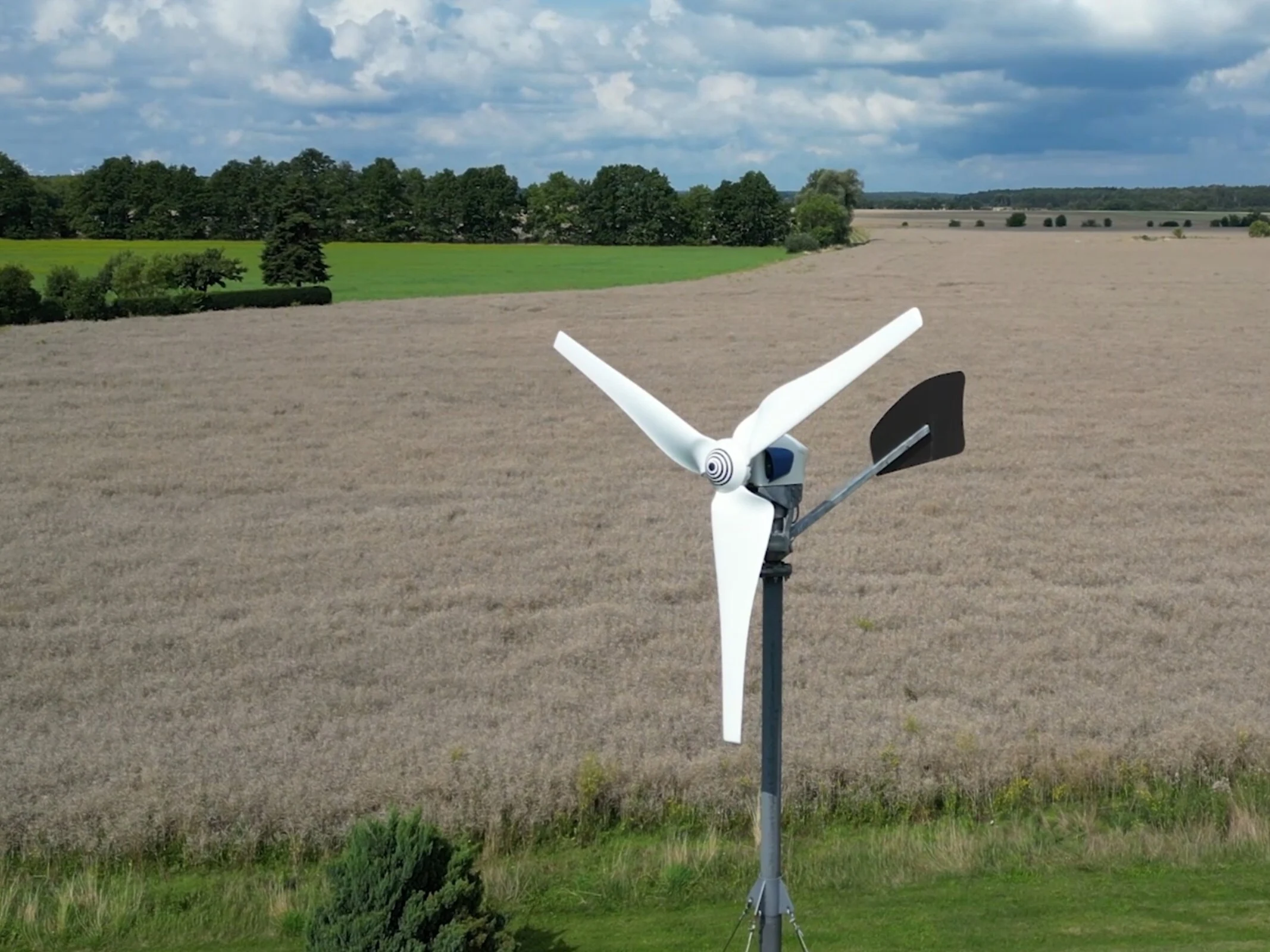
The Fraunhofer Institute for Applied Polymer Research IAP, in collaboration with the Berlin-based BBF Group, has unveiled the first lightweight prototypes of a newly designed small wind turbine. This joint research initiative seeks to create highly efficient turbines tailored for regions with lower wind speeds, thus marking a significant step forward in decentralized energy solutions.
Operating Conditions
The newly designed small wind turbines can start working at wind speeds as low as 2.7 meters per second, which is notably earlier than most commercial models that typically need around 4 m/s. When the wind speed hits 10 m/s, the rotors can achieve up to 450 revolutions per minute and produce around 2,500 watts of power. Impressively, their noise level is just 40 decibels, comparable to the sound of a regular kitchen refrigerator. The turbines operate at an efficiency rate of 53%, which is quite close to the theoretical limit of 59%.
Innovative Design
One of the main reasons for the high efficiency is the rotor blades’ lightweight design, crafted from fiber composites that have a hollow structure and no foam core. This innovative design allows researchers to cut blade weight by up to 35%. The manufacturing process involves industrial 3D printing and an automated fiber placement (AFP) system, which guarantees careful layering of the fiber strips, while also minimizing material overlap.
Versatile Applications
The small wind turbines’ compact and lightweight design makes them perfect for a variety of uses. With a starting speed of only 2.7 m/s, they are well-suited for areas with scarce wind, where traditional systems may not be financially feasible. They also serve as a promising supplementary energy source for private homes.
These lightweight turbines are especially ideal for remote locations lacking reliable grid access, such as mountain cabins, research stations, or island communities. Their compact nature also makes them a viable and sustainable energy option for disaster relief and mobile operations, supplying electricity to field labs and emergency shelters.
Planning Advantages
Fraunhofer notes that one of the principal benefits of these new small wind turbines is that they typically don’t need planning permission. In most instances, simply notifying the local building authority before installation is enough. Over time, these prototypes are anticipated to aid in the development of decentralized energy islands that integrate solar power, battery storage, and small wind systems, thus creating a self-sufficient energy supply that can better withstand weather variability and support the local energy transition.
In total, five prototypes have been sent to the BBF Group and will be set up in various locations to evaluate their performance under different conditions and altitudes. However, it is still uncertain when these small wind turbines will move into mass production and be accessible for both private and commercial usage.
Source:
Link

Leave a Reply