
Key Takeaways
1. Google’s Willow processor executes the Quantum Echoes algorithm 13,000 times faster than the fastest classical supercomputers.
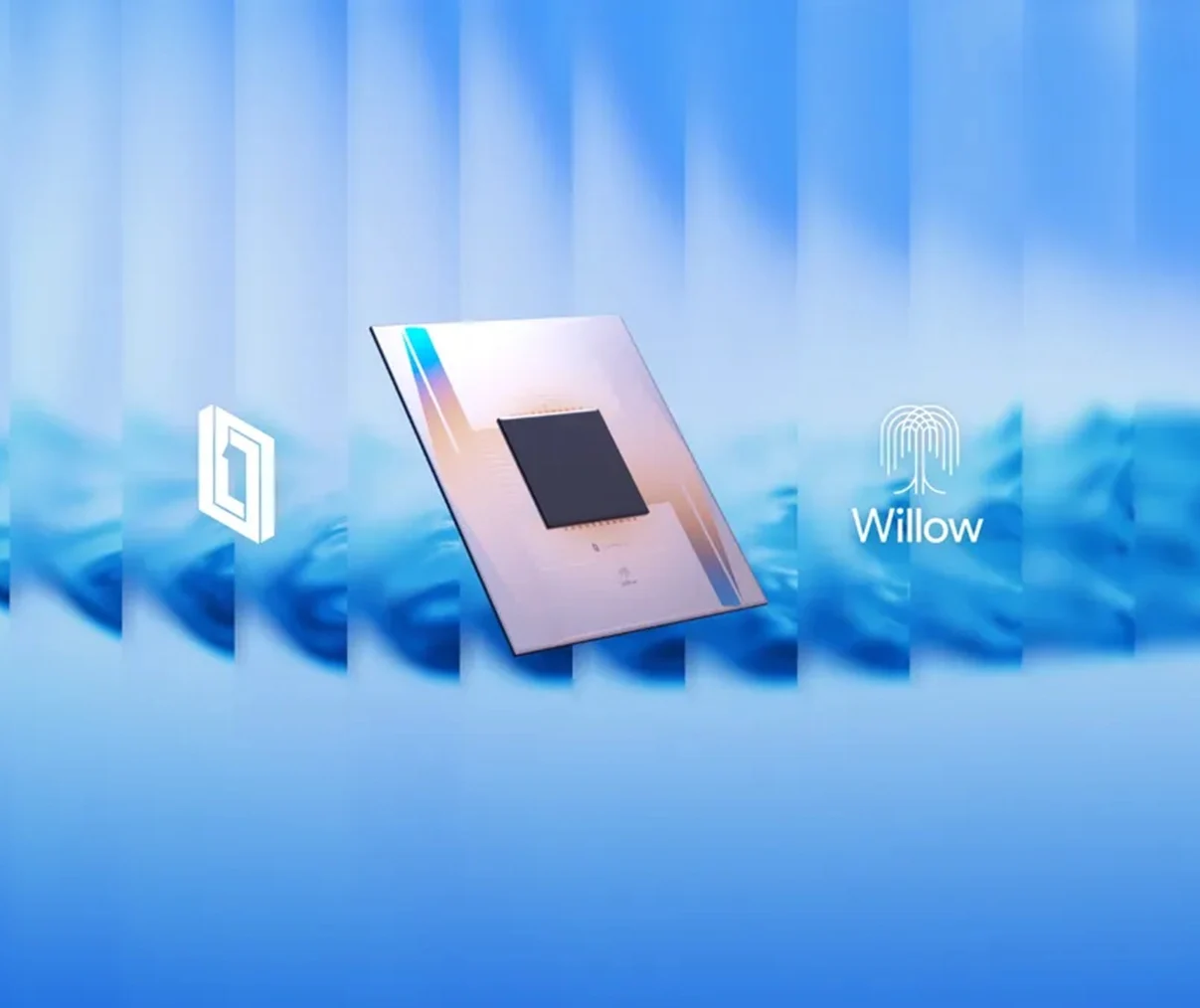
2. The Willow chip utilizes 105 superconducting qubits, allowing for complex computations through superposition and entanglement.
3. Designed to operate at nearly absolute zero, Willow minimizes heat and vibrational interference to maintain stability in quantum states.
4. The reproducibility of results from the Quantum Echoes algorithm confirms quantum superiority and enhances the modeling of molecular behavior.
5. Willow has potential applications in AI development, chemical modeling, and the design of new materials, pushing quantum computing toward practical solutions.
Google has made a significant announcement regarding its advancements in quantum computing. The company’s Willow processor has successfully executed a complex Quantum Echoes algorithm approximately 13,000 times quicker than the fastest classical supercomputers available today.
A New Era of Quantum Computing
Willow marks a distinct progress from Google’s earlier success with the Sycamore chip back in 2019. In contrast to the latter, this new superconducting chip has tangible benefits in real-world applications. It has shown promise in areas such as AI development, chemical modeling, and research into advanced materials, as noted in findings published in Nature.
Understanding the Technology
The Willow chip utilizes 105 superconducting qubits (a qubit is the quantum equivalent of a classical bit, serving as the fundamental unit of information in quantum computing). Each qubit acts like a simulated atom, capable of storing information in superposition or in various states at the same time.
When these qubits become entangled (which is a condition where two or more qubits influence each other regardless of the distance), they can transmit quantum information instantly. This allows the processor to assess numerous solutions at once.
Stability is Key
For quantum systems to function predictably over time, they must maintain stability in their quantum states. Therefore, Google has engineered Willow to work at nearly absolute zero, effectively minimizing heat and vibrational interference.
The design of the chip prioritizes speed and accuracy, with reported single-qubit gate fidelities of 99.97 percent and entangling gates achieving 99.88 percent. Such specifications make Willow exceptionally well-suited for executing large-scale quantum algorithms.
(Gate fidelity refers to how well a quantum gate operates in comparison to its perfect, error-free counterpart. The closer the fidelity is to 100 percent, the more accurately it functions as intended.)
Verifiability and Practical Application
The Willow project stands out primarily due to its verifiability. By validating the results of the Quantum Echoes algorithm across various machines or lab conditions, Google has fulfilled crucial criteria for asserting quantum superiority.
The Quantum Echoes algorithm allows scientists to model molecular behavior, chemical bonds, and electronic structures with greater precision than classical simulations. The chip drove a supercomputer that completed the algorithm, yielding results in one-thirteenth-thousandth of the time required by a classical supercomputer.
As Google researcher Tom O’Brien pointed out, the reproducibility of Willow distinguishes true breakthroughs from theoretical ones. He remarked, “If we can’t prove the data is correct, we can’t do anything with it.”
Insights from the Experts
Another key figure in the project, Nobel laureate Michel H. Devoret, who served as the lead physicist, stated, “We demonstrated that electrical circuits can mimic atoms. Now we are revealing what these artificial atoms are capable of.”
The Willow superconductor chip has the potential to significantly decrease the time needed for scientists to simulate biological systems. Additionally, it could tackle scenarios where classical computing struggles to produce accurate data.
Google’s processor is also applicable in the design of new materials and in training data-efficient AI systems. If further confirmed, the Willow breakthrough might bring quantum computation closer to practical and scalable solutions for industrial challenges.


