
Key Takeaways
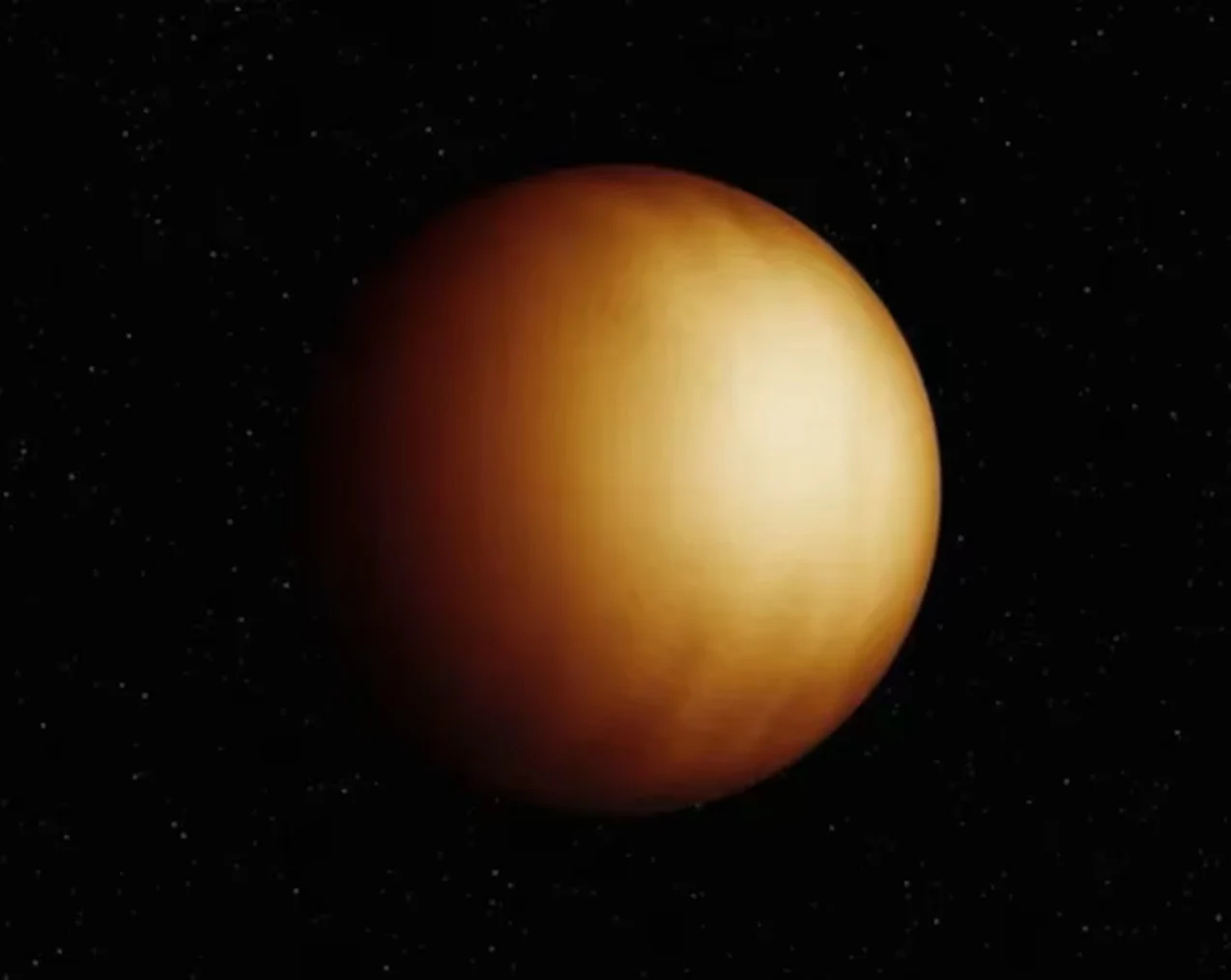
1. The James Webb Space Telescope (JWST) has produced the first 3D thermal map of the exoplanet WASP-18b, located 400 light-years away.
2. WASP-18b is an ultra-hot Jupiter, with extreme temperature differences between its sunlit and dark sides.
3. The JWST used a technique called spectroscopic eclipse mapping to analyze the planet’s atmosphere during its transit behind its star.
4. The mapping revealed a hot central area on WASP-18b reaching temperatures close to 2,760 °C (5,000 °F) and signs of water vapor loss.
5. This groundbreaking study marks the first 3D mapping of an exoplanet’s atmosphere, enhancing our understanding of heat distribution on distant planets.
The James Webb Space Telescope (JWST) continues to amaze with its remarkable contributions. Recently, NASA has unveiled the very first 3D thermal map of an exoplanet located beyond our solar system, specifically the WASP-18b, which is situated 400 light-years away from Earth.
Characteristics of WASP-18b
WASP-18b is classified as an ultra-hot Jupiter, a type of exoplanet that has one side constantly exposed to its star. This situation leads to extreme temperature differences between the illuminated side and the dark side, resulting in conditions that are quite unique.
With the advanced infrared features of the JWST, scientists can now delve deeper into the study of such tidal planets.
The Mapping Process
The JWST employed its Near-Infrared Imager and Slitless Spectrograph (NIRISS) to carry out a technique called spectroscopic eclipse mapping. This method allowed researchers to observe drops in infrared light across various wavelengths while the WASP-18b exoplanet completely passed behind the star it orbits in a span of 24 hours.
By analyzing different wavelengths, which penetrated distinct layers of WASP-18b’s atmosphere, the JWST was able to create a comprehensive 3D model of the planet’s temperature and composition.
This approach proves advantageous for studying exoplanets that cannot be directly seen, as they are often outshone by their parent stars.
New Discoveries
From the 3D mapping, astronomers found that the exoplanet has an extremely hot central area on the sunlit side, reaching temperatures close to 2,760 °C (5,000 °F). Surrounding this hot spot is a cooler region that still has the potential to vaporize metals.
One of the most intriguing findings is that the hotter area shows signs of a significant loss of water vapor. This observation has led scientists to speculate that WASP-18b is breaking down water molecules, a phenomenon that has not been extensively studied before.
These groundbreaking results mark the first instance of mapping an exoplanet’s atmosphere in 3D. This advances our understanding of heat distribution on distant planets. The techniques developed here will be applied to explore other exoplanets in the future.
Nature.
Source:
Link