
Key Takeaways
1. Dolphin is the top emulator for Nintendo GameCube and Wii, continuously improving as an open-source project.
2. Software emulation often suffers from input latency issues, particularly on Android devices and other platforms.
3. Recent advancements in Dolphin have reduced input lag significantly, achieving as low as 37 milliseconds with new features.
4. External experts contributed to Dolphin’s improvements, specifically for games like Super Smash Bros. Melee.
5. Future updates aim to enhance performance further, including RetroAchievements support for Dolphin on Android devices.
Dolphin is recognized as the top emulator for Nintendo GameCube and Wii, but being an open-source project means there’s always potential for enhancements and new features. Recently, significant advancements have come, especially for those who appreciate CRT monitors and the low latency of the original Nintendo systems.
Input Latency Issues
For those who may not know, one of the main drawbacks of software emulation is the higher input latency when compared to actual hardware. This issue is particularly noticeable on Android devices and inexpensive emulators, but it also affects PCs and even legitimate emulation options. Notably, the Nintendo Switch 2’s GameCube emulation service for Nintendo Switch Online has a latency issue that surpasses Dolphin’s performance before this latest update. Although an update earlier this month improved that latency, it is still lagging behind the original hardware.
Dolphin’s Breakthrough
Dolphin, however, has made a significant leap. Some might say that Dolphin and other software emulators already made a breakthrough long ago, as games such as Super Mario Sunshine and The Legend of Zelda: Breath of the Wild received transformative mods that allowed for 60 FPS gameplay, well ahead of the official Switch and Switch 2 versions. But that’s a bit unfair—doubling the framerate naturally decreases input lag. Even with the intended 30 FPS limit, those games were less responsive than on original systems.
Exciting New Features
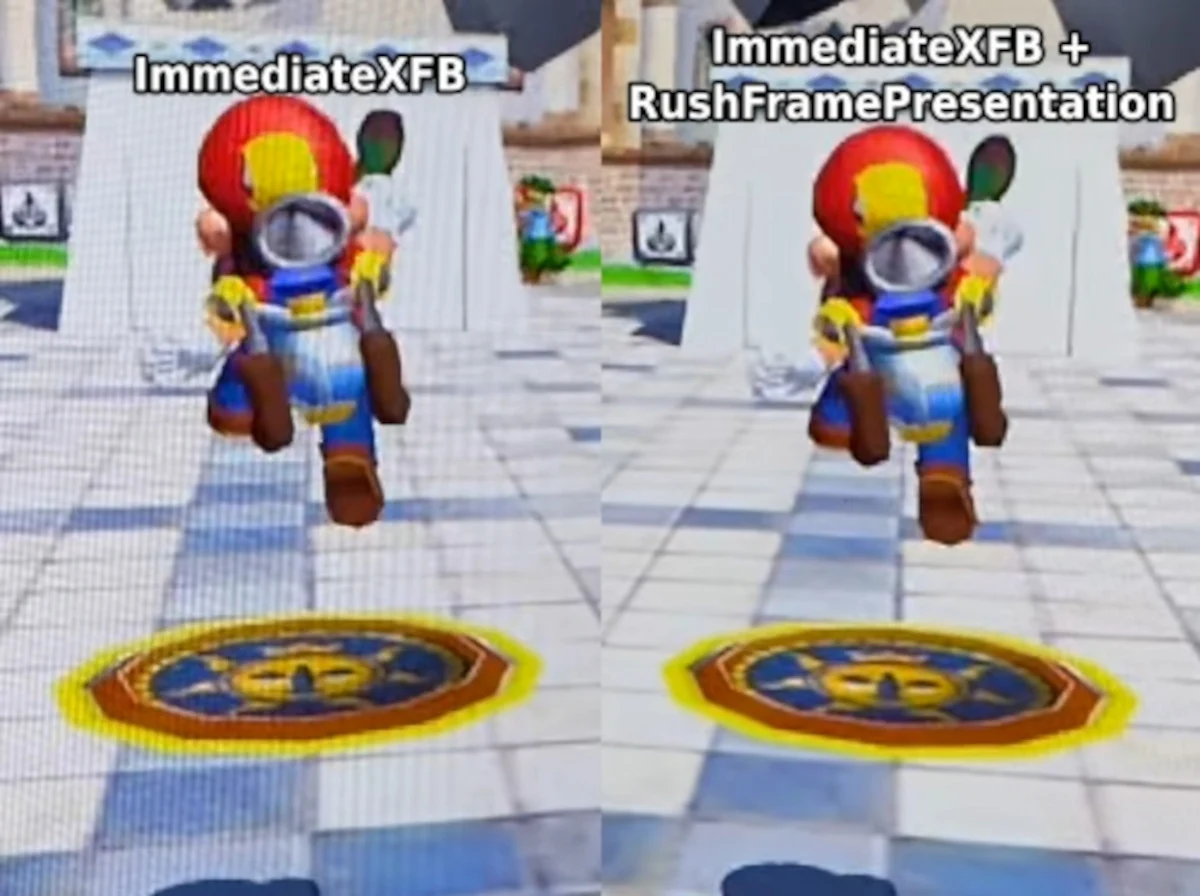
Until now, that is. The developers of Dolphin sought advice from two external experts—Fizzi from Slippi.gg and Arte, who created a GameCube controller adapter featuring a photon sensor—to achieve the benchmarks mentioned. When played on a CRT TV, Super Smash Bros. Melee had an expected input lag of 62 milliseconds. Yet, with Dolphin’s new default settings on a 144 Hz monitor (still at 60 FPS in Melee), the lag was even lower, at 56 milliseconds. The new “Rush Frame Presentation” feature has pushed that down even further to 53.3 milliseconds. Furthermore, the “Immediately Prevent XFB” feature achieved an impressive 37 milliseconds, although it might lead to serious graphical glitches in some games.
For those not familiar with Slippi, you might be curious how “Slippi Melee Hacks” manages to achieve such low input lag. It’s not exactly a fair comparison, as it’s a modified version of both Dolphin and Super Smash Bros. Melee designed for online play, but it serves as a valuable reference point for faster-than-native software emulation.
Future Updates
The complete Dolphin December 2025 progress update blog post reveals more intriguing enhancements, including the addition of RetroAchievements support for Dolphin on Android. It is hoped that these latency improvements will also be implemented in the Android version of Dolphin, as this would greatly enhance performance on devices like the Ayaneo Pocket Vert and other handhelds focused on software emulation.
Dolphin Progress Report, Slippi
Source:
Link