Tag: smartphone display

  • Google Pixel 10 Series Leak: Major Display Upgrades Before Launch

    Google Pixel 10 Series Leak: Major Display Upgrades Before Launch

    Key Takeaways

    1. Google acknowledges discomfort issues like headaches and eyestrain related to Pixel smartphones, particularly with the Pixel 9’s 120 Hz pulse-width modulation (PWM).
    2. The upcoming Pixel 10 series is expected to feature consistent 240 Hz PWM across all brightness settings, but it may still not be competitive.
    3. The Pixel 10 Pro and Pixel 10 Pro XL may reach 480 Hz PWM with brightness adjustments, improving their standing against competitors like the Galaxy S25 and iPhone 16.
    4. All Pixel 10 models will have at least a 200 nits increase in brightness compared to Pixel 9 models, enhancing display quality.
    5. The Pixel 10 Pro Fold is expected to achieve up to 1,850 nits on its main display and 2,050 nits on its foldable screen, with a release set for August.


    It’s well-known that Google knows its Pixel smartphones can lead to discomfort like headaches and eyestrain for some users. For instance, the basic Pixel 9 (currently priced at $589 for refurbished models on Amazon) shows pulse-width modulation at a mere 120 Hz. In contrast, the Pixel 9 Pro Fold, Pixel 9 Pro, and Pixel 9 Pro XL have improved this to 240 Hz, yet they still lag behind rivals like Apple, OnePlus, Xiaomi, and Samsung, among other Android manufacturers.

    Upcoming Improvements

    Earlier this year, we mentioned that Google promised enhancements for Pixel fans with the upcoming Pixel 10 series. Sadly, the company hasn’t provided any detailed information on this. As reported by Android Authority, it has been revealed that the Pixel 10 and Pixel 10 Pro Fold will feature a consistent 240 Hz across all brightness settings, which still isn’t very competitive and could lead to headaches.

    Comparing with Competitors

    On the other hand, the Pixel 10 Pro and Pixel 10 Pro XL are expected to reach 480 Hz when adjusting brightness, aligning them more closely with the Galaxy S25 and iPhone 16 series. To put things into perspective, recent high-end devices from Honor, such as the Magic7 Pro, have PWM dimming values of 4,320 Hz, which should significantly reduce any health concerns tied to flickering screens.

    Brightness Enhancements

    According to Android Authority, every Pixel 10 model will enjoy at least a 200 nits increase in brightness compared to their Pixel 9 counterparts. Specifically, the Pixel 10 Pro Fold is anticipated to achieve up to 1,850 nits on its main display and 2,050 nits when utilizing its foldable screen in bright conditions. Meanwhile, the Pixel 10 will reach 2,000 nits, while the Pixel 10 Pro and Pixel Pro XL will offer 2,250 nits. Presently, Google is set to release the Pixel 10 series in August.

    Source:
    Link


  • iQOO Z10 Turbo Series Display Specs Unveiled Before Launch

    iQOO Z10 Turbo Series Display Specs Unveiled Before Launch

    Key Takeaways

    1. iQOO is launching the Z10 Turbo and Z10 Turbo Pro in China on April 28, featuring a 6.78-inch flat OLED LTPS display with 1.5K resolution.
    2. Both models will have a TCL Huaxing C9+ display with a 144Hz refresh rate and a 3000Hz touch sampling rate, achieving peak brightness of 2000 nits.
    3. The Z10 Turbo Pro will have a 7,000mAh battery with 120W fast charging, while the Z10 Turbo will feature a 7,620mAh battery with 90W charging.
    4. The Z10 Turbo will use the Dimensity 8400 chipset, and the Z10 Turbo Pro will be powered by the Snapdragon 8s Gen 4 processor.
    5. Camera specifications include a dual-camera system with a 50MP and 2MP sensor for the standard model, and a 50MP and 8MP sensor for the Pro variant.


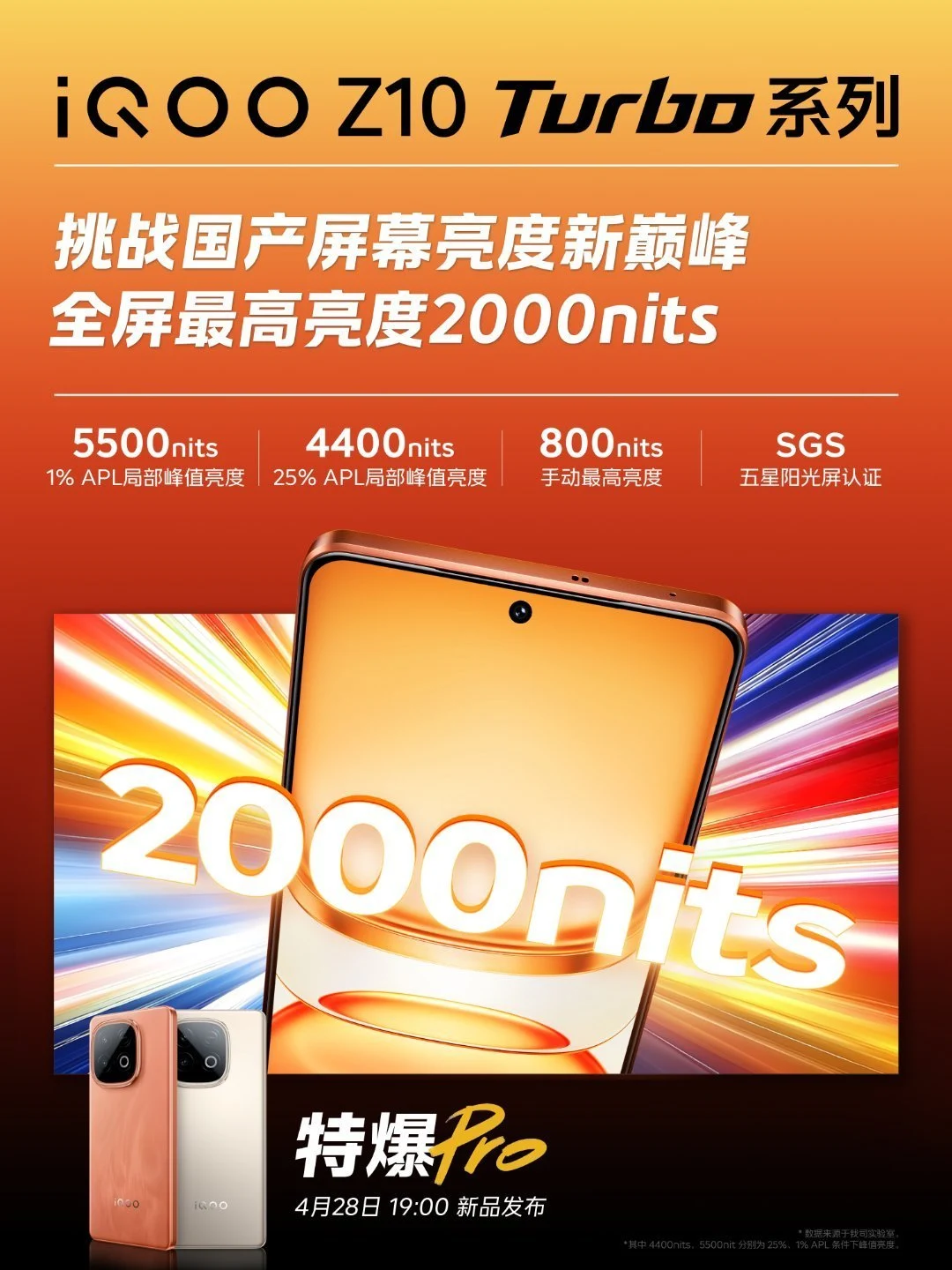
    iQOO is gearing up to launch the Z10 Turbo and Z10 Turbo Pro in China on April 28. Before the official reveal, the company has disclosed various important aspects, such as design, chipset, battery size, and charging features. Rumors indicate that both models will be equipped with a 6.78-inch flat OLED LTPS display boasting a 1.5K resolution. To create buzz for the upcoming event, iQOO has released a series of promotional posters confirming these display specifics, heightening anticipation for the official announcement.

    Display Features of the iQOO Z10 Turbo Series

    iQOO states that the Z10 Turbo lineup will incorporate a TCL Huaxing C9+ flat OLED display, which will offer a fluid 144Hz refresh rate and a remarkable 3000Hz instantaneous touch sampling rate. The display can achieve a peak brightness of 2000 nits, with local peak brightness reaching up to 5500 nits at a 1% APL (average picture level) and 4400 nits at 25% APL. To enhance visual performance, the screen will include global DC dimming along with ultra-high frequency PWM dimming at 4320Hz. Furthermore, the Z10 Turbo series will come with a premium temperature sensor and has obtained the SGS Five-star Sunlight Screen certification.

    Specifications of the iQOO Z10 Turbo Series

    Previously, iQOO confirmed that the Z10 Turbo Pro will sport a substantial 7,000mAh battery that supports 120W rapid charging. Thanks to this large battery, the phone is anticipated to charge from 0 to 100 percent in only 33 minutes, showcasing a notable upgrade compared to its predecessor, the Z9 Turbo. Meanwhile, the Z10 Turbo is set to feature a 7,620mAh battery with 90W fast charging capabilities. The Z10 Turbo will utilize the Dimensity 8400 chipset, whereas the Z10 Turbo Pro will be powered by the latest Snapdragon 8s Gen 4 processor. The standard variant is expected to have a dual-camera system with a 50-megapixel and a 2-megapixel sensor, while the Pro model may offer a dual-camera arrangement of a 50-megapixel and an 8-megapixel sensor.


  • Oppo Find X8s Previewed with Compact Smartphones Comparison

    Oppo Find X8s Previewed with Compact Smartphones Comparison

    Key Takeaways

    1. The Find X8s Plus (X8s+) will have a 6.59-inch display and newer silicon technology.
    2. The standard Find X8s will feature a new compact display, making it the first of its kind in the series.
    3. The Find X8s is positioned between the Xiaomi 15 and Vivo X200 Pro Mini, with a screen size of 6.32 inches.
    4. The X8s is expected to have industry-leading thin bezels measuring only 1.25 millimeters.
    5. The Find X8s is projected to launch on April 10, 2025, with potential rebranding as the OnePlus 13T.


    The Find X8s Plus, also known as the X8s+, is expected to come with a display size of 6.59 inches, similar to the X8, but it will be equipped with newer silicon technology in its case.

    New Display for the Non-Plus Model

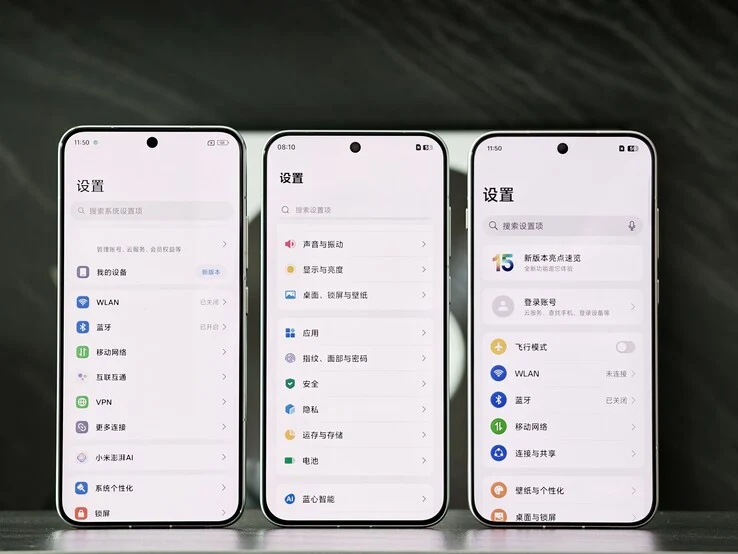
    On the other hand, Oppo has created an entirely new display for the standard X8s, which is set to be the first compact version in its series. Leaks suggest that this device has been showcasing its new front panel in various settings prior to its official announcement.

    Size Comparisons with Competitors

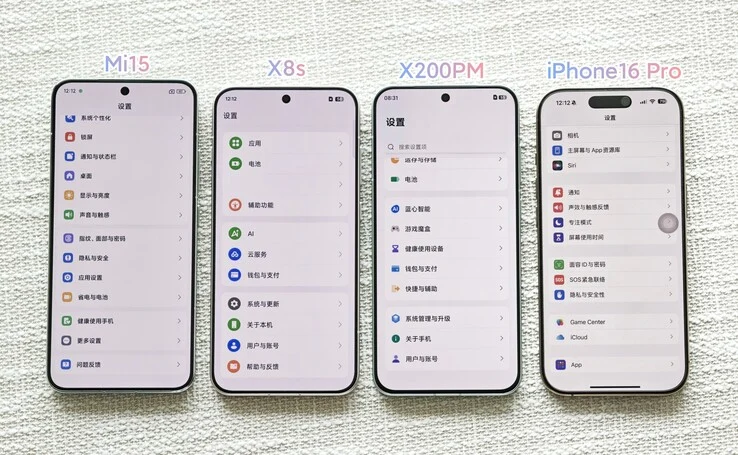
    Reports indicate that the Find X8s has come to light in leaks, positioned between the Xiaomi 15 and the Vivo X200 Pro Mini. It appears to be slightly smaller than the Xiaomi model but larger than the Vivo. The screen size of the X8s is said to be 6.32 inches diagonally, which is a bit smaller than the 6.36 inches of the Xiaomi flagship and slightly larger than the 6.31 inches of the Vivo model.

    Industry-Leading Bezels and Launch Date

    Newly surfaced images seem to back up claims that the X8s will feature some of the thinnest bezels in the market, measuring just 1.25 millimeters in depth. This has even led to comparisons with the iPhone 16 Pro. The Find X8s, along with its innovative display, is projected to be unveiled on April 10, 2025, and there’s a chance it might be rebranded as the OnePlus 13T later on.

    Source:
    Link