
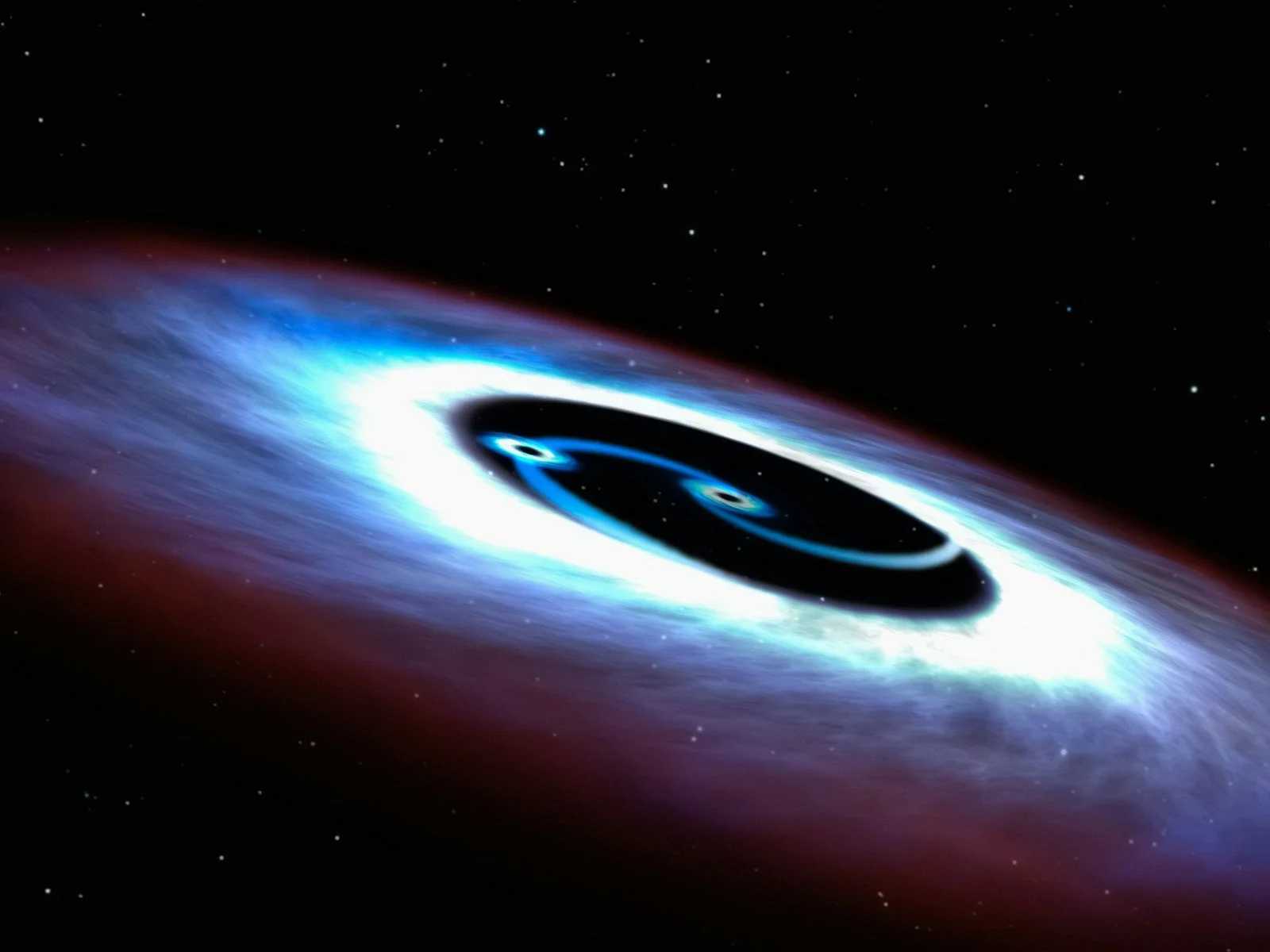
– Black hole winds in quasar J2318 reach 30% of light speed (201.2 million mph).
– Quasar J2318 is 3 billion light-years away with a mass of 1.7 billion Suns.
– The wind speed is equivalent to a “Category 79 hurricane” — vastly beyond Earthly storms.
– Winds consist of high-speed matter, not atmospheric air.
– Discovery used Sloan Digital Sky Survey data, improving understanding of black holes.
Mysterious cosmic winds break records
In the universe, many objects remain mysterious and poorly understood by astronomers, such as black holes. But recently, astronomers have discovered a black hole with winds reaching up to 30% of the speed of light, or about 201.2 million miles per hour. This finding realy challanges our understanding of extreme physics.
The quasar J2318 and its supermassive black hole
These winds were detected in a quasar, which is a bright core of a galaxy fed by a supermassive black hole. Thus, this quasar, named J2318, is located about 3 billion light-years from Earth, and according to astronomers, its mass is estimated to be about 1.7 billion times that of the Sun. That is an absolutly colossal size.
Category 79 hurricane? Not quite
However, while its mass is already remarkable, the speed of its winds is also impressive, as Lucas Seaton explains: “In terms of its speed, this quasar’s wind could be called a category 79 hurricane. Every category of hurricane is about 20% faster than the category below it. Calling it Category 79 gives an idea of just how fast it is, but of course this wind is unlike anything on Earth.”
Indeed, these are not winds like those found on Earth, as they are composed of matter propelled at high speeds. And that’s not all, because in order to detect this phenomenon, astronomers used data from the Sloan Digital Sky Survey (SDSS). These measurments required high-precision instruments.
What this means for science
As a result, while this discovery highlights the power of black holes, it also allows researchers to better understand these celestial objects, which remain mysterious and poorly understood. And there is no doubt that further studies will be conducted in the near future. The data continues to inspire awe.