

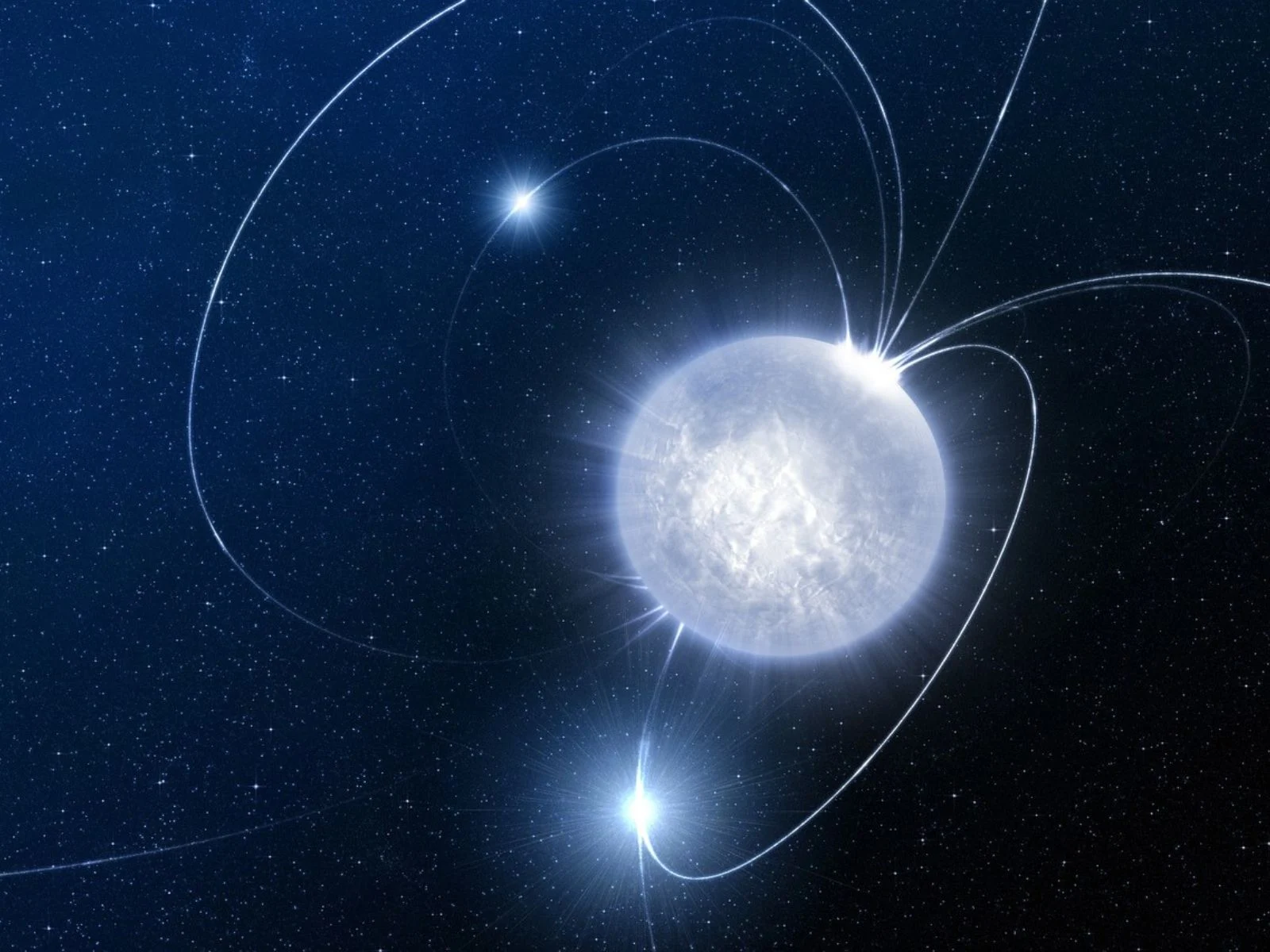
Tag: PSR J1748-2446ad

  • 15 New Pulsars Discovered in Nearby Globular Cluster by Astronomers

    15 New Pulsars Discovered in Nearby Globular Cluster by Astronomers

    Key Takeaway

    – 15 new millisecond pulsars discovered in 47 Tucanae, bringing the total to 42 confirmed pulsars in the cluster.
    – Pulsar spin periods range from 1.88 to 13.03 milliseconds; majority (12) are in binary systems with low-mass companions.
    – The fastest known pulsar overall remains PSR J1748-2446ad, spinning at 716 Hz (716 times per second).


    When using the MeerKAT radio telescope, a team of astronomers has recently uncovered 15 new millisecond pulsars. These celestial bodies sit about 13,000 light-years away from Earth, inside the globular cluster known as 47 Tucanae. The finding adds a notable chapter to the study of dense, rapidly spinning stars in that crowded region of the galaxy.

    Discovery details and context

    Pulsars are neutron stars with a diameter of roughly 20 kilometers and a mass around 1.5 times that of the Sun, which makes them incredibly dense and fast rotators. Led by Weiwei Chen from the Max Planck Institute for Radio Astronomy (MPIfR) in Bonn, Germany, the team announced the identification of 15 millisecond pulsars, sometimes referred to as MSPs. These MSPs boast spin periods that span from 1.88 to 13.03 milliseconds, marking them as some of the most rapidly spinning stellar remnants known.

    Binary and isolated pulsars

    Among the newly found pulsars, 12 are in binary systems with low-mass companions, while the rest are isolated. This mix helps researchers explore how interactions in dense cluster environments affect pulsar formation and evolution. The discovery therefore enhances the census of 47 Tucanae, bringing the total confirmed pulsars in this cluster to 42. Further observations are needed to deepen understanding and potentially uncover more similar objects in the future.

    Comparison and notable milestones

    Even with these exciting finds, the fastest pulsar ever detected remains PSR J1748-2446ad, which lies about 18,000 light-years away and spins at an extraordinary 716 times per second. This record-setting object underscores the extreme physics at work in millisecond pulsars and the capacity of modern radio telescopes to probe such rapid rotations. The new MSPs from 47 Tucanae add valuable data points for models of neutron star spin evolution and cluster dynamics.

    • Spin periods: 1.88 to 13.03 milliseconds
    • Binary status: 12 binary pulsars, rest isolated
    • Total known pulsars in 47 Tucanae after discovery: 42

    Sources

  • Pulsar Spins 122 Times Per Second at Milky Way’s Core

    Pulsar Spins 122 Times Per Second at Milky Way’s Core

    Key Takeaways

    1. Researchers are still uncovering secrets about the Milky Way, despite extensive exploration.
    2. The first image of the Milky Way’s supermassive black hole, Sagittarius A, was captured in 2022.
    3. Pulsars are rapidly rotating neutron stars, with PSR J1748-2446ad being the fastest known, spinning 716 times per second.
    4. The Breakthrough Listen project found a pulsar candidate that rotates 122 times per second, but only one candidate was identified, surprising researchers.
    5. Further observations with advanced telescopes are needed to confirm the existence of the newly discovered pulsar and enhance our understanding of the galaxy.


    Although researchers have been exploring the Milky Way for a long time, many aspects of our galaxy still hold secrets. In 2022, astronomers succeeded in capturing the first image of its supermassive black hole called Sagittarius A. Nearby, a pulsar with a very strong magnetic field could be found.

    What are Pulsars?

    Pulsars are neutron stars that rotate at incredibly high speeds. A notable example is PSR J1748-2446ad, which is situated around 18,000 light-years away and spins 716 times every second, making it the fastest pulsar identified so far. These pulsars have a mass equal to twice that of our sun, all packed into a diameter of just 12 miles (about 19 kilometers). They can be detected because of the beams of electromagnetic radiation that come from their poles.

    Recent Findings

    From 2021 to 2023, scientists working on the Breakthrough Listen project utilized the Green Bank Telescope (GBT) and found a pulsar that rotates around 122 times per second. Nonetheless, the few pulsars found surprised the researchers. As Karen Perez points out:

    “We should have been able to detect about 10% of millisecond pulsars and 50% of canonical, slow pulsars, if the pulsar population in the Galactic Center is like that of the larger Milky Way. Even with this level of sensitivity, we only found one candidate, named the Breakthrough Listen Pulsar (BLPSR), which is still under ongoing study.”

    Next Steps for Validation

    This discovery needs to be confirmed, which requires further observations, especially with the help of the Very Large Array (ngVLA) and Square Kilometre Array (SKA) telescopes. If the existence of this pulsar is validated, astronomers will gain deeper insights into our galaxy and others throughout the universe.

    Source:
    Link