Tag: Nvidia RTX 40 series

  • 12VHPWR Connector Issues Continue: RX 9070 XT Reports Burnout

    12VHPWR Connector Issues Continue: RX 9070 XT Reports Burnout

    Key Takeaways

    1. The 12VHPWR power connector, introduced with the RTX 40 series, has been criticized for being unreliable and prone to melting issues, earning it a negative reputation.
    2. Nvidia attempted to address these problems with a new version in the RTX 50 series, but failures with the 12V-2×6 cables continue to be reported.
    3. AMD avoided the 12VHPWR connector, which helped it avoid similar public relation issues, although some AIB Radeon models still use it.
    4. Reliability concerns are significant, as incidents like the burned-out 12VHPWR connector on the RX 9070 XT occurred even under normal usage conditions.
    5. Potential buyers of the Radeon RX 9070 XT should consider choosing models with traditional 8-pin connectors to avoid reliability issues associated with the 12VHPWR.


    Ever since the 12VHPWR power connector was introduced with the RTX 40 series, it has gained a bad reputation for being unreliable and even unsafe. This new connector was designed to replace the old 6-pin and 8-pin connectors, offering up to 600 W through one cable. Unfortunately, Nvidia’s attempt turned into a mess, as the 12VHPWR connector was melting all over the place. Gamers Nexus called it a “Dumpster Fire,” and it’s easy to see why.

    Revised Connector Issues

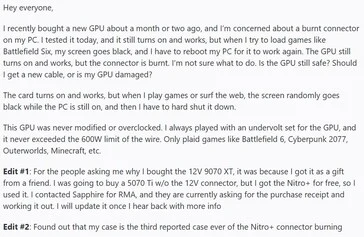
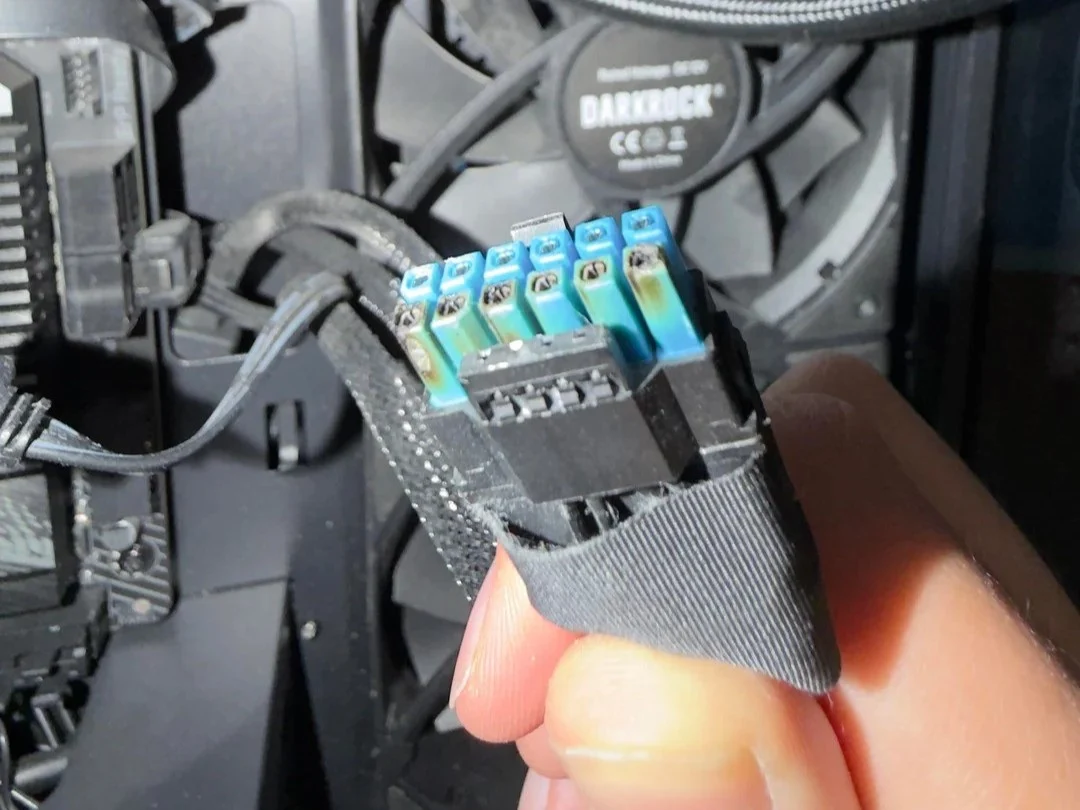
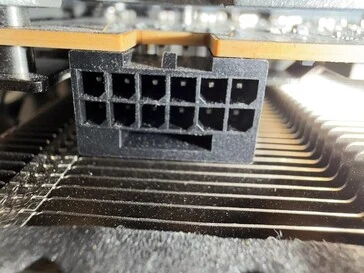
    Nvidia tried to fix the problem by using a new version of the connector in the RTX 50 series, but reports of the new 12V-2×6 cables failing still surfaced. On the other hand, AMD’s choice to avoid the 12VHPWR and the 12V-2×6 connectors spared the company from public relation troubles. That said, some AIB Radeon models do rely on the 12VHPWR/12V-2×6 connectors. One such example is the Sapphire Nitro+ RX 9070 XT, which, according to a post on r/pcmasterrace, has suffered from a burned-out 12VHPWR connector.

    Concerns About Reliability

    What’s alarming is that the affected RX 9070 XT had been in use for only about two months and was under the 600 W power limit. The GPU was also undervolted, which should have lessened the strain on the cable even further.

    Fortunately, Sapphire appears to have accepted an RMA request from the user and will either repair or replace the damaged RX 9070 XT.

    Choosing Wisely

    Though there are only a handful of Radeon RX 9070 XT AIB models equipped with a 12VHPWR power connector, this recent incident highlights the ongoing reliability issues with the 12VHPWR. Of course, several other factors could contribute to these failures, such as improper cable connection. However, the fact that the 12VHPWR connector has been linked to numerous problems with both Radeon and GeForce GPUs should definitely make users think twice before purchasing a GPU that uses this connector.

    So, if you’re considering a Radeon RX 9070 XT, it may be wise to opt for a version that uses the traditional 8-pin connector instead.

    Source:
    Link


  • Game Developers Urge RTX 40 Series Users to Uninstall Nvidia Drivers

    Game Developers Urge RTX 40 Series Users to Uninstall Nvidia Drivers

    Key Takeaways

    1. Nvidia’s RTX 40 series is facing serious issues with drivers starting from version 572.xx, causing black screens and instability.
    2. Hotfixes are being released, but many problems remain unresolved, leading to user frustration.
    3. Rolling back to driver version 566.36 resolves issues for some RTX 40 series users, but they lose access to new features like DLSS 4.
    4. Popular games are experiencing compatibility issues with the new drivers, prompting developers to recommend reverting to older driver versions.
    5. Nvidia has not publicly acknowledged the ongoing problems for RTX 30 and 40 series users, focusing more on the RTX 50 series.


    Nvidia’s RTX 40 series is facing serious issues with the latest drivers, starting from version 572.xx. Problems began surfacing in February, with users experiencing black screens and other stability problems.

    Ongoing Troubles

    Nvidia is trying to address these issues by releasing hotfixes, but many of the problems remain unresolved. Users of the RTX 30 and 40 series have expressed frustration, feeling that the company is focusing more on the RTX 50 series, where these issues seem to be less prevalent.

    User Concerns

    A Reddit user named “Scotty1992” shared a detailed list of grievances from RTX 30 and 40 series users. Rolling back to the 566.36 drivers appears to resolve the issues for those with the 40 series, but they lose access to new features like DLSS 4.

    Game Compatibility Issues

    Popular games such as Cyberpunk 2077, Alan Wake 2, and Indiana Jones and The Great Circle are reportedly experiencing problems with the new drivers, including stuttering and BSOD crashes.

    It seems that game developers are also advising users to uninstall Nvidia’s latest drivers. Developers from InZoi and Neople are encouraging RTX 40 series users to revert to the 566.36 driver version from December of last year. Owners of RTX 50 series and RTX 30 series or older are recommended to keep the new drivers.

    Conclusion

    Although Nvidia has been providing fixes for RTX 50 series users, they have not publicly acknowledged the ongoing problems for older GPUs. Until these issues are resolved, RTX 40 users may have to pick between stability and newer DLSS features.

    Source:
    Link

  • CheckMag: Understanding the GPU Slowdown Crisis

    CheckMag: Understanding the GPU Slowdown Crisis

    For many years, GPUs have changed the way we compute, bringing amazing improvements in performance with every new release. However, as the industry nears the physical and financial limits of making silicon, these advances have begun to slow down. This situation is leading to a change in how we measure and achieve performance. By looking at trends over the years, we can see this shift and the necessity for fresh strategies to keep pushing GPU technology forward.

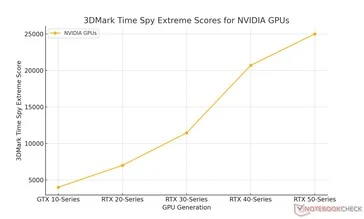
    Nvidia’s Progression

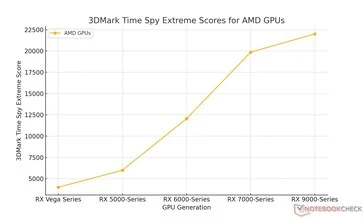
    Nvidia’s journey illustrates this evolution well. The RTX 20 series (Turing) marked a major step with the introduction of real-time ray tracing. Following that, the RTX 30 series (Ampere) and RTX 40 series (Ada Lovelace) raised computational power significantly. But, the speed of performance improvements is not as fast anymore. Monthly growth rates have dropped from around ~2.68% during the transition from RTX 20 to 30, to an estimated ~0.96% for the upcoming RTX 50 series. Similarly, AMD’s RDNA 2 (RX 6000 series) achieved a remarkable ~6.25% monthly growth, but RDNA 3 only manages about ~2.60%.

    Challenges in Scaling

    This slowdown isn’t because of lack of ambition; it’s due to increasing difficulties in scaling silicon. Process nodes like 7nm and 4nm have unlocked amazing capabilities, but pushing for even smaller sizes encounters serious technical and financial obstacles. The time of rapid hardware growth is shifting towards a focus on architectural innovation as the key driver of progress.

    Technological advancements like Nvidia’s DLSS and AMD’s multi-chip designs show this new path. These technologies utilize AI, advanced memory integration, and software-driven tweaks to boost performance in real-world use. New ideas such as chiplet architectures and 3D stacking also hold the potential to change GPU design, helping manufacturers go beyond the limits of single-chip designs and achieve better performance under existing restrictions.

    Rethinking Performance Metrics

    As hardware innovation slows down, the way we view performance needs to change too. Traditional benchmarks like teraflops and synthetic scores are still useful but often miss the mark on real-world user experiences, especially in gaming. A more relevant measurement is frame latency, which looks at the time it takes for a GPU to create and show each frame. This provides a clearer view of how smooth and responsive gameplay is.

    Different gaming genres also have unique latency needs. Fast-paced shooters (FPS) require ultra-low latency for smooth visuals and accurate controls during intense moments. Conversely, role-playing games (RPGs) focus more on rich visuals, where a bit of extra latency is acceptable. Casual games or strategy titles can handle even more latency without affecting player satisfaction. Understanding these distinctions helps developers and manufacturers fine-tune graphics cards and software for specific gaming experiences, ensuring the best performance across a range of applications.

    The Importance of Frame Latency

    Frame latency plays a crucial role in how smooth and responsive a game feels, especially during graphically demanding or high-frame-rate situations. Evaluating GPUs based on latency and stability gives a clearer picture of their real-world performance. A GPU that has moderate raw power might still outperform a higher-rated model by reducing stutters and frame drops in challenging gameplay. By focusing on these metrics, manufacturers can better meet the needs of both gamers and professionals.

    The GPU sector is at a pivotal point. With traditional silicon scaling yielding less impressive results, the way forward involves blending innovative hardware designs with more intelligent methods of measuring performance. AI-enhanced rendering, clever resource management, and advanced memory structures will drive the next phase of GPU development. By using metrics like frame latency, we can ensure that these advancements bring real, significant benefits to users.

    The future for GPUs isn’t solely about making silicon quicker or smaller. It’s about rethinking how we approach computing itself, emphasizing creativity, efficiency, and user experience to foster innovation in a time when the limits of silicon no longer define what’s possible.