
Tag: multicolor 3D printing

  • 3D Printer Revolution: Prusa ColorMix for Color Printing

    3D Printer Revolution: Prusa ColorMix for Color Printing

    Key Takeaway

    – Multicolor 3D printing with affordable devices now possible without manual filament changes
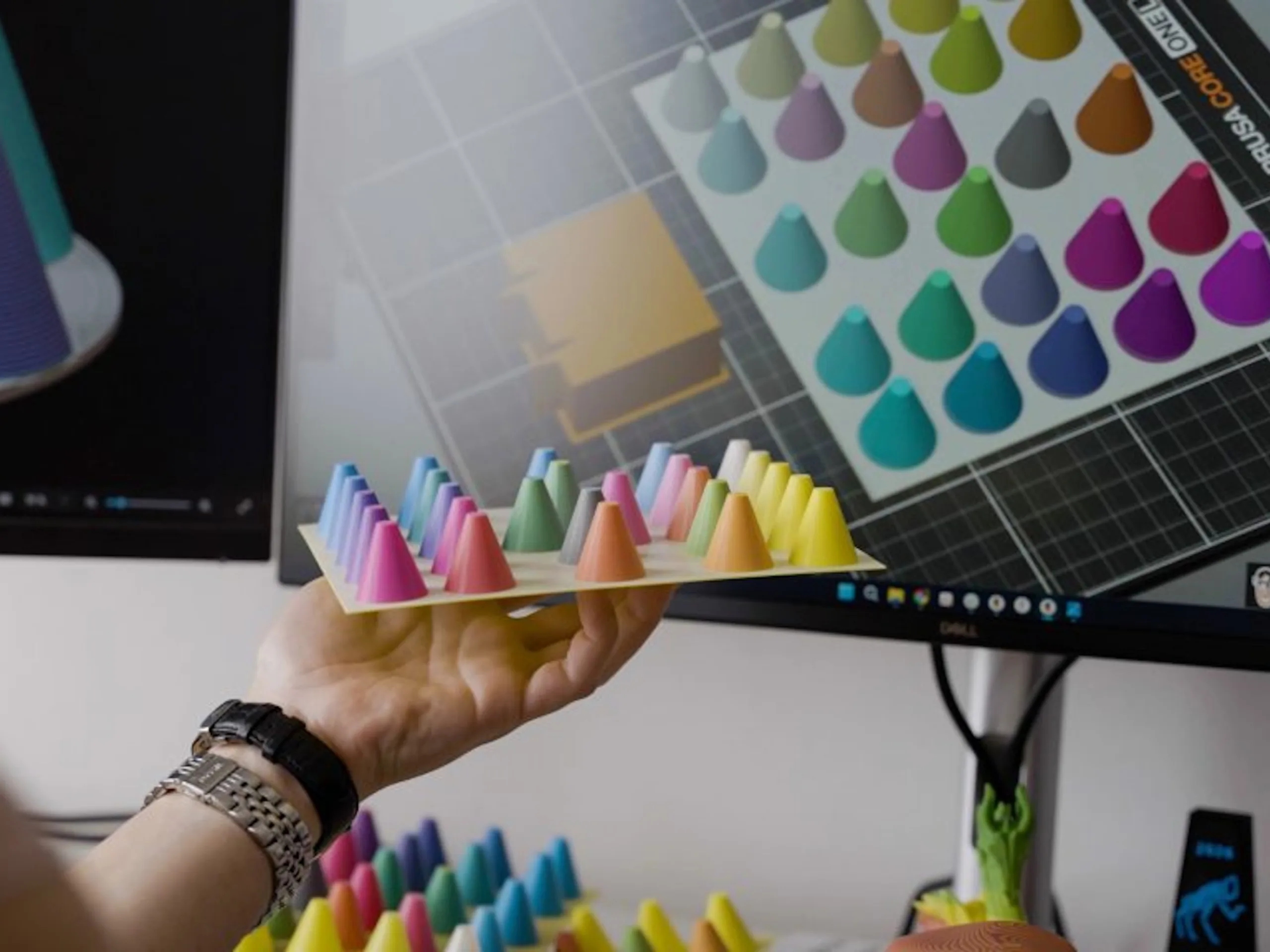
    – Prusa ColorMix achieves mixed colors by stacking different colored layers in depth, not on the surface
    – Mixing ratio and number of producible colors are limited
    – Workflow simplified with settings directly in PrusaSlicer and EasyPrint
    – CMYKW set in development for more reproducible results; filament shade consistency and color-accurate monitors matter for best outcomes


    Multicolor 3D Printing Gets a Upgrade with Prusa ColorMix

    3D printing in multiple colors is now possible even with relatively affordable devices without having to change individual filaments manually. If only one print head is used, however, cutting the filament and therefore generating waste is unavoidable. Users are also naturally limited to the colors they have available as filament. Prusa ColorMix, a new system released under the MIT license, has now been introduced and could significantly simplify multicolor printing in terms of material requirements.

    How the Technology Works for Better Color Mixing

    The basic principle does not fundamentally differ from conventional two-dimensional color printing. The human eye has limited resolving power, so differently colored dots effectively blur into a mixed color. However, Prusa ColorMix does not alternate the dots across the surface but in depth. The layers stacked on top of each other then form the mixed color. There are limitations. For example, the mixing ratio cannot be freely selected, and the number of colors that can be produced this way is also limited. According to Prusa, the workflow itself has been significantly simplified, with the corresponding settings available directly in PrusaSlicer and EasyPrint.

    Development of CMYKW and Color Accuracy Considerations

    A CMYKW set is also in development, which could lead to more reproducible results. Optimal results should only be expected if the source filaments match the same shade across batches, not just the same basic color. The integrated color mixing model is intended to predict which color will actually be produced in a print. In such cases, a monitor that is not necessarily calibrated but at least reasonably color-accurate could become relevant.

    Additional Insights and Recommendation for Readers

    Prusa’s blog post is also recommended beyond the announcement itself, as it discusses various color mixing models and the insights gained during development. The system aims to make multi-color printing more accesible while reducing waste, although users must still consider filament batch consistency. Understanding these limitations helps in achieving the best possible print results.
    Sources
  • Elegoo Centauri Carbon 2 Combo: Affordable Multicolor 3D Printer

    Elegoo Centauri Carbon 2 Combo: Affordable Multicolor 3D Printer

    Key Takeaways

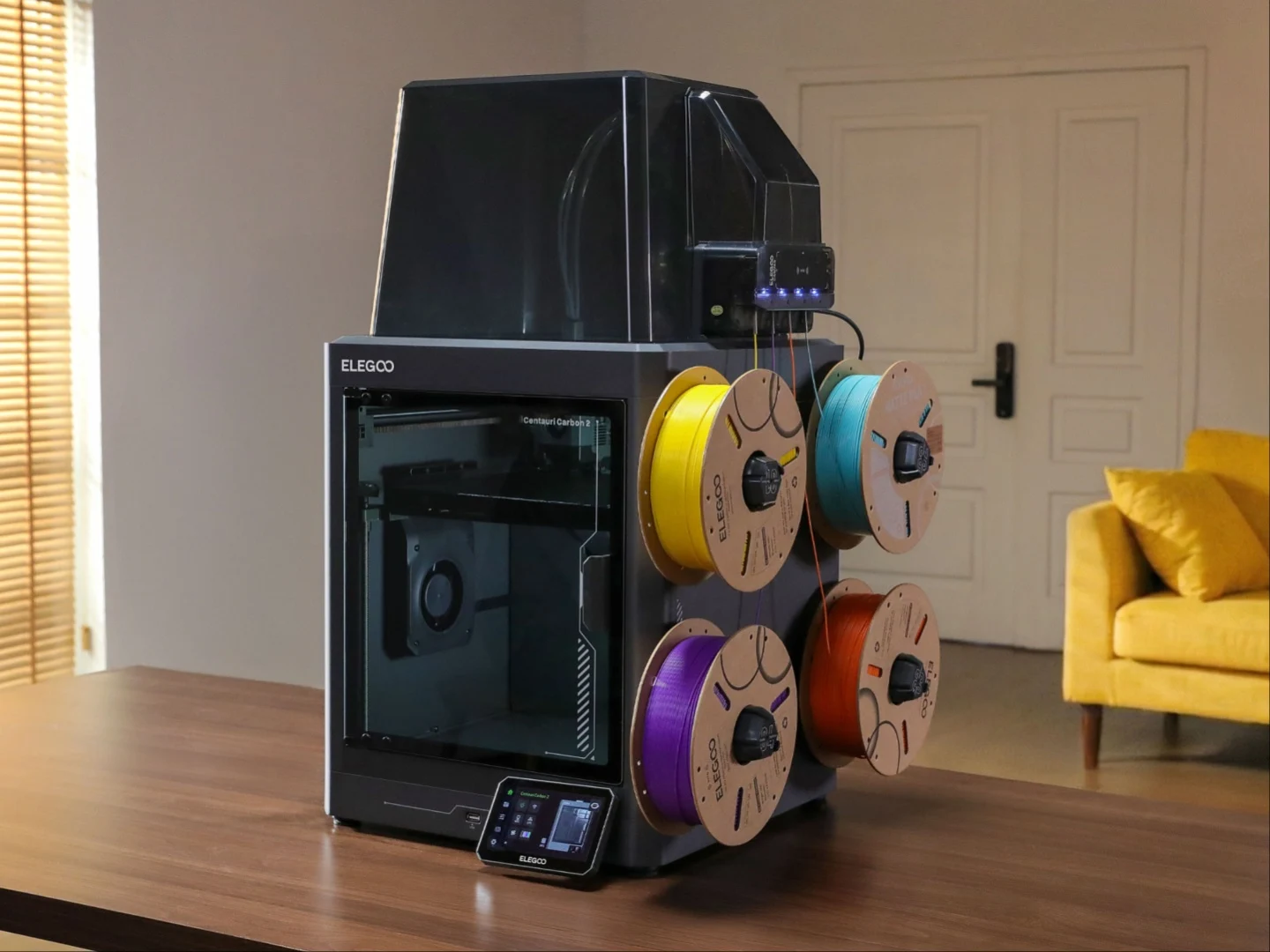
    1. Multicolor 3D Printing: The Centauri Carbon 2 Combo (CC 2) introduces support for multicolor printing, featuring a new Canvas system with RFID detection for automatic filament loading.

    2. Design Enhancements: The CC 2 retains the overall design of the original CC but includes key upgrades such as a new filament attachment system and improved usability with four spools connected to the printer.

    3. Improved User Experience: The printer features a larger 5-inch touchscreen, a hardened steel nozzle that can reach 350 degrees C, and a 14% faster auto leveling process, all while operating more quietly at 45 dB.

    4. Consistent Specifications: The CC 2 maintains the same build volume (256 x 256 x 256 mm), maximum print speed (500 mm/s), and acceleration (20,000 mm/s²) as its predecessor.

    5. Affordability and Availability: The CC 2 is priced at $449 and is available for order through the official website, with distribution in multiple countries including the US, Canada, and Australia.


    Following the previous year’s budget core XY enclosed model, the Centauri Carbon (CC), Elegoo has introduced its successor with some nice enhancements. The Centauri Carbon 2 Combo (CC 2) now supports multicolor 3D printing, a feature that was supposed to be in the original CC but didn’t make it. However, the CC 2 brings Elegoo up to speed with its rivals while keeping its wallet-friendly nature.

    Design Improvements

    In terms of its overall design, the CC 2 resembles the original CC but features important upgrades, including a new Canvas system with RFID detection. This system allows for printing in up to four colors and includes automatic filament loading, along with the ability to identify the color and type of filament. It’s important to note that the auto detection is limited to Elegoo’s own RFID filament spools. The multicolor setup differs from well-known brands like Bambu’s AMS or Creality’s CMS as there is no separate filament box. Instead, all four spools are attached to the side of the printer, connecting to the Canvas system that directs four PTFE tubes to the hotend.

    Enhanced User Experience

    The touchscreen has been enlarged to 5 inches (up from 4.3 inches on the CC). The hardened steel nozzle can now reach temperatures up to 350 degrees C (previously 320 degrees C on CC), and the auto leveling feature is said to be about 14% quicker, according to Elegoo’s claims. Additionally, it is designed to be quieter, operating at 45 dB compared to around 55 dB for the CC. Elegoo has also incorporated automatic opening vents that regulate chamber airflow, similar to the premium offerings from Bambu Lab. This means that filaments like PLA, which don’t require extremely high temperatures, can be printed with the vents open.

    Specifications

    Despite all the upgrades, the Centauri Carbon 2 Combo maintains the same build volume as its predecessor, which is 256 x 256 x 256 mm. The maximum print speed and acceleration remain unchanged at 500 mm/s and 20,000 mm/s², respectively. A camera for live monitoring is also included; however, details regarding resolution and frame rate are not currently available.

    The Centauri Carbon 2 Combo is available for purchase at $449, €439, £339, $619 CAD, $999 AUD, and ¥79,999. It can be ordered now through the official website and will be distributed in the US, Canada, Australia, Japan, and the European Union.

    Source:
    Link