
Tag: laptop CPUs

  • Pay for Ryzen 7, Get Less Than Ryzen 5 in AMD Marketing Spin

    Pay for Ryzen 7, Get Less Than Ryzen 5 in AMD Marketing Spin

    Key Takeaway

    – Ryzen AI 7 345 laptops are priced higher than Ryzen AI 5 340 counterparts, despite the 7 model being slower in core configuration and overall performance.
    – The 345’s core count is effectively two large Zen 5 cores plus an underclocked Zen 5c core, with a 200 MHz lower boost clock, reducing CPU performance versus the 5 340.
    – AMD has halved the L3 cache and removed two PCIe 4.0 lanes (out of 16), contributing to the performance disadvantage.
    – The Radeon 840M GPU remains the same in both chips but with only four compute units, making it unsuitable for most gaming.
    – Overall, the Ryzen AI 7 345 offers less performance than expected in its tier, while being more expensive.


    The initial preorders for the new AMD Ryzen AI 7 345 equipped laptops have begun in Europe, and a quick glance at the price comparison site Geizhals confirms this. The most affordable notebook with this processor is listed at €999, indicating that systems sporting Ryzen AI 7 345 are notably pricier than those built around Ryzen AI 5 340, such as the HP OmniBook 3 which can be found around $590 on certain retailers.

    Pricing contrasts and expectations

    Interestingly, consumers may assume the 7-series would outpace the 5-series, yet the Ryzen AI 7 345 actually trails the Ryzen AI 5 340 in overall performance. The core reason given is that the newest Ryzen design name is a bit deceptive, since the chip features only two full Zen 5 cores rather than three, and those two cores run at a boost clock that sits about 200 MHz lower. An extra Zen 5c core exists, but it operates at even lower frequencies, which could translate to slightly reduced CPU performance relative to the Ryzen AI 5 340.

    Hardware specifics and gaming implications

    On the memory and I/O front, AMD has trimmed the L3 cache by half when compared with the Ryzen AI 5 340, and two PCIe 4.0 lanes have been removed from the mix. The Radeon 840M GPU design remains the same on both chips, yet with only four compute units, it tends to be too slow for many modern games. When looking at the Ryzen AI 7 350 as a reference point, the newest Ryzen AI 7 appears considerably slower than what one might expect from a top-tier member of this family.

    In sum, the price-to-performance relationship for the Ryzen AI 7 345 seems misaligned at present, with higher costs not clearly rewarded by stronger performance in typical workloads. Prospective buyers might weigh these dynamics carefully, especially if gaming or heavy multitasking is a primary concern, and compare closely against Ryzen AI 5 340 options before committing to a purchase.
  • First Look at Wildcat Lake Intel-Powered Reference Laptop Experience

    First Look at Wildcat Lake Intel-Powered Reference Laptop Experience

    Key Takeaway

    1. Intel’s Wildcat Lake CPUs are designed for thin-and-light laptops, offering lower power and performance compared to Panther Lake, with weaker iGPU and fewer cores.
    2. A recent Wildcat Lake laptop features a dual-core P-processor, 4 LPE cores, a 17W PL1 limit, and integrated security with a 17 TOPS NPU.
    3. The laptop’s design resembles a MacBook, is likely fanless, and supports even minimal cooling, indicating suitability for portable, low-power devices.

    Introduction to Wildcat Lake CPUs

    Intel has quietly introduced a fresh lineup of laptop processors named Wildcat Lake, which are quite similar to Panther Lake chips but without the ‘Ultra’ branding. These new CPUs are designed mainly for lightweight, slim laptops, so they feature weaker integrated graphics, fewer cores, and more modest power limits. Basically, they’re targeted at users who prefer portability over raw performance. Recently, a Wildcat Lake-based device was seen at an Intel event, giving us a sneak peek into what to expect from these chips.

    Details of the Featured Laptop

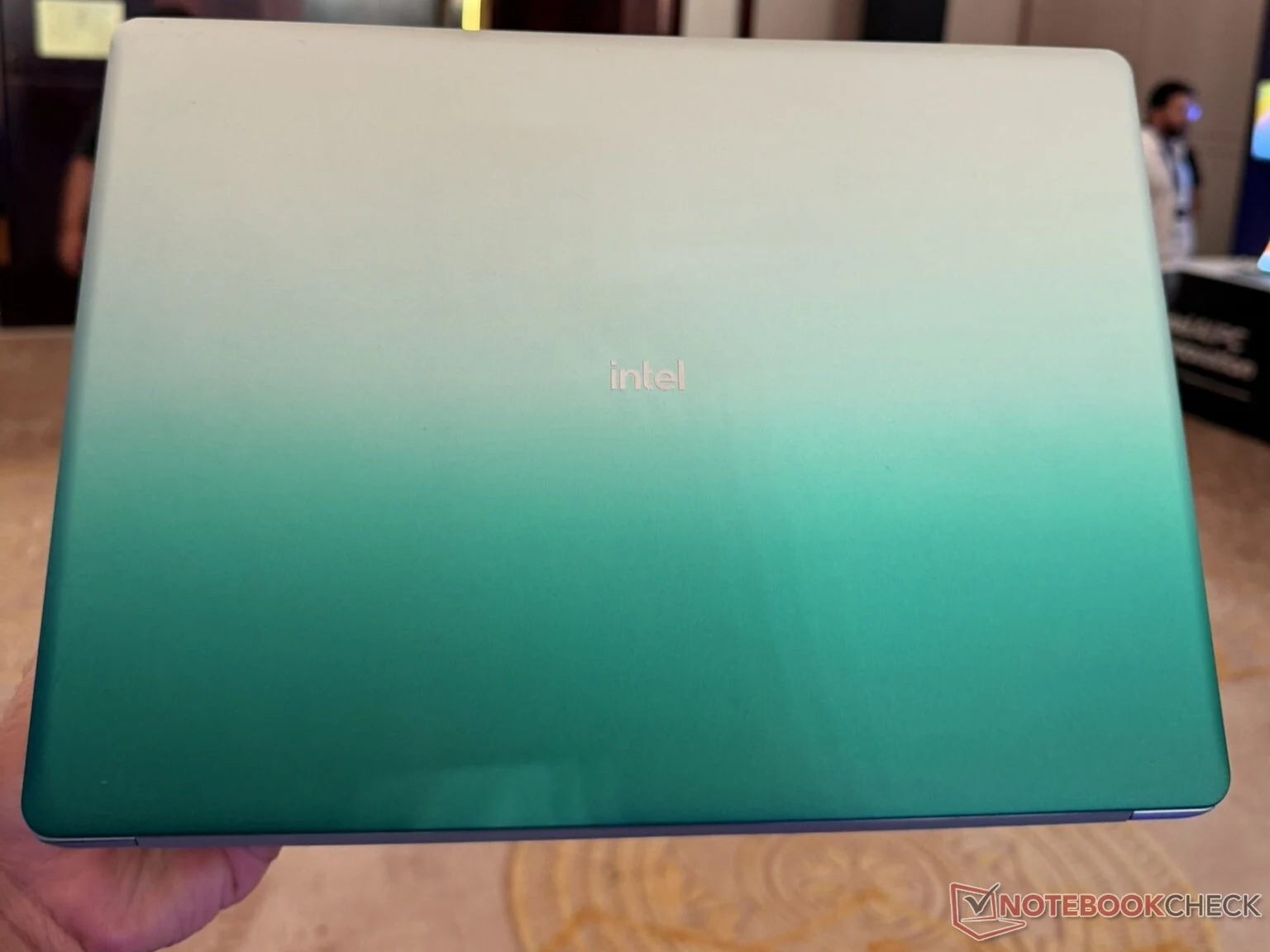
    The machine spotted was an Intel reference model with a sleek aluminium body plus a keyboard that looks pretty much like a MacBook’s. Inside, there’s an intriguing Intel processor with a configuration of two Cougar Cove P-cores and four Darkmont LPE-cores. Its power settings include a PL1 of 17 Watts, which can peak at 22 Watts, and a PL2 of 35 Watts. For fanless designs, it’s limited to a TDP of 11 Watts, and an Intel rep said it can work even without active cooling — making it perfect for ultra-slim devices or silent operation.

    Technical specs and possible models

    Other key features of this device include a 17 TOPS Neural Processing Unit (NPU), an integrated 2-EU iGPU, and 16 GB of soldered RAM, probably running at around 7467 MT/s. While it’s difficult to pinpoint the exact SKU due to the CPU core configuration, the presence of the 17 TOPS NPU suggests it could be one of the Core 7 models, like the Core 7 360 or Core 7 350. Both models are known to include this NPU, which adds some serious AI processing capabilities.

    Performance and Testing

    As of now, no performance benchmarks or detailed tests have been done on this particular device. We’ll keep an eye out and update you as soon as more information and tests become available. Meanwhile, this glimpse into Wildcat Lake chips indicates Intel’s ongoing strategy to cater to users who want lightweight but capable laptops—balancing power efficiency with enough juice for daily tasks.


    Sources