

Tag: IXPE

  • Scientists Explore the Inner Region of a White Dwarf for First Time

    Scientists Explore the Inner Region of a White Dwarf for First Time

    Key Takeaways

    1. NASA’s IXPE focused on the intermediate polar EX Hydrae, a white dwarf system located about 200 light-years from Earth, for nearly a week in 2024.

    2. EX Hydrae is a binary system with a main-sequence companion star, featuring a magnetic field that allows material to form an accretion disk and be attracted to the white dwarf’s magnetic poles.

    3. IXPE observations measured the polarization of EX Hydrae at eight percent, which exceeded some theoretical expectations.

    4. The X-rays from EX Hydrae originated from a column of extremely hot gas, estimated to be about 2,000 miles high, directing gas from the inner disk to the white dwarf’s surface.

    5. The X-ray polarization direction was found to be perpendicular to the gas column, indicating that X-rays bounced off the white dwarf’s surface before scattering into space.


    NASA’s IXPE (Imaging X-ray Polarization Explorer) directed its attention to a system known as the intermediate polar EX Hydrae in 2024 for almost a week. Located approximately 200 light-years away from Earth, EX Hydrae is a white dwarf system. A white dwarf is the compact core that remains after a star similar to the Sun reaches the end of its life.

    Binary System Dynamics

    EX Hydrae is part of a binary star system, where it has a main-sequence companion star. This system has a magnetic field of moderate strength, which draws material from its companion star. In cases of strong magnetic fields, material is pulled directly into the magnetic poles of the white dwarf. However, where the magnetic field is weaker, the stellar material orbits around the dwarf in an accretion disk. In the case of EX Hydrae, stellar material forms an accretion disk and is also attracted toward the magnetic poles of the white dwarf, thus earning its classification as an intermediate polar.

    Insights from IXPE Observations

    Through IXPE’s observations, astronomers successfully measured the polarization of EX Hydrae, revealing a polarization degree of eight percent. This figure was notably higher than what some theoretical models had suggested.

    Additionally, IXPE’s findings identified the origin of the X-rays. These X-rays were traced back to a column that directs extremely hot gas from the inner disk to the surface of the white dwarf. The astronomers estimated that this column reaches approximately 2,000 miles in height, which is significantly taller than previous predictions.

    X-ray Polarization Discoveries

    The study also examined the orientation of EX Hydrae’s X-ray polarization. The research team measured the polarization direction and found it was perpendicular to the gas column. This indicated that the X-rays emitted from the column bounced off the surface of the white dwarf before scattering into space and reaching IXPE.

    The findings were published in the Astrophysical Journal. The team aims to utilize X-ray polarization in further studies of other white dwarf systems. This research could enhance scientists’ comprehension of larger-scale cosmic events that share similar physical processes.

    The Astrophysical Journal via NASA

    Source:
    Link


  • NASA IXPE Uncovers Secrets of Black Hole Jets

    NASA IXPE Uncovers Secrets of Black Hole Jets

    Key Takeaways

    1. The Perseus Cluster is the most luminous galaxy cluster observed in X-rays, with IXPE focusing on it for the first time.
    2. The active galaxy 3C 84 at the center of the cluster is a key target for X-ray studies due to its brightness and proximity.
    3. X-rays from active galaxies like 3C 84 are believed to originate from a process called inverse Compton scattering.
    4. Two possible origins for the seed photons involved in producing X-rays were proposed: Synchrotron self-Compton and external Compton, with Synchrotron self-Compton being favored.
    5. IXPE’s findings were enhanced by collaboration with data from other observatories, including Chandra, NuSTAR, and Swift, and published in the Astrophysical Journal Letters.


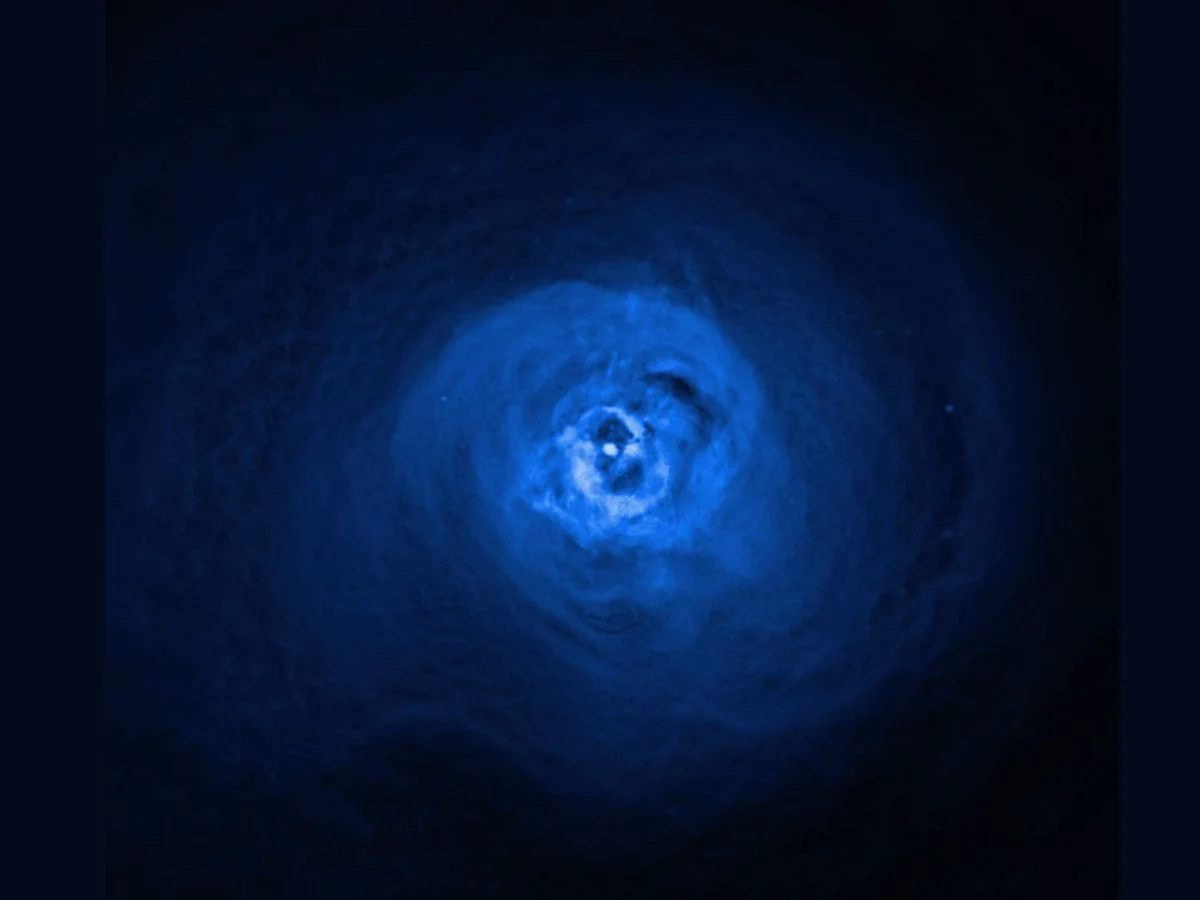
    The Perseus Cluster stands out as the most luminous galaxy cluster that can be seen in X-rays. The IXPE mission zeroed in on this cluster to learn about the origins of X-rays emitted from a supermassive black hole’s jet. This marks the first occasion IXPE has focused on a galaxy cluster, and it also represents the longest period of observation for a single target since the mission began.

    Active Galaxy in Focus

    At the heart of the Perseus Cluster lies an active galaxy known as 3C 84. Due to its closeness and brightness, this galaxy is frequently studied in X-ray astronomy. The mission aimed to analyze the polarization of 3C 84, which provides insights into the direction and alignment of the X-rays that are emitted.

    Understanding X-ray Origins

    Researchers already think that the X-rays from active galaxies like 3C 84 are produced through a process called inverse Compton scattering. In this process, low-energy photons gain energy and shift into the X-ray spectrum through interactions with electrons. The low-energy photons, referred to as seed photons, are essential for this study. As a result, scientists proposed two possible origins for these seed photons.

    The first possibility is the Synchrotron self-Compton scenario, where the seed photons come from the same jet that also generates the higher-energy emissions. The second possibility is called external Compton, suggesting that the seed photons are sourced from background radiation that exists outside the jet. After careful examination of the data, astronomers leaned toward the conclusion that the Synchrotron self-Compton scenario is the more plausible explanation for 3C 84.

    Data Collaboration and Findings

    To arrive at these conclusions, the astronomers integrated IXPE’s observations with data from other major observatories, including the Chandra X-ray Observatory, Nuclear Spectroscopic Telescope Array (NuSTAR), and the Neil Gehrels Swift Observatory. The results of their research were shared in the Astrophysical Journal Letters.

    Source:
    Link