
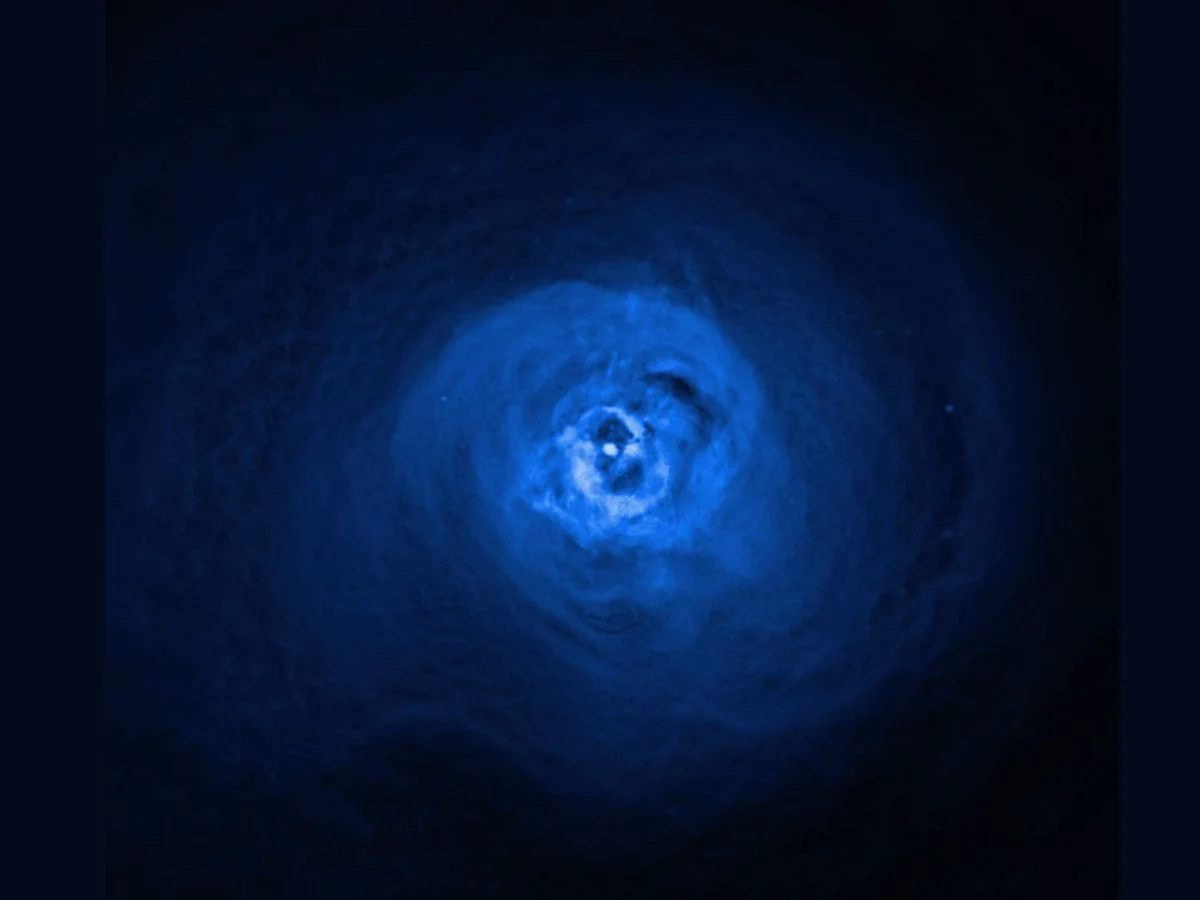
Key Takeaways
1. The Perseus Cluster is the most luminous galaxy cluster observed in X-rays, with IXPE focusing on it for the first time.
2. The active galaxy 3C 84 at the center of the cluster is a key target for X-ray studies due to its brightness and proximity.
3. X-rays from active galaxies like 3C 84 are believed to originate from a process called inverse Compton scattering.
4. Two possible origins for the seed photons involved in producing X-rays were proposed: Synchrotron self-Compton and external Compton, with Synchrotron self-Compton being favored.
5. IXPE’s findings were enhanced by collaboration with data from other observatories, including Chandra, NuSTAR, and Swift, and published in the Astrophysical Journal Letters.
The Perseus Cluster stands out as the most luminous galaxy cluster that can be seen in X-rays. The IXPE mission zeroed in on this cluster to learn about the origins of X-rays emitted from a supermassive black hole’s jet. This marks the first occasion IXPE has focused on a galaxy cluster, and it also represents the longest period of observation for a single target since the mission began.
Active Galaxy in Focus
At the heart of the Perseus Cluster lies an active galaxy known as 3C 84. Due to its closeness and brightness, this galaxy is frequently studied in X-ray astronomy. The mission aimed to analyze the polarization of 3C 84, which provides insights into the direction and alignment of the X-rays that are emitted.
Understanding X-ray Origins
Researchers already think that the X-rays from active galaxies like 3C 84 are produced through a process called inverse Compton scattering. In this process, low-energy photons gain energy and shift into the X-ray spectrum through interactions with electrons. The low-energy photons, referred to as seed photons, are essential for this study. As a result, scientists proposed two possible origins for these seed photons.
The first possibility is the Synchrotron self-Compton scenario, where the seed photons come from the same jet that also generates the higher-energy emissions. The second possibility is called external Compton, suggesting that the seed photons are sourced from background radiation that exists outside the jet. After careful examination of the data, astronomers leaned toward the conclusion that the Synchrotron self-Compton scenario is the more plausible explanation for 3C 84.
Data Collaboration and Findings
To arrive at these conclusions, the astronomers integrated IXPE’s observations with data from other major observatories, including the Chandra X-ray Observatory, Nuclear Spectroscopic Telescope Array (NuSTAR), and the Neil Gehrels Swift Observatory. The results of their research were shared in the Astrophysical Journal Letters.
Source:
Link