Tag: itch.io

  • Itch.io Reindexes Free NSFW Games After Recent Ban

    Itch.io Reindexes Free NSFW Games After Recent Ban

    Key Takeaways

    1. Itch.io plans to restore NSFW material in search results, but only for free games.
    2. Paid NSFW games will remain excluded from search results for now, with potential slow reintroduction later.
    3. The initial removal of NSFW content was influenced by pressure from payment processors and activist groups.
    4. Itch.io is exploring alternative payment processors after disabling Stripe payments for NSFW games.
    5. Creators must offer their NSFW content for free to be eligible for reindexing on the platform.


    Itch.io, a platform for indie games and various content, has revealed plans to start bringing back NSFW material that was previously removed from its site-wide search results.

    Conditions for Restoration

    However, this only concerns games that are available for free. Paid NSFW games will continue to be excluded from search results. Leaf Corcoran, the founder of the platform, mentioned that they would “slowly reintroducing paid content” to ensure long-term support for it.

    Background of the Decision

    Earlier this month, Itch.io took down NSFW content from search results following pressure from payment processors such as Visa and Mastercard, along with activist groups like Collective Shout. Both Itch.io and Steam suddenly banned NSFW content, leading to significant backlash, including a petition that has gathered over 200,000 signatures.

    Future Plans

    Corcoran stated that they are actively looking for alternative payment processors. He also relayed a statement from Stripe, clarifying that the service does not support “content designed for sexual gratification.” Last week, the platform disabled Stripe payments for NSFW games. Corcoran indicated that they would “review that initial list for potential re-introduction,” now that they have “a more specific definition.”

    Eligibility for Creators

    Meanwhile, creators who wish to have their content reindexed must offer it for free.

    In a related incident, writer Ana Valens from Vice was caught in the turmoil. She, along with several colleagues, resigned in protest after being instructed to take down an article about Collective Shout, which the article referred to as a “radical feminist organization.”

    Source:
    Link
  • Mastercard Reacts to Steam Games Ban Over Adult Content Issues

    Mastercard Reacts to Steam Games Ban Over Adult Content Issues

    Key Takeaways

    1. Steam and Itch.io removed thousands of games with adult themes to comply with payment processor guidelines.
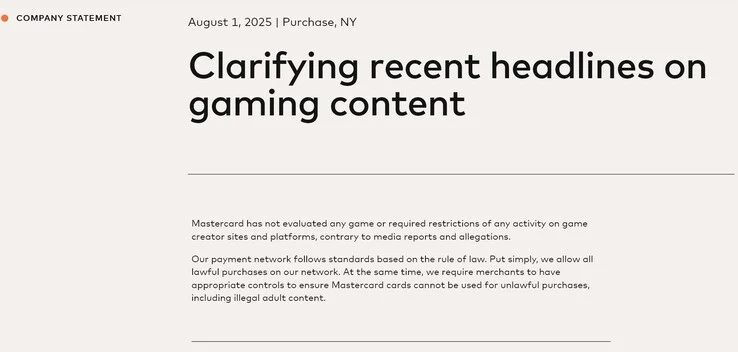
    2. Mastercard clarified that it did not mandate game restrictions but emphasized the need to prevent unlawful purchases.
    3. Gamers reacted negatively to the bans, leading to significant backlash and a petition on Change.org.
    4. Collective Shout, an advocacy group, lobbied payment processors to pressure vendors against adult content, causing further controversy.
    5. Itch.io is exploring alternative payment processors while reinstating free adult-oriented games, distancing itself from Mastercard’s policies.


    Recently, the large-scale removal of Steam games that feature adult themes has caused a stir in the gaming industry. Itch.io soon followed suit, taking down more than 20,000 independent titles that contained NSFW material. Both companies mentioned that they were adhering to the guidelines set by payment processors such as Visa, Mastercard, and Stripe. In response to backlash, including a petition on Change.org, Mastercard released a statement to clarify its involvement in the bans.

    Mastercard’s Position

    The credit card company asserts that it did not “evaluate any game or mandate restrictions on activities on game creator sites and platforms.” However, Mastercard reiterates that it is essential for merchants to prevent “unlawful purchases, including illegal adult content.” This particular aspect of the statement has incited significant outrage among gamers. While it’s true that some Steam games may have encouraged illegal activities, other games appear to be targeted merely because they contain adult themes.

    Gamers’ Reactions

    After receiving numerous angry calls and emails from gamers, Mastercard likely felt it needed to address the situation. The company maintains that it doesn’t play a direct role in determining which games marketplaces are allowed to sell. Nonetheless, the advocacy group Collective Shout asserts that it lobbied payment processors to exert pressure on these vendors. This Australian organization stands against the objectification of women and the sexualization of girls. Despite this, critics argue that the group campaigns against all mature content based on moral or political reasons.

    Itch.io’s Approach

    Regarding Itch.io, Mastercard can more easily distance itself from the ongoing debate. The gaming platform primarily uses Stripe and PayPal for transactions rather than Mastercard or Visa. Stripe is more transparent about its policy of not permitting retailers to sell any mature-themed games, videos, or art. Itch.io is currently seeking out alternative payment processors while reinstating free adult-oriented games.

    On Reddit and various forums, the feedback to Mastercard’s explanation has been far from supportive. Major credit card companies will likely continue to face backlash from consumers who feel that games are being unfairly censored.

    Source:
    Link


  • Steam Game Theft: Indie Developers Face Valve’s Moderation Issues

    Steam Game Theft: Indie Developers Face Valve’s Moderation Issues

    Key Takeaways

    1. Indie games are being uploaded to Steam without the original creators’ permission, with many taken from itch.io.
    2. A specific developer, referred to as “me,” has uploaded around 70 stolen games, including titles like Hard Cop 2 and Open Star Fighter.
    3. Valve struggles to manage the influx of new games, leading to the presence of low-quality and potentially harmful content on Steam.
    4. The community has raised concerns about Valve’s hands-off approach to moderation, allowing hate speech and harassment to persist in forums.
    5. The issue of stolen and low-quality games extends beyond Steam, affecting other platforms like the PlayStation Store and Nintendo eShop, exacerbated by generative AI.


    Some indie game creators are discovering their games showing up on Steam. Sadly, this can happen without their permission. An article from Gamepressure reveals that one developer has uploaded many stolen games onto the platform. The recent case highlights Valve’s inability to effectively manage the ongoing influx of new games on Steam.

    Developer’s Identity

    The developer in question uses terms like “me” or “myself.” Gamepressure found out that a significant number of the nearly 70 games from this developer were taken from itch.io. This site is known for giving visibility to new game creators, with some games available for free or often priced at $5 or less. Among the games taken by “me” are Hard Cop 2 and Open Star Fighter, which were previously released on itch.io.

    Ongoing Issues

    Many of the questionable titles have been removed from Steam, yet “me” is still active on the platform. Critics have criticized Valve for allowing low-quality games, or even in some cases, malware. Publishing games on Steam is cheap, though getting visibility for them is much harder. Consequently, the platform has seen tremendous growth. However, it has also become a haven for developers with dubious motives.

    Community Concerns

    Valve has faced backlash for permitting hate speech and harassment in the Steam forums. Taking a mostly hands-off approach, the company counts on players to report any rule-breaking behavior. The indie games sourced from itch.io were probably only removed after users complained.

    Broader Implications

    The issue of low-quality games, imitation titles, and stolen games isn’t limited to Steam. On platforms like the PlayStation Store and Nintendo eShop, gamers encounter numerous dubious listings. The rise of generative AI has added to the problem, as these tools can quickly produce generic game assets. Many of these games try to cash in by mimicking popular titles with misleading names.

    Source:
    Link