Tag: ISOCELL HP9

  • Super Stylish Camera: Top-Tier Alternative to iPhone 17

    Key Takeaway

    – Dual 200MP camera setup with Samsung ISOCELL HP9 main sensor (f/1.6, OIS)
    – Inherits 200MP telephoto and ultra-wide cameras from the larger Find X9 Pro
    – Significantly better detail and low-light performance than iPhone 17
    – Telephoto zoom remains impressively usable even at 20x magnification
    – Compact design with flagship-level camera hardware starting at ~$940


    Compact Camera Powerhouse

    The Oppo Find X9s Pro impressively shows in our review how much camera potential a compact smartphone can have and why it is also a top-tier alternative to the Apple iPhone 17 or Galaxy S26. Prices start at around $940 from Trading Shenzhen.

    Dual 200 MP Camera Setup

    Oppo relies on a dual 200 MPix camera setup for its mini flagship, as with the Ultra model. Although it does not use the same sensors as the Find X9 Ultra, the hardware of the smaller Pro model is still impressive. The main camera is Samsung’s ISOCELL HP9 with an f/1.6 aperture and optical image stabilization (OIS).

    Zoom and Ultra-Wide Inherited from Flagship

    The Oppo Find X9s Pro inherits the ultra wide and zoom cameras from the larger flagship Find X9 Prowhich is quite remarkable. This means that the 1/1.56-inch ISOCELL HP5 sensor fpr the 200 MPix telephoto lens is just as large as the main camera of the iPhone 17. By contrast, the Apple smartphone only zooms digitally.

    Real-World Camera Performance

    In real word usage, the Find X9s Pro has significantly better camera hardware and delivers visibly more detail in our review despite its similar dimensions. Especially in the dark, the iPhone 17’s photos are not competitive with Oppo’s mini flagship. The Find X9s Pro’s main camera offers more texture and a better level of sharpness.

    Telephoto Lens Dominance

    However, the Find X9s Pro really plays to its biggest strength when it comes to the telephoto lens. Although Oppo’s mini flagship does not quite reach the level of the Ultra model, the zoom’s photo quality is impressively good for a compact smartphone. Even a 20x magnified shot still looks absolutely usable with the Find X9s Pro and does not look artificial.

    All information and measurement data on the Find X9s Pro can be found in our review of the Oppo phone.

    • Price: around $940 (Trading Shenzhen)
    • Main camera: Samsung ISOCELL HP9, f/1.6, OIS
    • Telephoto: 200 MPix ISOCELL HP5, 1/1.56-inch sensor
    • Ultra-wide: inherited from Find X9 Pro
    • No digital zoom limitation like iPhone
    Sources
    • Sony May Sell Camera Sensor Division Despite Market Leadership

      Sony May Sell Camera Sensor Division Despite Market Leadership

      Key Takeaways

      1. Samsung and OmniVision are emerging competitors to Sony in the camera sensor market, with significant partnerships forming around their products.
      2. Sony remains the market leader with a 45% share, while Samsung and OmniVision hold 19% and 11% shares, respectively.
      3. Apple consistently chooses Sony for iPhone camera sensors, while Honor is reportedly opting for OmniVision in its Magic8 Pro.
      4. Sony’s camera sensor division has seen profit margins drop from 25% to 10%, prompting speculation about a potential sale or public listing.
      5. Economic uncertainties and tariff issues may delay Sony’s plans to spin off its camera sensor division, with updates expected later this year.


      In the past few years, it’s easy to think that Samsung and OmniVision are competing closely with Sony in the camera sensor arena. For instance, many high-end smartphones today use sensors from all three companies, with the ISOCELL HP9 being the preferred telephoto sensor for brands like Vivo and Xiaomi.

      Shifting Partnerships

      Similarly, there are whispers that Honor has chosen OmniVision for the main camera in the Magic8 Pro. On the other hand, Apple usually goes with Sony for its iPhone camera sensors, which includes those in the iPhone 16 Pro Max (curr. $1,091 – refurbished on Amazon).

      Market Dynamics

      Despite this, Sony still leads the camera sensor market, holding about 45% of the share. In contrast, Samsung and OmniVision lag behind with 19% and 11% shares, respectively. Financially, Sony’s camera sensor branch is believed to be valued between $35 billion and $49 billion (JPY 5-7 trillion) based on current exchange rates.

      Potential Changes Ahead

      However, according to Bloomberg, Sony might be planning to sell off its camera sensor division. They report that a profit margin has fallen from 25% to just 10% in recent years. Bloomberg states that Sony could list this division publicly as Sony Semiconductor Solutions Corp, while possibly keeping a minority stake in it.

      It seems that Sony’s higher-ups haven’t settled on a clear strategy yet. The economic turbulence and uncertainty stemming from ongoing tariffs in the United States might lead the company to delay its spin-off plans for now. Nonetheless, we should likely receive updates on this situation later this year.

      Source:
      Link

    • Vivo X200 Pro: Stunning 200 MP Zeiss Zoom Camera Samples Revealed

      Vivo X200 Pro: Stunning 200 MP Zeiss Zoom Camera Samples Revealed

      The Vivo X200 series is set to officially debut in China within just one weekend. This new lineup will feature three models right off the bat and is expected to have a quicker global release than previous versions. Among these models, the Vivo X200 and the Vivo X200 Pro Mini may catch the eye of users who prefer smaller smartphones. However, the Vivo X200 Pro stands out for its impressive camera capabilities, sporting the same ISOCELL HP9 sensor that premiered in the Vivo X100 Ultra, which was the first 200 MP telephoto camera exclusive to China.

      Camera Capabilities

      This sensor measures 1/1.4 inches, making it not only the smartphone telephoto camera with the most megapixels but also the largest one available. This size is expected to improve the quality of zoom shots, especially in challenging lighting situations. Vivo recently shared a promotional video on their Weibo page, showcasing the impressive zoom capabilities of the Vivo X200 Pro. While the maximum zoom of 100x might lead to pixel distortion, the camera still promises exciting features.

      Zoom Performance

      When it comes to zooming between 20x and 30x, Vivo’s enhanced AI zoom technology, along with the telephoto macro function and the Zeiss Vario APO Sonnar lens, delivers fairly good outcomes. The latest sample photos shared on Weibo appear to illustrate these results quite well.

      Sensor Specs

      On paper, the new 50 MP Lytia 818 sensor by Sony seems like a step back. With a size of 1/1.28 inches, it does not quite match the 1-inch format of the Sony IMX989 used in the Vivo X100 Pro’s main camera. However, this is balanced out by a larger F/1.57 aperture compared to the F/1.8 of its predecessor, along with enhanced sensor features such as an improved dynamic range of 86dB, a lower noise level of 0.95e, and better HDR performance. Notably, this sensor is also included in the Vivo X200 Pro Mini, paired with a slightly smaller 50 MP telephoto lens.

      Vivo’s Weibo.


      Image 1
      Image 1
      Image 1
      Image 1
      Image 1
      Image 1
      Image 1
    • Samsung Unveils Advanced New Camera Sensors

      Samsung Unveils Advanced New Camera Sensors

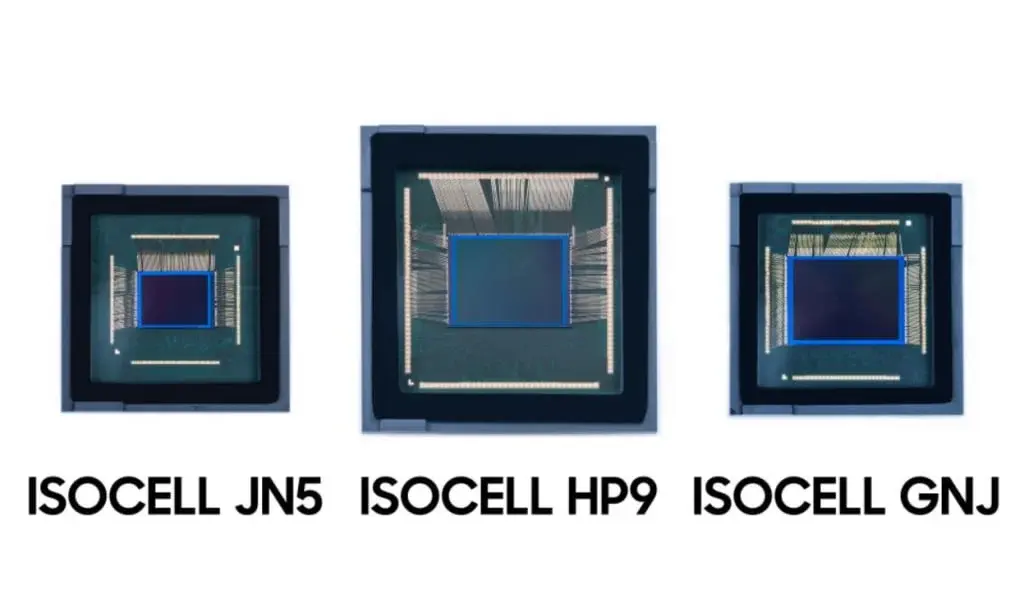
      Samsung has unveiled three new ISOCELL camera sensors: the ISOCELL GNJ, ISOCELL HP9, and ISOCELL JN5. While these sensors are not the flagship models, they are excellent choices for telephoto and ultrawide cameras in smartphones. Various Android smartphone manufacturers, including Samsung, are expected to adopt these sensors going forward.

      ISOCELL GNJ

      The ISOCELL GNJ features a 50MP sensor with 1µm pixels and a 1/1.57-inch optical format. It includes dual-pixel autofocus for quick and precise focusing, even in low-light conditions. The sensor also offers in-sensor zoom, which, when combined with an optical zoom lens, enhances zoom capabilities without significant loss in image quality.

      To improve light collection and minimize unwanted reflections, the GNJ sensor is equipped with an enhanced anti-reflective layer and a high-refractive microlens. It utilizes silicon oxide between pixels to reduce noise. Additionally, it is energy-efficient, consuming 29% less power in preview mode and 34% less power during 4K 60fps video recording.

      ISOCELL HP9

      The ISOCELL HP9 is a 200MP sensor with a 1/1.4-inch optical format and 0.56µm pixels. Compared to the older ISOCELL HP3, it boasts 12% higher light sensitivity and 10% better autofocus. This sensor is suitable for both main and telephoto cameras and is already featured in the Vivo X100 Ultra’s telephoto camera.

      This sensor employs a highly refractive microlens to direct light more effectively to the RGB color filter, enhancing color accuracy, autofocus speed, and light sensitivity. Its 4×4 pixel binning capability allows it to perform well in low-light conditions while creating a realistic background blur. It offers 2x and 4x in-sensor zoom and can achieve up to 12x optical-quality zoom with a 3x optical zoom lens.

      ISOCELL JN5

      The ISOCELL JN5 is a 50MP sensor with a 1/2.76-inch size, ideal for ultrawide cameras in smartphones. It delivers improved autofocus and a broader color range for a consistent camera experience. The sensor employs Dual Vertical Transfer Gate (Dual VTG) technology to enhance pixel charge transfer, minimizing noise in low-light conditions. Super Quad Phase Detection (Super QPD) improves autofocus accuracy by comparing horizontal and vertical phase differences.

      The JN5 sensor utilizes Dual Slope Gain (DSG) for enhanced dynamic range and HDR, amplifying and converting light signals for a wider color gamut. It also features hardware remosaic algorithms for faster capture and real-time zoom preview. Its compact size makes it suitable for front-facing, telephoto, or ultrawide cameras.

      Jesuk Lee, Executive Vice President and CTO of the System LSI Sensor Business Team at Samsung Electronics, commented, “Improving image sensor performance and making main and sub cameras work better together for a consistent photo experience is the new direction of the industry. We will keep setting industry standards and pushing technology boundaries with our new mobile sensors that include the latest advancements.”