
Key Takeaways
1. Mars has significant frozen water, which could aid human habitation.
2. Thick ice walls can raise internal temperatures from -120 °C to -20 °C.
3. Ice blocks harmful UV radiation while allowing visible and infrared light to pass through.
4. Building structures on Mars requires processing large amounts of ice daily, consuming substantial energy.
5. A protective layer on Martian ice could prevent sublimation and improve structural strength.
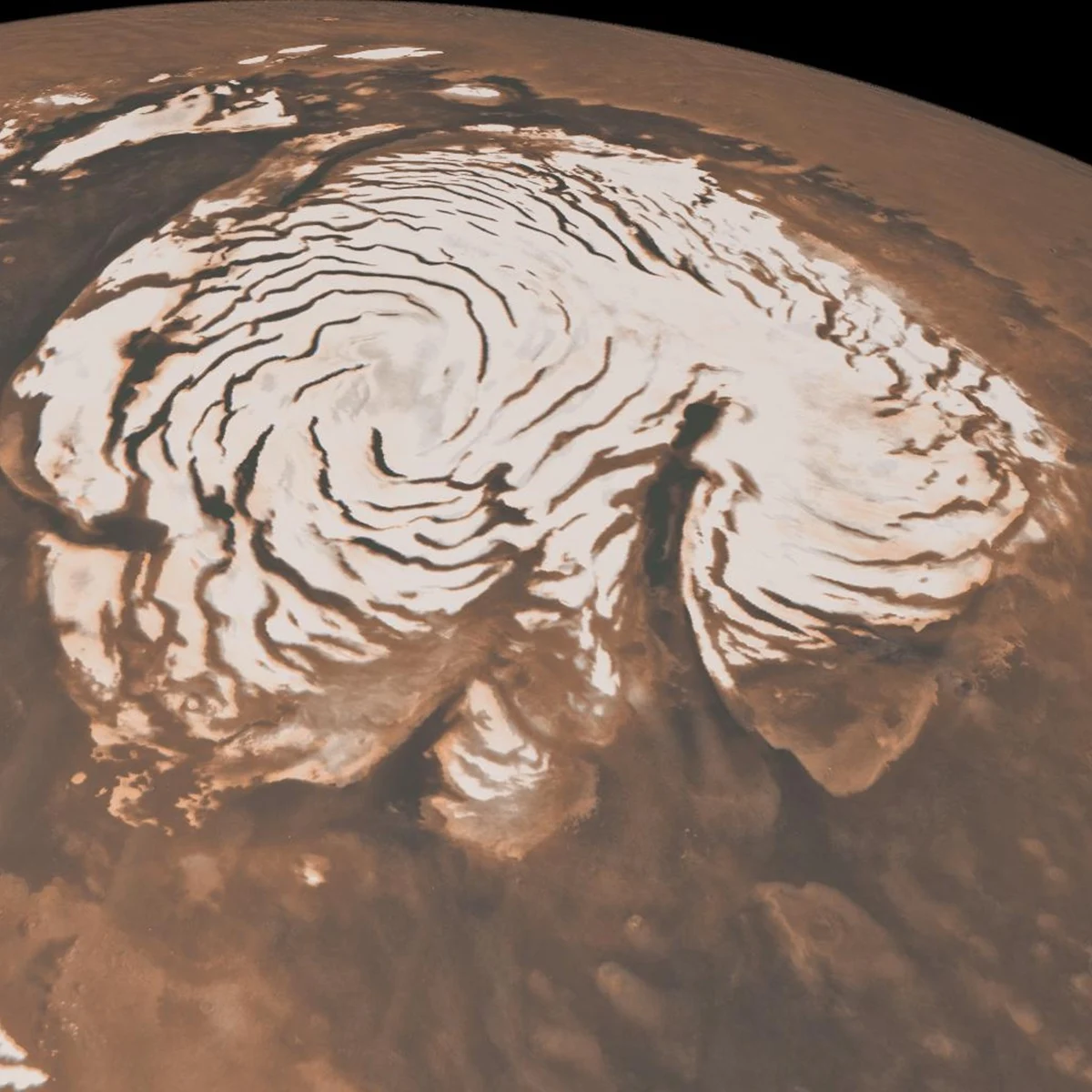
Mars has a significant amount of frozen water either on its surface or beneath it. A new study suggests that this ice could enhance the ability for humans to live on the planet when they arrive.
Ice Thickness and Temperature Rise
The study discovered that ice walls several meters thick could increase the temperature inside from around -120 °C outside to a much warmer -20 °C.
UV Protection and Natural Light
Moreover, researchers found that ice can effectively block a lot of the harmful UV radiation that is prevalent on Mars. Interestingly, while it offers protection from these rays, visible and infrared light can still pass through the ice. This means that people living on Mars can be safeguarded from cosmic rays yet still enjoy some natural lighting.
Challenges in Ice Usage
Despite highlighting the insulating and protective qualities of ice, there are significant challenges to consider. For instance, to build just one structure, it may be necessary to process around 15 square meters of ice each day, which would use a huge amount of energy—comparable to the energy used by the International Space Station. Additionally, ice might lose some of its efficiency as an insulator if it gathers dust.
To combat these issues, the researchers recommend putting a protective, water-resistant layer on Martian ice. This would help to stop sublimation (the process where ice turns straight into gas without becoming liquid) and would also enhance the strength of the structure.
Source:
Link