
Tag: Google Search

  • Google’s AI Highlights Scam Support Numbers to Avoid

    Google’s AI Highlights Scam Support Numbers to Avoid

    Key Takeaways

    1. Scammers are using AI technology to create innovative ways to defraud consumers, including secret phishing messages and voice mimicry.

    2. Individuals should be cautious when using AI-generated summaries for customer service numbers, as they may lead to scams.

    3. A recent incident involved a man who was scammed while trying to book a shuttle for a cruise after calling a fraudulent number found through an AI summary.

    4. Unauthorized charges can occur even when initial information seems correct; consumers should be vigilant with personal details.

    5. Trusting AI summaries and search results is becoming riskier, and users should verify information carefully before sharing sensitive information.


    There have been several instances where scammers are taking advantage of AI technology to defraud consumers in innovative ways. From secret phishing messages to mimicking voices, the latest event serves as a warning for individuals seeking support numbers and dialing the numbers provided by AI summaries. For many people using Google, AI summaries are the initial results that appear when they look for something online.

    A Cautionary Tale

    This story was shared by Alex Rivlin on Facebook (through Digital Trends) while he was in the process of reserving a shuttle for his Royal Caribbean cruise, which would transport him from the downtown area to the port. As Royal Caribbean lacked an online booking system, Rivlin turned to Google to find their customer service number. The first result he encountered was an AI summary that included a recap of his inquiry, along with a support number.

    When Rivlin called the number, he spoke to a person claiming to be from Royal Caribbean who provided all the correct information and requested his credit card details to pay for the shuttle. Following this, the representative mentioned a dock fee, which Rivlin accepted. However, the call then took a turn as they asked for additional personal details. He chose not to disclose more than necessary, and after hanging up, he noticed unauthorized charges on his credit card. Luckily, he managed to contact his credit card company and block those charges without incurring any losses.

    Rising Concerns

    This wasn’t an isolated incident. A few months earlier, a user on Reddit recounted a comparable experience where the customer service number for Southwest Airlines displayed by Google’s AI summary was actually a scam number.

    With scammers developing more advanced methods of employing AI to trick consumers, trusting AI summaries and search results is becoming more difficult. In some instances, even verifying the support number leads to what appears to be a legitimate company customer service line. Additionally, for numerous users, AI summaries are the first results that appear in Google searches. The main point to remember is to exercise extra caution regarding information from AI summaries and to be careful when sharing personal details with those numbers.

    Source:
    Link


  • Simplify Your Vacation Planning with Google Search and Maps Updates

    Simplify Your Vacation Planning with Google Search and Maps Updates

    Key Takeaways

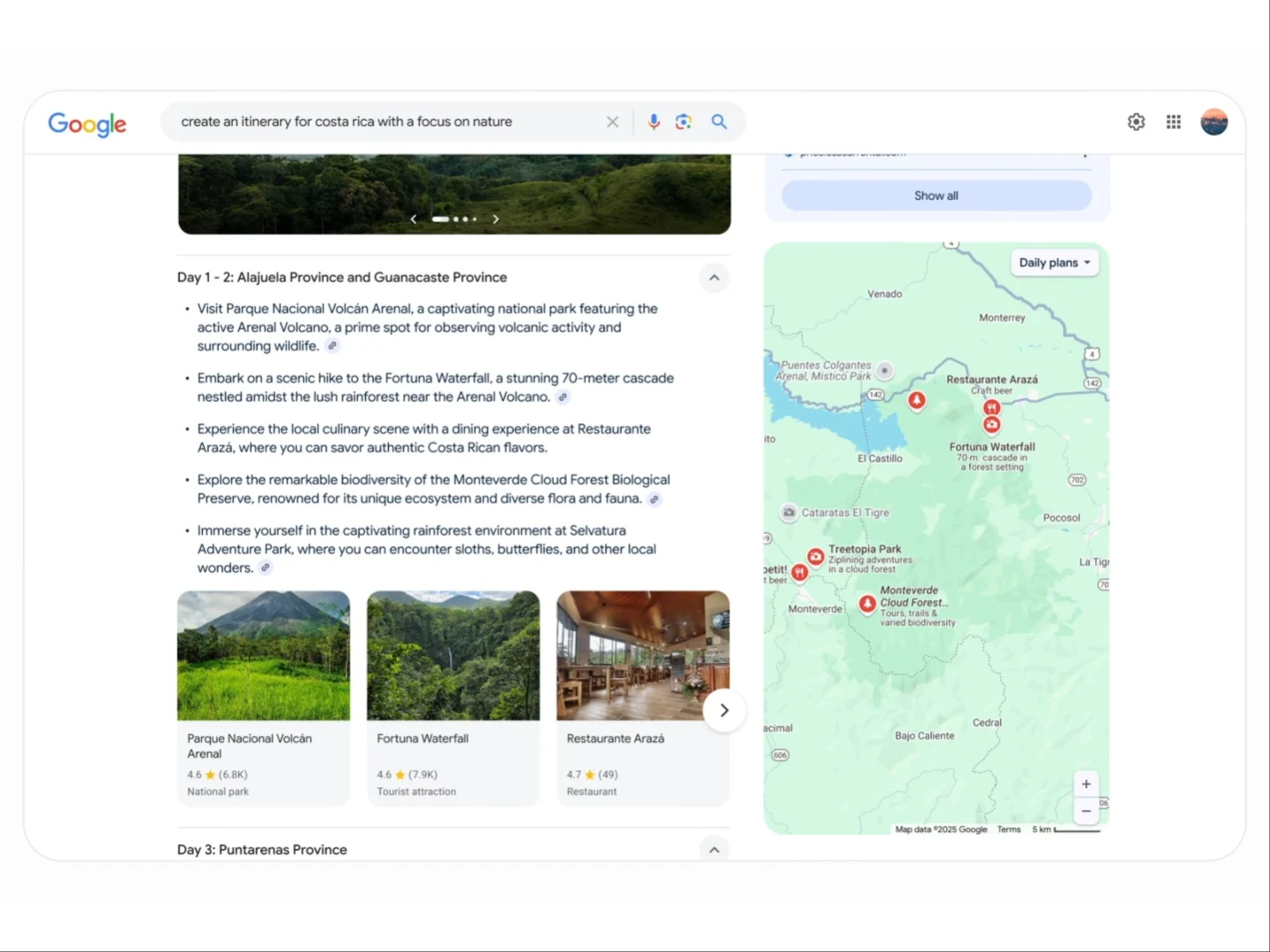
    1. AI Overviews in Search: Users can create detailed travel itineraries for specific destinations with suggestions for activities, images, and reviews, shareable via Google Docs or Maps.

    2. Integrating Screenshots in Maps: Users can now integrate screenshots of locations into Google Maps, which recognizes the places and allows users to save favorites and compile lists.

    3. Personalized Travel Guides with Gemini: The Gems feature lets users create a personal AI travel assistant for recommendations on destinations, dining, and more, along with a hotel price tracking feature.

    4. Ease of Access: New features are launching in the US for English-speaking users on both mobile and desktop platforms, enhancing the planning experience.

    5. Using Lens for Travel Insights: Travelers can use Google Lens to get detailed AI Overviews by simply pointing their camera at an object and asking questions, currently available for English-speaking users.


    Those who are wanting to take a summer vacation can now find more help from Google. A bunch of new features are here to help with planning trips, booking hotels, and exploring sights. These updates are part of Google Search, Google Maps, Lens, and Gemini. One of the key improvements is in AI Overviews, which can suggest trip ideas for various countries and regions, helping users to plan their days effectively while ensuring they don’t miss any attractions they want to see during their holidays.

    AI Overviews in Search

    In Search, AI Overviews can do more than just give a daily schedule; they can also provide suggestions on activities in a specific area or nation with an easy prompt like, “create an itinerary for Costa Rica with a focus on nature.” The output will feature images and reviews to help finalize the chosen spots. When finished, the itinerary can be shared via Google Docs, Gmail, or added to a Google Maps list. This new feature is launching this week in the US for English-speaking users on both mobile and desktop.

    Integrating Screenshots in Maps

    Trip planning usually means taking lots of notes and screenshots. To make this process smoother, Google has added a feature that lets users integrate screenshots into Maps, utilizing Gemini’s abilities. The places shown in the screenshots will be recognized, enabling users to save their favorites and compile a list. These locations will also appear on the map, but Maps will require access to photos for this feature. It will be available in the US on iOS next week, with Android support coming soon thereafter.

    Personalized Travel Guides with Gemini

    Moreover, the Gems feature from Gemini allows users to build their own AI expert at no cost, making it easy to have a travel assistant on their mobile devices at all times. With this tool, users can select a destination, discover dining options, receive recommendations, and much more. On top of that, Google’s hotel search is introducing a price tracking feature for selected dates and locations. This will be available this week on both mobile and desktop platforms.

    Lastly, using Lens, travelers can point their camera at an object and ask a question to receive an AI Overview filled with details and useful links. These overviews in Lens are currently available for English-speaking users.

    Google’s new features are aimed at making travel planning easier and more enjoyable for everyone.

    Source:
    Link

  • Google Search May Introduce Fees for New AI Features

    Google Search May Introduce Fees for New AI Features

    For some time now, Google has been exploring novel AI search functionalities within its Google Search platform. It is worth noting that certain features, like the Search Generative Experience, may not align well with the traditional concept of an ad-supported online environment.

    Google’s Revenue Model and AI Development

    Google garners a substantial portion of its income from advertisements, and there is also a significant investment in developing AI models that ultimately benefit end users. While Google’s primary goal is to enhance the search experience, this evolution raises concerns about the sustainability of the current system. Despite these advancements, the conventional ad-supported Google Search will continue to be accessible at no cost.

    Potential Introduction of Paid AI Features

    According to a report by the Financial Times (subscription-based), there are speculations that Google might introduce AI-powered search features with a monetary value in the upcoming period. Sources familiar with Google’s strategies suggest that these advanced features could be integrated into existing subscription services such as Google One.

    Surprisingly, even with a paid experience, advertisements are expected to be present. This underscores the enduring significance of ads within Google’s business framework. The question arises as to why Google is pushing forth with features that disrupt its established business model.

    The aim appears to be offering a comprehensive solution catering to diverse user preferences. While some individuals may be inclined to pay for an AI-enhanced search experience, the majority might prefer to continue using the service for free. Research indicates that over 70% of users are likely to stick with the no-cost option.

    Regarding Google’s Search Generative Experience (SGE), it is currently undergoing experimental phases. Google emphasizes that this feature is not yet prepared for full-scale production services.