Tag: Geekbench

  • Apple M4 Max Launches on Geekbench with 31% Performance Boost

    Apple M4 Max Launches on Geekbench with 31% Performance Boost

    Earlier today, we witnessed the impressive performance of the Apple M4 Pro, showcased on a premium 16-inch MacBook Pro. In terms of CPU capabilities, it significantly outperformed last year’s Apple M3 Pro and even the M3 Max. Now, we are eager to see the Apple M4 Max, which is touted as Apple’s most powerful laptop CPU, in action.

    Performance Comparison

    When looking at the Apple M4 Max compared to the Apple M3 Max, it shows a remarkable increase in speed—31% faster in single-core tasks and 25% faster in multi-core operations. This is an incredible boost in performance, which can be largely credited to an updated architecture and probably a greater power allowance.

    Graphics Performance

    On the graphics front, the Apple M4 Max achieved an impressive score of 192,532 points in Geekbench’s Metal benchmark, outperforming the Apple M3 Max’s score of 155,214 by 24%. While the benchmark doesn’t clearly state that the GPU consists of 40 cores, the other specifications, including a 16-core CPU and 128 GB of RAM, strongly suggest that it does.

    Future Competitiveness

    The Apple M4 Max is quickly becoming one of the most formidable laptop CPUs released this generation. Currently, there’s nothing from Intel, AMD, or Qualcomm that can compete with it, though this may change once AMD’s Strix Halo CPUs are released next year.

    If Apple chooses to pair two M4 Max chips together and introduce an M4 Ultra, it could really spell doom for competitors. However, the M3 Ultra never materialized, and up until now, there haven’t been many rumors suggesting such a chip is in the works.


    Image 1
    Image 1
  • Apple M4 Pro Debuts on Geekbench with Amazing Performance Boost

    Apple M4 Pro Debuts on Geekbench with Amazing Performance Boost

    The Apple M4 Pro has just appeared on Geekbench alongside what looks to be a 16-inch MacBook Pro. This version is the high-end model, featuring a 14-core CPU, a 20-core GPU, and 48 GB of RAM. It shows a remarkable improvement from the M3 Pro, enhancing both CPU and GPU performance.

    Performance Scores

    In Geekbench’s single-core and multi-core tests, the M4 Pro achieved scores of 3,925 and 22,669 points, respectively. This translates to a 25% increase in single-core performance and a 46% boost in multi-core performance compared to the Apple M3 Pro’s scores of 3,138 and 15,480. While the multi-core improvement was anticipated due to the additional CPU cores, the surge in single-core performance is truly impressive, likely because the M4 Pro can reach speeds of 4.51 GHz as opposed to the 4.06 GHz of the M3 Pro. Actually, the M4 Pro’s multi-core score surpasses that of last year’s 16-core M3 Max, which scored 21,253 points in the benchmarks.

    GPU Performance

    We also get a glimpse of the M4 Pro’s 20-core GPU performance through Geekbench’s OpenCL benchmark, where it scored 69,867 points. This marks a 38% enhancement over the Apple M3 Pro’s score of 50,373. Although it falls short of the M3 Max’s impressive 40-core GPU score of 91,413, it’s only 31% slower despite having half the cores, which is quite remarkable. With the M4 Pro performing so well, it will be fascinating to see what Apple’s top-tier M4 Max has to offer for MacBook users.


    Image 1
    Image 1
  • AMD Ryzen 7 9800X3D Debuts on Geekbench with Strong Performance

    AMD Ryzen 7 9800X3D Debuts on Geekbench with Strong Performance

    Supposed marketing material from AMD suggests that the Ryzen 9 9800X3D will provide only a small 8% performance increase over the Ryzen 7 7800X3D, especially in gaming scenarios. In synthetic benchmarks, the X3D version will likely fall short when compared to its regular counterpart, the Ryzen 7 9700X, due to lower boost clock speeds. This information is supported by two separate Geekbench listings for the Ryzen 9 9800X3D.

    Geekbench Performance

    In its first test, the CPU achieved scores of 3,295 and 18,560 in Geekbench 6.2’s single-core and multi-core assessments. During its second test, it recorded 3,305 and 18,221 points. Although these scores are close enough to be within the margin of error, they were obtained from different platforms. The first test was conducted on a Biostar X870E motherboard with 48 GB of DDR5-8000 RAM, while the second utilized an Asus ROG Crosshair X870E motherboard with the same memory configuration.

    Boost and Comparisons

    For the second test, the Ryzen 9 9800X3D reached a boost speed of 5.3 GHz. It’s unclear if these results were achieved at stock settings, but it probably represents the maximum performance one could expect right out of the box. Not surprisingly, it lags behind the Ryzen 7 9700X, which scores around 3,400 in single-core performance, but performs slightly better in multi-core tests. When compared to the Ryzen 7 7800X3D, which has scores of about 2,700 for single-core and 14,000 for multi-core, the Zen 5 model displays a notable 22% improvement in single-core and a 30% boost in multi-core performance. Naturally, X3D chips may not excel in synthetic benchmarks, so it would be wise to wait for more gaming benchmarks to make a fair evaluation.

    via @Olrak29_ on X’


    Image 1
    Image 1
  • Xiaomi 15 Launching with Boosted Performance from Snapdragon 8 Elite

    Xiaomi 15 Launching with Boosted Performance from Snapdragon 8 Elite

    Xiaomi’s Upcoming Release

    The Xiaomi 15 is set to launch soon, according to a recent leak. Xiaomi has announced the unveiling of its new flagship smartphones later this month. Meanwhile, the Xiaomi 15 has already appeared on Geekbench, showcasing what looks like Qualcomm’s latest Snapdragon 8 Elite chipset.

    Recent Geekbench Activity

    Building on recent leaks, nearly one hundred Geekbench entries have been noted in just about two days. It appears that all these entries highlight the Xiaomi 15 featuring 16 GB of RAM. Furthermore, the Xiaomi 14 (currently priced at $779.99 on Amazon) suggests that this RAM configuration could be one of many options Xiaomi will provide both domestically and globally.

    Operating System and Performance

    Moreover, the Xiaomi 15 seems to be running Android 15, along with Xiaomi’s HyperOS 2.0 installed on top. The Snapdragon 8 Elite chipset allows this device to significantly outperform its predecessor and other competitors using Snapdragon 8 Gen 3.

    Performance Metrics

    For context, the Snapdragon 8 Gen 3 typically scores 2,106 in single-core and 6,638 in multi-core benchmarks on Geekbench 6. In comparison, the Snapdragon 8 Elite within the Xiaomi 15 averages 3,043 and 9,385 in those same benchmarks, translating to a remarkable 45% and 41% increase in performance, respectively. These upgrades reflect Qualcomm’s statements made during the Snapdragon 8 Elite announcement; refer to our launch article for additional insights on Qualcomm’s recent chipset.

    GPU Capabilities

    In a similar vein, Qualcomm’s latest Adreno GPU is proving to be much more robust than the Adreno 750 found in the Snapdragon 8 Gen 3. To provide perspective, the Snapdragon 8 Gen 3 generally scores around 13,947 in Geekbench 6 OpenCL and 15,837 in Geekbench 6 Vulkan, with maximum scores of 15,678 and 17,531. In contrast, Qualcomm’s new Adreno GPU consistently achieves scores above 18,000 in OpenCL and 24,000 in Vulkan.

    Geekbench (1) (2) via GSMArena


    Image 1
    Image 1
    Image 1
  • Xiaomi 15 Geekbench Score Revealed with Snapdragon 8 Elite Processor

    Xiaomi 15 Geekbench Score Revealed with Snapdragon 8 Elite Processor

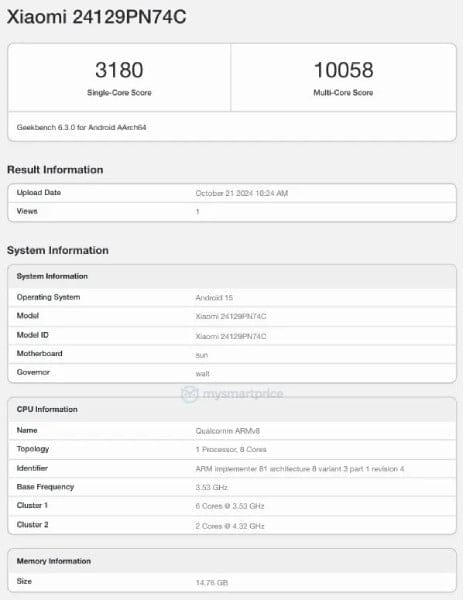
    Xiaomi seems to be getting ready to launch its upcoming flagship smartphone series, the Xiaomi 15. A device thought to be part of this lineup has recently shown up on the Geekbench benchmarking site, with a chip that will be revealed just hours from now.

    Geekbench Findings

    This device is believed to be the standard Xiaomi 15, which carries the model number 24129PN74C. It’s expected to be equipped with the Snapdragon 8 Elite SoC, which Qualcomm is set to announce at an event today. The chipset received scores of 3180 in single-core tests and 10058 in multi-core tests. This marks a significant upgrade compared to the previous Xiaomi 14, which typically scored around 2100 and 6700, respectively.

    Specifications and Features

    The Geekbench listing also indicates that the Xiaomi 15 will come with 16GB of RAM and will operate on an Android 15-based system right out of the box. This fits our predictions for flagship devices that are set to launch in late 2024. Furthermore, there are rumors that the Xiaomi 15 series will comprise three models: the standard Xiaomi 15, a Pro variant, and an Ultra version. While the Ultra model may debut next year, it seems the standard and Pro versions could be the first to utilize Qualcomm’s latest and most powerful Snapdragon chip.

    Market Availability and Charging Capabilities

    On a global scale, it’s likely that we will only see the Xiaomi 15 and 15 Ultra, as the company launched their respective predecessors only last year. Moreover, information from the 3C certification website shows that both the Xiaomi 15 and 15 Pro will support up to 90W wired charging with MDY-14-EC adapters, following in the footsteps of their predecessors.

    Despite all this information, Xiaomi has yet to officially confirm any specifics about the Xiaomi 15 series. Thus, it’s wise to approach these details with a degree of skepticism until official announcements are made.

  • Samsung Galaxy A36 5G Specs Leaked Ahead of Release

    Samsung Galaxy A36 5G Specs Leaked Ahead of Release

    The Galaxy A35 5G, currently priced at $257.50 on Amazon, has been around for just a little over six months. However, there are already signs that a successor might be on the way, as it has appeared in no less than nine listings on Geekbench. Like always, the benchmarking site does not disclose the device’s final retail name or provide any visual details.

    ### Details on the Galaxy A36 5G

    All the Geekbench listings indicate that the Galaxy A36 5G has been tested with 6 GB of RAM. This is probably the lowest RAM option for this model, considering what we know about its predecessor. Furthermore, it looks like Samsung is planning to swap out the Exynos 1380 chip that powers the Galaxy A35 5G for a new chipset from Qualcomm.

    ### Potential Chipset Options

    Once again, Geekbench does not specify which chipset is being used. However, the identifier ARM implementer 65 architecture 8 variant 1 part 3393 revision 2 gives us some hints, along with its CPU layout. It appears that Samsung is choosing among three possibilities, which may include the Snapdragon 6 Gen 3, Snapdragon 7 Gen 1, or Snapdragon 7s Gen 3. Unfortunately, it’s still unclear which chipset will actually be included in the Galaxy A36 5G; while the GPU suggests it might be the Snapdragon 6 Gen 3 or Snapdragon 7s Gen 3, its CPU setup indicates that the Snapdragon 7 Gen 1 could be the one being used.

    ### Conclusion

    In conclusion, the information available suggests that the Galaxy A36 5G is shaping up to be an interesting successor to the Galaxy A35 5G. With its potential new chipset and RAM configurations, fans are eagerly awaiting more details to confirm what this new device will offer.

    ***

    Image 1
    Image 1
  • Exynos 2500 Geekbench: Unique CPU Setup, Weak GPU Performance

    Exynos 2500 Geekbench: Unique CPU Setup, Weak GPU Performance

    Even with increasing signs of the Exynos 2500’s delay, Samsung has yet to make a final decision about it and intends to do so shortly. We had a sneak peek at the SoC on PowerBoard, where its GPU displayed a solid improvement compared to previous generations. In contrast, its performance on Geekbench isn’t as striking.

    Performance Metrics

    The Exynos 2500 (s5e9955) achieved a score of 15,960 points in Geekbench’s OpenCL test. This score falls short when compared to the Exynos 2400’s Xclipse 940, which scored 16,946 points in the same benchmark. However, it’s worth considering that what we’re seeing might be a pre-production version, and the scores are likely to improve as development continues. The Xclipse 950 has a maximum clock speed of 1.3 GHz and features 8 WGPs (which equate to 16 CUs).

    CPU Architecture Insights

    We’ve also caught our first look at the Exynos 2500’s CPU configuration. Unlike its predecessor, which had a 1+2+3+4 layout, this new chip opts for a unique 2+5+3 arrangement. The two E-cores operate at 1.75 GHz, the five mid-tier cores run at 2.25 GHz, and the three P-cores clock in at 2.59 GHz. Naturally, these clock speeds are not set in stone and may be altered before the product’s official launch. When it comes to raw clock speed, the Exynos 2500 lags significantly behind competitors like the Dimensity 9400 and Snapdragon 8 Gen 4 (also known as Snapdragon 8 Elite), making it interesting to see how it will compete in the market.

    Geekbench


    Image 1
  • Redmi 14C 5G Geekbench: Over 100% Performance Boost vs 4G

    Redmi 14C 5G Geekbench: Over 100% Performance Boost vs 4G

    Redmi 14C 4G was introduced in August with the Helio G81 Ultra processor. Now, a 5G variant has appeared on Geekbench, showcasing a new chipset that achieves scores of 917 for single-core and 2182 for multi-core performance.

    Performance Comparison

    In comparison, the Redmi 14C 4G scores about 418 and 1390 in the same tests. Therefore, the new 5G model promises a much smoother experience for everyday tasks along with faster internet connectivity.

    Chipset Details

    The motherboard details revealed in the Geekbench listing confirm that the new chipset is the Snapdragon 4 Gen 2, which is manufactured using an efficient 4nm process. This chipset features a 6+2 core setup: six cores running at 1.96GHz for efficiency and two high-performance cores at 2.21GHz. The listing also indicates that it supports 8GB of RAM and runs on Android 14.

    What’s Coming with Redmi 14C 5G?

    Previous reports indicate that this phone is essentially a rebranded version of the Redmi 14R 5G, which was released in China the previous month. The 14R 5G boasts a substantial 6.88-inch HD+ (720 x 1640) display that achieves a peak brightness of 600 nits in direct sunlight and 450 nits manually. This brightness level is decent for its price range. It also houses a large 5160mAh battery.

    Camera and Storage Specs

    When it comes to cameras, the phone features a dual-camera setup on the back: a 13MP main camera paired with a 2MP macro lens, along with a 5MP front-facing camera for selfies. The Snapdragon 4 Gen 2 chip is combined with UFS 2.2 storage, offering an upgrade from the slower eMMC storage found in the Redmi 14C 4G, which is likely to result in quicker app loading times.

    Release and Pricing Insights

    The Redmi 14C 5G has already been spotted in Xiaomi’s HyperOS source code and the IMEI database, hinting at a near release. As for the price, 91mobiles reports that it could be launched in India at a price range of Rs 10,000 – 12,000. For reference, the 4G version was launched globally at a price of $119 USD, which is approximately Rs 10,000.


    Image 1
  • iQOO 13 Outperforms Galaxy S25 Ultra in Geekbench Test

    iQOO 13 Outperforms Galaxy S25 Ultra in Geekbench Test

    iQOO 13 is set to be launched at the end of October, likely shortly after the introduction of the Snapdragon 8 Gen 4 processor. The company has shared some details about the smartphone, showcasing its design, display attributes, and the addition of the Supercomputing Chip Q2 that operates alongside the main processor in specific situations.

    Geekbench Performance Scores

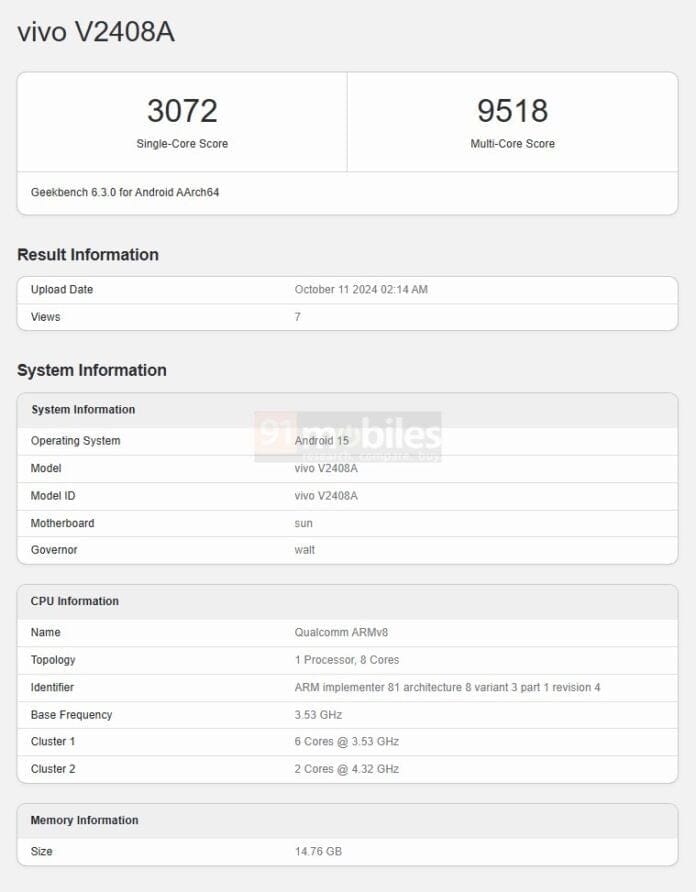
    Recently, the device was listed on Geekbench with impressive single-core and multi-core scores of 3072 and 9518, respectively. When compared to the leaked Geekbench score of the Galaxy S25 Ultra from a few days ago, the single-core result is nearly the same, but the multi-core score surpasses it—the S25 Ultra managed to score 9080 points. It’s important to note that the S25 Ultra utilizes an overclocked "For Galaxy" version of the chipset. The enhanced performance showcases the efficiency of the redesigned heat dissipation system in the iQOO 13, which a company representative mentioned earlier.

    Snapdragon 8 Gen 4 Specifications

    The Geekbench listing also validates the speculated 6+2 core configuration, where the two cores are aimed at enhancing performance. As per the listing, all six efficiency cores achieve a clock speed of 3.53GHz, while the performance cores can reach up to 4.3GHz, which is a notable increase from the previous model. Regarding gaming capabilities, earlier rumors suggested that the chipset could offer up to a 56% boost in GPU performance compared to its predecessor.

    Nevertheless, even though the new chipset presents a revised core architecture, it’s premature to assess its power efficiency based solely on the more efficient 3nm process node. It’s also essential to highlight that the device is equipped with a large 6,150mAh battery, which is an upgrade from the iQOO 12’s 5,000mAh, allowing for a significantly extended battery life. This comes alongside support for 100W PD/PPS charging.

    Display and Software Features

    On the front, the iQOO 13 sports a 6.7-inch 2K AMOLED display that incorporates BOE’s latest luminescent material, promising enhanced brightness and more precise color representation. For the software experience, users will engage with Vivo’s Android 15-based OriginOS 5 interface, which provides smoother animations, a more practical ‘Atomic Island,’ and Vivo’s self-developed AI assistant.


    Image 1
  • Dimensity 9400 GPU Performance: What You Need to Know

    Dimensity 9400 GPU Performance: What You Need to Know

    MediaTek has been making waves lately, particularly with news surrounding its upcoming Dimensity 9400 processor. Recently, it achieved a remarkable milestone by recording the highest score for an Android device on AnTuTu. Now, the spotlight shifts to its GPU performance on another benchmarking site, Geekbench.

    Geekbench Performance of the Dimensity 9400 GPU

    The Dimensity 9400 is equipped with the Arm Immortalis-G925 MP12 GPU, which secured a score of 16,257 points in Geekbench’s OpenCL benchmark. While this score surpasses that of the Dimensity 9300, the new system-on-chip (SoC) only shows a 10% improvement over its predecessor. ARM, the company behind the GPU, has promoted the Immortalis-G925 as “the highest performing, most efficient GPU” to date; however, this Geekbench result raises some questions.

    Understanding Benchmark Limitations

    Before making any sweeping conclusions about the Dimensity 9400’s graphics capabilities, it’s crucial to acknowledge the limitations of benchmarking tests. While Geekbench provides a useful insight into overall performance, it may not capture the complete picture. A previous leak hinted that the Immortalis-G925 could outperform the Apple A18 Pro in the GFXBench Aztec 1440p off-screen Vulkan benchmark, suggesting that the Dimensity 9400 might excel in practical applications.

    Given this information, there remains a possibility that the Dimensity 9400 could deliver significantly better performance in real-world gaming and demanding tasks.

    Impressive Specifications

    Examining the specs, the Immortalis-G925 boasts impressive features, including 12 compute units and a peak clock speed of 1.62 GHz, placing it among the fastest smartphone GPUs available. It’s worth noting that the benchmark test was performed on an unreleased Vivo X200 series device, which may not have been fully optimized for the Dimensity 9400.

    The official unveiling of the Dimensity 9400 is set for October 9th, which should provide a more accurate understanding of the Immortalis-G925’s true performance capabilities. Until then, it is wise to refrain from making any conclusive assessments based solely on Geekbench results.


    Image 1