
Tag: eVTOL

  • New Electric Air Taxi with 621-Mile Range Launches in Wuhan

    New Electric Air Taxi with 621-Mile Range Launches in Wuhan

    Key Takeaways

    1. Four eVTOL vehicles were showcased in Wuhan, signaling progress in China’s low-altitude economy.
    2. The eVTOL industry is moving towards real-world applications, with 2026 seen as a key year for large-scale production.
    3. Innovations like the E-Hawk and V1000 highlight advancements in urban air mobility and long-distance travel.
    4. The industry is exploring emergency applications, exemplified by the Sparrow-X2, which reduces rescue costs significantly.
    5. China has 547 companies in the eVTOL field, benefiting from investments and increasing aviation patent activity.


    On February 24, four unique electric vertical takeoff and landing (eVTOL) vehicles were prominently displayed outside the Hongshan Auditorium in Wuhan, located in Hubei province. This event, held during the first provincial meeting after the Spring Festival, marks a significant leap forward for the nation’s low-altitude economy.

    Transitioning to Reality

    The eVTOL industry is swiftly moving from just an idea to a real-world application, greatly aided by its strong ties with current new energy vehicle supply chains. Industry experts see 2026 as a crucial year for large-scale production, prompting local developers to race against time to obtain necessary certifications and begin commercial passenger flights.

    Showcasing Innovation

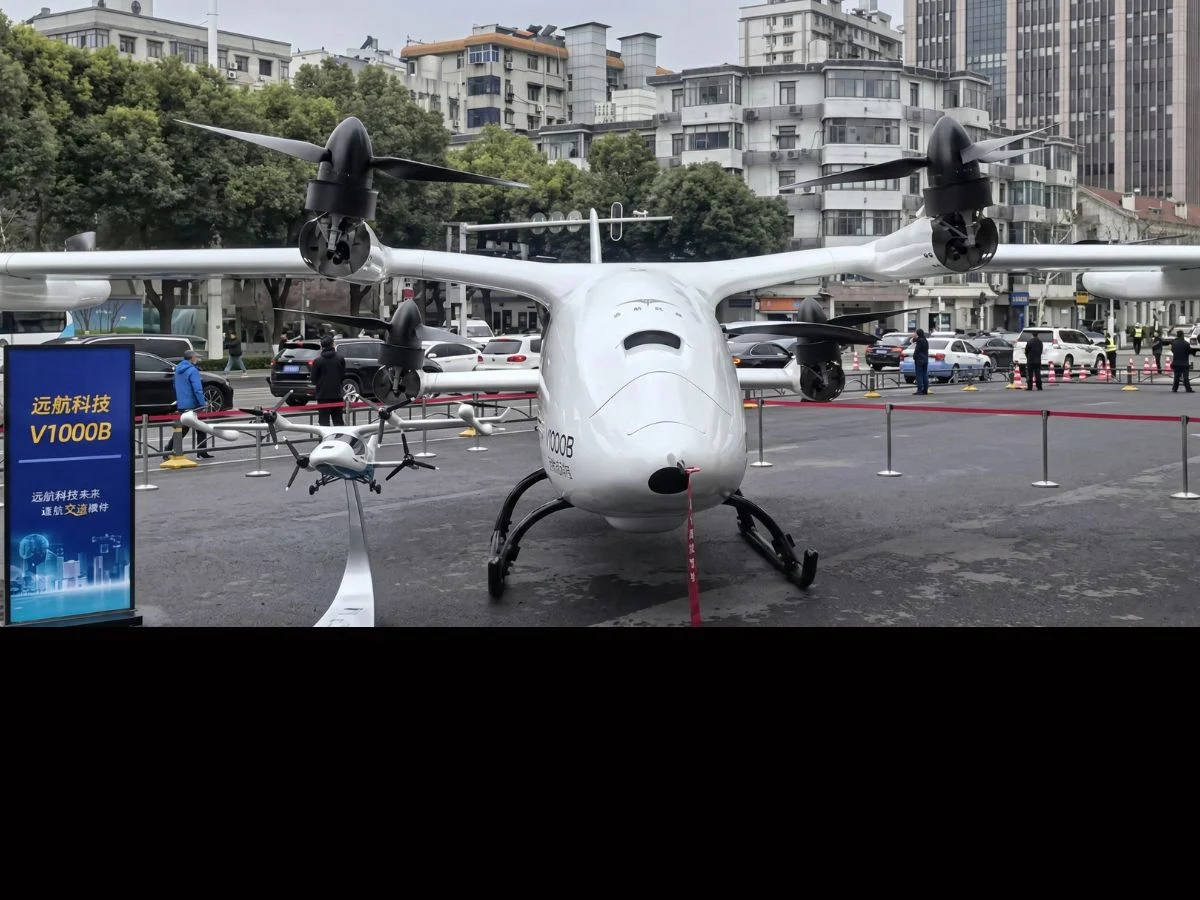
    The aircraft on display reflect Hubei’s rich history in aviation manufacturing, a province that recorded an impressive 27.9 billion yuan in aviation revenue in 2025. One notable innovation is the E-Hawk, a ton-class vehicle equipped with enclosed rotors, which can transport four passengers for short urban trips. To tackle concerns about distance, Wuhan Xunqi Technology showcased the V1000, utilizing a hybrid tilt-rotor design that allows it to fly over 1,000 kilometers. This model has already secured formal design approval from the Civil Aviation Administration of China. Additionally, Shi Yun Aviation introduced the SW-one, an aircraft operated with a conventional steering wheel, targeted for personal water sports and tourism in the future.

    Expanding Applications

    In addition to models meant for commuting and leisure, the industry is also exploring vital emergency uses. Fusheng General Aviation unveiled the Sparrow-X2, an airborne intensive care unit equipped to carry a stretcher and medical monitoring tools. This all-electric aircraft lowers hourly emergency rescue costs to about 2,200 yuan, which is a significant reduction compared to the expenses of using traditional helicopters.

    With 547 companies linked to this field across the country and a notable increase in aviation patent applications, the domestic sector is taking advantage of substantial investments to create a strong presence in the future of aerial mobility on a global scale.

    Source:
    Link


  • AutoFlight Launches First eVTOL Air Taxi Water Landing Platform

    AutoFlight Launches First eVTOL Air Taxi Water Landing Platform

    Key Takeaways

    1. AutoFlight has introduced the first “sea-air mobility solution” with a floating airport for eVTOL aircraft landings on water.
    2. The eVTOL take-off platform features autonomous charging using solar panels and energy storage systems.
    3. The Water Vertiport supports various applications, including urban air taxis, emergency responses, and recreational flights.
    4. The platform can be quickly deployed in different water bodies and supports coordinated operations through a “Sea-Air Super Hub.”
    5. AutoFlight has secured orders for over 2,000 units and aims to reduce emergency response times and improve offshore maintenance efficiency.


    AutoFlight, a company that designs electric vertical take-off and landing (eVTOL) aircraft and is supported by battery manufacturer CATL, has unveiled the first “sea-air mobility solution.” This innovation is essentially a floating airport designed for eVTOL landings, which can be set up anywhere on the water.

    Autonomous Charging Capabilities

    The eVTOL take-off platform operates on its own and can recharge the aircraft using its solar panels and energy storage systems. AutoFlight specializes in creating electric aircraft for various uses, including passenger transport, cargo delivery, rescue missions, firefighting, air taxi services, and other commercial applications that do not require lengthy runways for takeoff or landing.

    Versatile Applications for Urban Mobility

    With the introduction of the eVTOL Water Vertiport, the firm aims to provide comprehensive air, land, and sea services for uses like urban air taxis, emergency responses, maintenance of ocean oil rigs, or simply recreational flights to popular tourist spots.

    In addition to the landing area and charging facilities, the Vertiport includes a dispatch center and communication systems, allowing it to be rapidly deployed in different bodies of water such as lakes, rivers, or oceans. Multiple eVTOL solutions can be deployed to create a “high-throughput, distributed Vertiport cluster,” which supports large-scale coordinated operations for wider coverage and smarter applications, according to AutoFlight, or what they refer to as a Sea-Air Super Hub.

    Expanding Market Potential

    The company, which has received significant investments from CATL, has already secured orders for over 2,000 units. It claims that the water landing platform will reduce emergency response times by 50% and make the maintenance of offshore wind farms and oil rigs up to ten times quicker. In the air taxi industry, it has the potential to provide shortcuts to airports or city centers, alleviating the burden on crowded transport networks.

    The emerging eVTOL market is gaining momentum, and CATL aims to capture a substantial share to boost its electric vehicle battery sales. They are also developing compact batteries for electric aircraft with a range of 2,000 miles, alongside standardized swap stations and other charging infrastructures to enhance their market presence.


    Source:
    Link