Key Takeaways
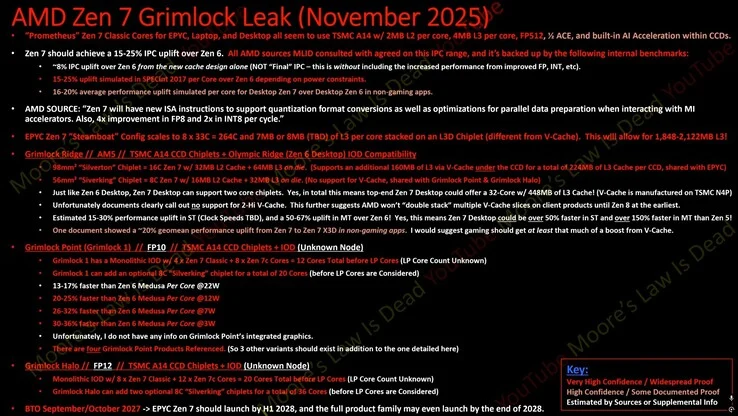
1. AMD Zen 7 Architecture: AMD’s Zen 7 will utilize TSMC’s advanced A14 node, with production expected to start in 2028, moving away from N2X due to delays.
2. Chiplet Variants: Two chiplet options named Grimlock will be released: Silverton with 16 cores and 3D V-cache support, and Silverking with 8 cores and no 3D V-cache.
3. Performance Potential: Zen 7 could feature up to 32 cores and 448 MB of 3D V-cache in a dual CCD consumer-grade CPU, possibly seen in the Ryzen 9 9950X3D2.
4. Laptop Innovations: New laptop models, Grimlock Point and Grimlock Halo, will combine different types of cores for improved performance, including Classic, Dense, Efficiency, and Low-Power cores.
5. Power Efficiency Improvements: Zen 7 laptops may achieve significant performance-per-watt gains, with efficiency increases ranging from 17% to 36% at various power levels.
Moore’s Law is Dead has revealed a significant leak regarding AMD’s Zen 7 architecture. This new information expands on earlier leaks about Zen 7 and provides details on its specifications, performance enhancements, and a possible release timeframe. It covers a variety of products, including consumer desktops, laptops, and server solutions.
Manufacturing Insights
Tom had mentioned that AMD Zen 6’s CCD would be fabricated using TSMC’s N2X node. However, TSMC’s latest roadmap indicates that mass production of N2X is expected to begin in 2027, leading AMD to likely transition to the N2P node. Zen 7 is set to follow this trend by utilizing TSMC’s advanced A14 node, which is projected to hit high-volume manufacturing in 2028.
Chiplet Details
AMD plans to release two Zen 7 chiplets known as Grimlock. The Silverton variant boasts 16 Zen 7 cores, a 32 MB L2 cache, a 64 MB L3 cache, and can support a 160 MB 3D V-cache tile per CCD. On the other hand, Silverking is a scaled-down option featuring 8 Zen 7 cores, a 16 MB L2 cache, a 32 MB L3 cache, and lacks support for 3D V-cache. Silverton is expected to appear in Epyc and premium Ryzen 13,000 series CPUs, while Silverfish will mainly cater to high-performance laptop components.
Performance Potential
Similar to Zen 6, Zen 7 will support two CCDs per die. With each CCD containing 16 cores, the highest-spec model could potentially feature 32 cores and a staggering 448 MB of 3D V-cache. However, this scenario will only materialize if AMD decides to introduce a consumer-grade CPU equipped with dual CCDs. We might witness this technology in action next year with the rumored Ryzen 9 9950X3D2.
Laptop Innovations
For laptops, Grimlock Point and Grimlock Halo will adopt the Strix/Medusa approach, blending Zen 7 with Zen 7c cores. Tom’s earlier leak noted that this generation would include four distinct types of CPU cores: “Classic,” “Dense,” “Efficiency,” and “Low-Power.” Grimlock Point will feature 4 Zen 7 cores alongside 8 Zen 7C cores, while Grimlock Halo (the successor to Medusa Halo) will launch with a configuration of 8 Zen 7 and 12 Zen 7C cores. Both models will also include an unspecified number of Zen 7 Low-Power cores.
Performance Metrics
Zen 7 desktop components are expected to deliver an average performance boost of 16-20% in non-gaming tasks compared to Zen 6. The IPC gain, however, is not as remarkable at 8%, though this number is still subject to change. In single-threaded tasks, Zen 7 desktops could show improvements of up to 20%, while multi-core performance could increase by 67%.
Power Efficiency
On the laptop front, Grimlock Point and Grimlock Halo could showcase significant enhancements in performance-per-watt, with potential increases of up to 36% at 3 watts, 32% at 7 watts, 25% at 12 watts, and 17% at 22 watts. This efficiency is expected to benefit chips like the anticipated Ryzen Z4 Extreme and aid OEMs and users in achieving better performance from portable gaming consoles.