
Key Takeaways
1. Handheld 3D Scanning Setup: The Asus ROG Xbox Ally X and Orbbec Gemini 336L depth sensor create a portable 3D scanning system using Dot3D software on Windows.
2. Real-Time Mapping: The setup allows for real-time scanning and mapping of indoor spaces, with a live interface showing depth visualization and mesh reconstruction.
3. Portable Advantage: Unlike traditional bulky scanners, this configuration leverages a handheld gaming PC for mobility and ease of use in 3D scanning.
4. Cost Considerations: The overall cost includes the scanner at around $379 and a subscription for Dot3D software, making it more suitable for professional rather than casual use.
5. Accuracy Limitations: While scans are usable, they may lack the precision of dedicated high-end scanning systems, highlighting the trade-off between mobility and accuracy.
A recent video shared on Reddit displays a handheld gaming PC being utilized as a portable 3D scanning rig. This setup combines the Asus ROG Xbox Ally X with an Orbbec Gemini 336L depth sensor, operating Dot3D scanning software on Windows. The outcome is a compact system capable of capturing entire indoor spaces while being carried like a gaming console.
Simple Hardware Setup
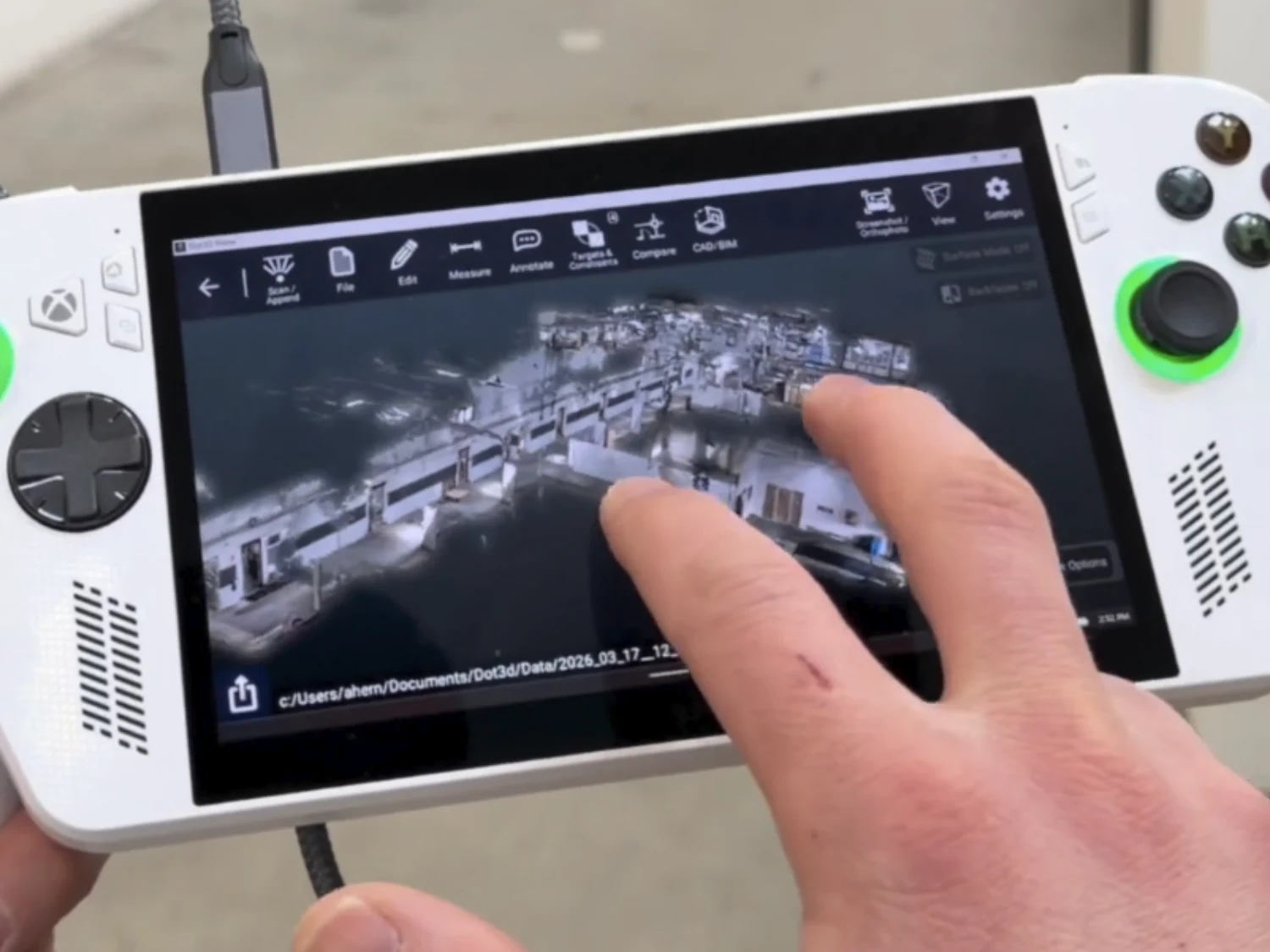
The hardware configuration is straightforward. The Orbbec 336L sensor is attached to the rear of the ROG Ally and linked through USB. The handheld device runs the complete Windows version of Dot3D, managing real-time mapping, capturing, and post-processing. Throughout the demonstration, viewers can notice a live scanning interface displaying depth visualization, mesh reconstruction, and navigation tools. As the user walks through a hallway, the software constructs a 3D model in real-time.
Detailed Scanning Results
Another segment shows the finalized scan as a comprehensive floor layout, including hallways, rooms, and structural elements. The mesh can be navigated directly on the handheld device, complete with pinch-to-zoom and rotation features. Nonetheless, there are some artifacts present. Certain surfaces appear noisy or unfinished, particularly around edges and ceilings. Still, the overall structure is suitable for practical applications. Additionally, the creator has shared sample datasets that include compressed models on Sketchfab and full-resolution files via Dropbox, offering a look at much higher detail than what is featured in the video.
Portable Solutions in 3D Scanning
While portable 3D scanning is not a new concept, it typically involves bulkier rigs or laptops. Devices like LiDAR-enabled iPads or tripod-based scanners are more common in fields such as real estate and construction. What makes this setup unique is the incorporation of a gaming handheld as the computing unit. The ROG Ally’s Ryzen Z1-series chip seems quite capable of managing real-time processing without needing additional hardware.
Cost and Complexity Considerations
From a technical standpoint, the concept is logical. A handheld PC includes a built-in display, battery, and sufficient GPU power to handle depth data processing. The downside is the cost and complexity involved. The scanner, priced at approximately $379, along with the Dot3D software, which is subscription-based and often costs around $999 per year, indicates that this is not just a casual setup—it leans more toward a professional tool. Moreover, there remains a concern regarding accuracy. Although the scans appear usable, they probably won’t reach the precision of dedicated high-end scanning systems.
Nevertheless, if you’re already using tools like Dot3D, swapping out a laptop for the ROG Ally could certainly enhance the mobility of your workflows, and this video serves as evidence of that.
Source:
Link