Tag: Arc 140V

  • Lenovo launches lightweight 14-inch laptop with dual SSDs, 120Hz display

    Lenovo launches lightweight 14-inch laptop with dual SSDs, 120Hz display

    Key Takeaway

    – Launches IdeaPad Slim 5 Ultra 14ILL11, using Intel’s older Lunar Lake platform with Arc 140V iGPU for better graphics.
    – 22% lighter than the previous Slim 5 model (1.06 kg with OLED, 1.14 kg with IPS).
    – Configurable with 16 GB or 32 GB RAM via Core Ultra 5 226V/228V or Core Ultra 7 256V processors.
    – Features dual M.2 slots (2242 PCIe 4 x4 and 2280 PCIe 4 x2) and a 65 Wh battery with anodised aluminium housing.
    – Pricing and availability not yet announced.


    A Fresh IdeaPad from Lenovo

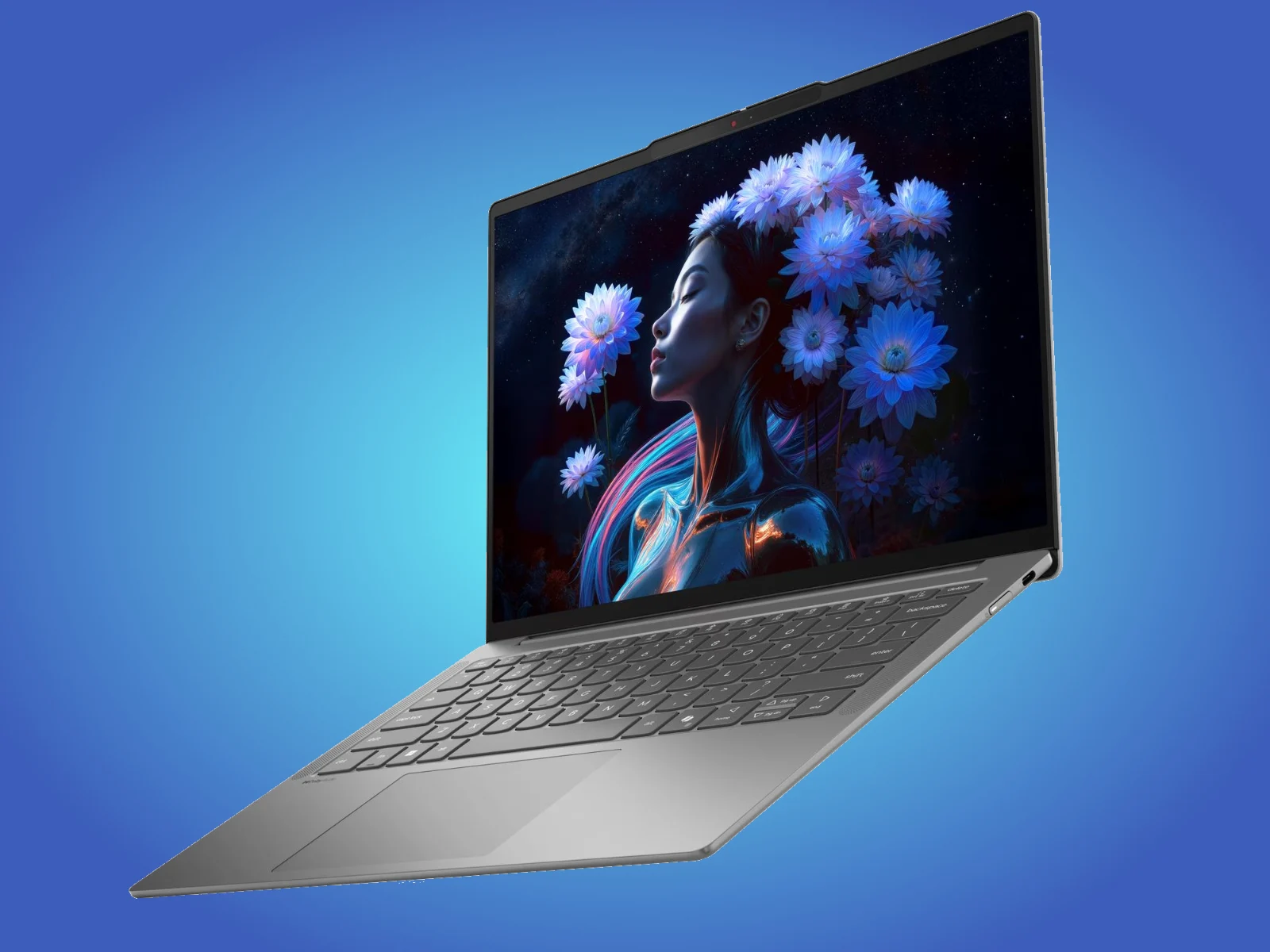
    Lenovo has allready released countless IdeaPad laptops this year. So far, many of these have featured AMD Ryzen AI 400 or Intel Panther Lake processors. Now, the company has returned to Intel’s older Lunar Lake platform with the introduction of the IdeaPad Slim 5 Ultra 14ILL11.

    Performance and Graphics Edge

    For reference, the company released the IdeaPad Slim 5 14IPH11 earlier this month featuring Intel Panther Lake processors. The IdeaPad Slim 5 Ultra 14ILL11 should have the edge when it comes to graphics performance though, thanks to its Arc 140V iGPU. According to our benchmarks, little will separate the Slim 5 Ultra from the IdeaPad Slim 5 when it comes to CPU performance, either.

    Weight and Display Options

    However, the IdeaPad Slim 5 Ultra 14ILL11 is around 22% lighter than the IdeaPad Slim 5 14IPH11. Specifically, the former weighs 1.06 kg with an OLED display and 1.14 kg with an IPS display. Hence, the IdeaPad Slim 5 Ultra 14ILL11 is lighter in all cases than the MacBook Air 13 despite featuring up to a 120 Hz IPS or 60 Hz OLED display.

    • Weight with OLED display: 1.06 kg
    • Weight with IPS display: 1.14 kg
    • Display options: 120 Hz IPS or 60 Hz OLED

    Configuration and Build Details

    Moreover, the IdeaPad Slim 5 Ultra 14ILL11 will be configurable with 16 GB or 32 GB of RAM by virtue of Intel’s Core Ultra 5 226V, Core Ultra 5 228V, and Core Ultra 7 256V processors. Also, the laptop contains M.2 2242 (PCIe 4 x4) and M.2 2280 (PCIe 4 x2) slots and a 65 Wh battery. Lenovo includes an anodised aluminium housing on all SKUs, too.

    Pricing and Availibility

    Lenovo has not revealed how much the IdeaPad Slim 5 Ultra 14ILL11 costs yet. Likewise, we have been unable to find the laptop at any third-party retailers, either. Please see Lenovo’s PSREF website for more details about the company’s first Ultra-branded IdeaPad laptop.


    Sources

  • Intel Showcases Panther Lake Gaming Performance Highlights

    Intel Showcases Panther Lake Gaming Performance Highlights

    Key Takeaways

    1. Panther Lake iGPUs show an average performance boost of 10% over Arc 140V at 1080p resolution with ‘Medium’ settings and XeSS enabled.
    2. Performance gains are inconsistent across various games; Panther Lake performs better in CPU-intensive titles like Fortnite and Counter-Strike 2.
    3. Panther Lake iGPU achieves microbenchmark improvements of up to 7.4 times in specific tasks.
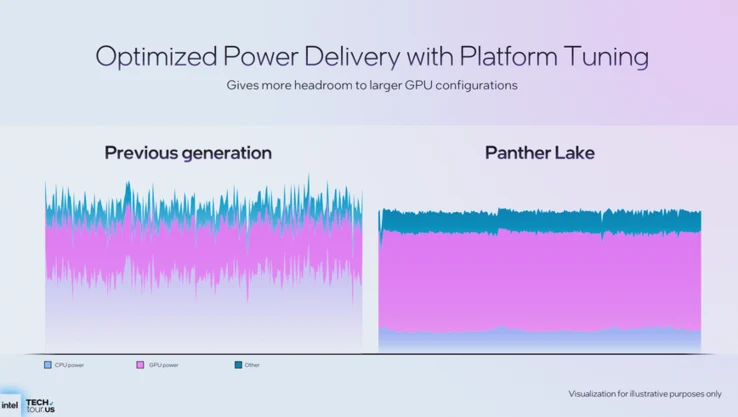
    4. Enhanced power delivery allows CPU and GPU to maintain assigned Wattages without competing for power, benefiting power-constrained devices.
    5. Lack of disclosed specifications for the Panther Lake iGPU limits definitive conclusions about overall performance; higher-end models may feature up to 12 Xe3 cores.


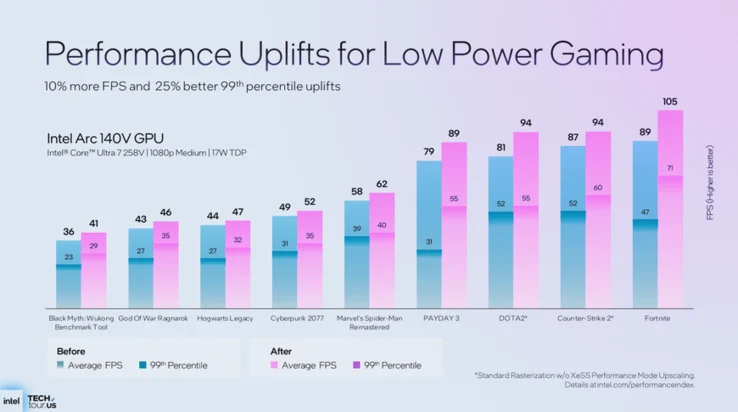
    Intel recently shared gaming benchmarks for its new Panther Lake integrated graphics units (iGPUs), along with some microbenchmark comparisons to Lunar Lake. The company’s data indicates that one of the Panther Lake iGPUs delivers, on average, a 10% boost in performance when compared to the Arc 140V. All tests were conducted at 1080p resolution using ‘Medium’ settings and with XeSS enabled. Both models were given a power allocation of 17 Watts.

    Performance Analysis

    The performance gains are somewhat inconsistent. For instance, the Panther Lake iGPU recorded 41 FPS in Black Myth: Wukong, while the Arc 140V managed 36 FPS. Similar patterns emerged in titles like God of War Ragnarok, Hogwarts Legacy, Marvel’s Spider-Man 2, and Payday 3, where the Panther Lake only provided a minimal performance increase. On a brighter note, the metrics significantly improve in CPU-intensive games such as Fortnite, Counter-Strike 2, and DOTA 2.

    Microbenchmark Improvements

    In microbenchmarks, the news is much more positive, with the Panther Lake iGPU achieving improvements of up to 7.4 times in certain tasks. Another significant enhancement from Panther Lake is its more efficient power delivery. The CPU and GPU are now designed to maintain their assigned Wattages without competing for power. This improvement is particularly beneficial in power-constrained settings like handheld gaming consoles.

    Speculation on Specs

    However, due to Intel not disclosing the specifications of the Panther Lake iGPU used for these tests, it makes it hard to draw solid conclusions regarding its overall performance. Earlier leaks hinted that the higher-end models could feature up to 12 Xe3 cores.

    Source:
    Link


  • AMD’s Radeon 890M Laptops Narrow Gap with Intel in Graphics Race

    AMD’s Radeon 890M Laptops Narrow Gap with Intel in Graphics Race

    Key Takeaways

    1. AMD has a strong advantage over Intel since the Radeon 680M’s release in 2022, outperforming Intel’s Iris Xe 96 EUs by 30 to 50 percent.
    2. Intel’s new Arc 8 graphics reduced the performance gap with AMD but was limited to Core H-series laptops, which are less common.
    3. Intel’s latest integrated graphics, the Arc 130V, 140V, and 140T, do not require Core H-series laptops, making them more accessible.
    4. The new Intel models show a performance improvement of 10 to 15 percent over the previous Arc 8, making them competitive with AMD.
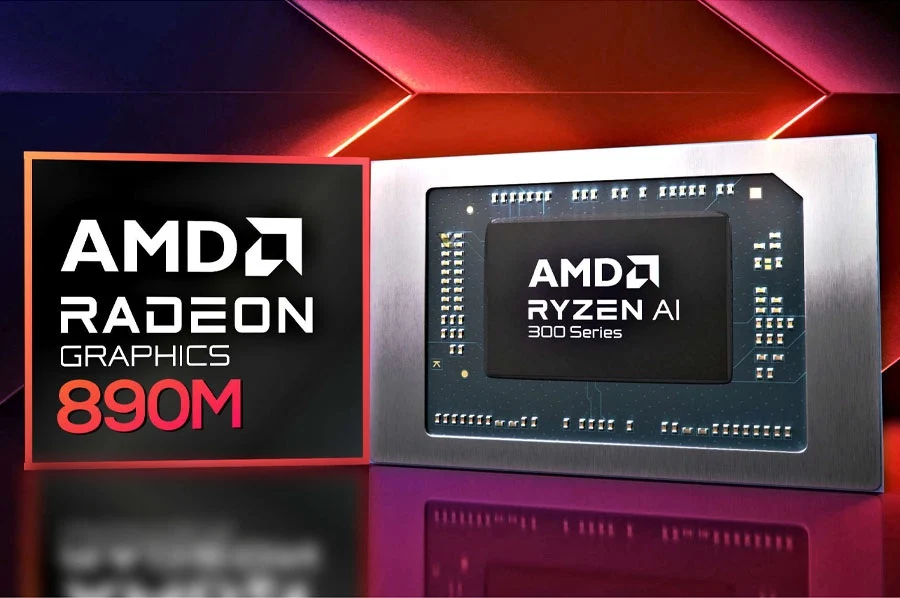
    5. Despite improvements, AMD’s Radeon 890M still outperforms the Arc 140V in most games by about 10 percent, with larger gaps in specific titles.


    AMD has maintained a strong advantage over Intel since the introduction of the Radeon 680M in 2022. At that point, Intel’s top integrated option, the Iris Xe 96 EUs, fell short, lagging behind the Radeon 680M by 30 to 50 percent. The gap widened slightly in favor of AMD with the release of the Radeon 780M.

    Intel’s New Strategy

    When Intel debuted the successor to the Iris Xe 96 EUs, named Arc 8, it successfully reduced the performance divide with AMD. However, the downside was that Arc 8 was limited to the more powerful Core H-series laptops, which are not as prevalent as their Core U-series and Ryzen U-series counterparts.

    Latest Intel Graphics

    The most recent integrated graphics lineup from Intel features the Arc 130V, 140V, and 140T. The V-series addresses the previous issue by eliminating the need for a Core H-series laptop to access Intel’s latest iGPU. Moreover, these new models provide a performance boost of about 10 to 15 percent over the Arc 8, as noted in 3DMark benchmarks. This improvement in both raw performance and performance-per-watt has made Intel’s integrated solutions competitive against AMD’s top offerings—a notable change after many years.

    Despite these advancements, the power-hungry Radeon 890M still surpasses the average Arc 140V in most games by approximately 10 percent. In specific titles, such as Tiny Tina’s Wonderlands, the difference can reach 20 percent, while games like Cyberpunk 2077 often result in a close match between both GPUs before factoring in any upscaling technologies. Nonetheless, Intel’s current progress appears promising if they can maintain their momentum in future generations.

  • Fastest and Slowest Arc 140V Laptops for Gaming: Tested Models

    Fastest and Slowest Arc 140V Laptops for Gaming: Tested Models

    Key Takeaways


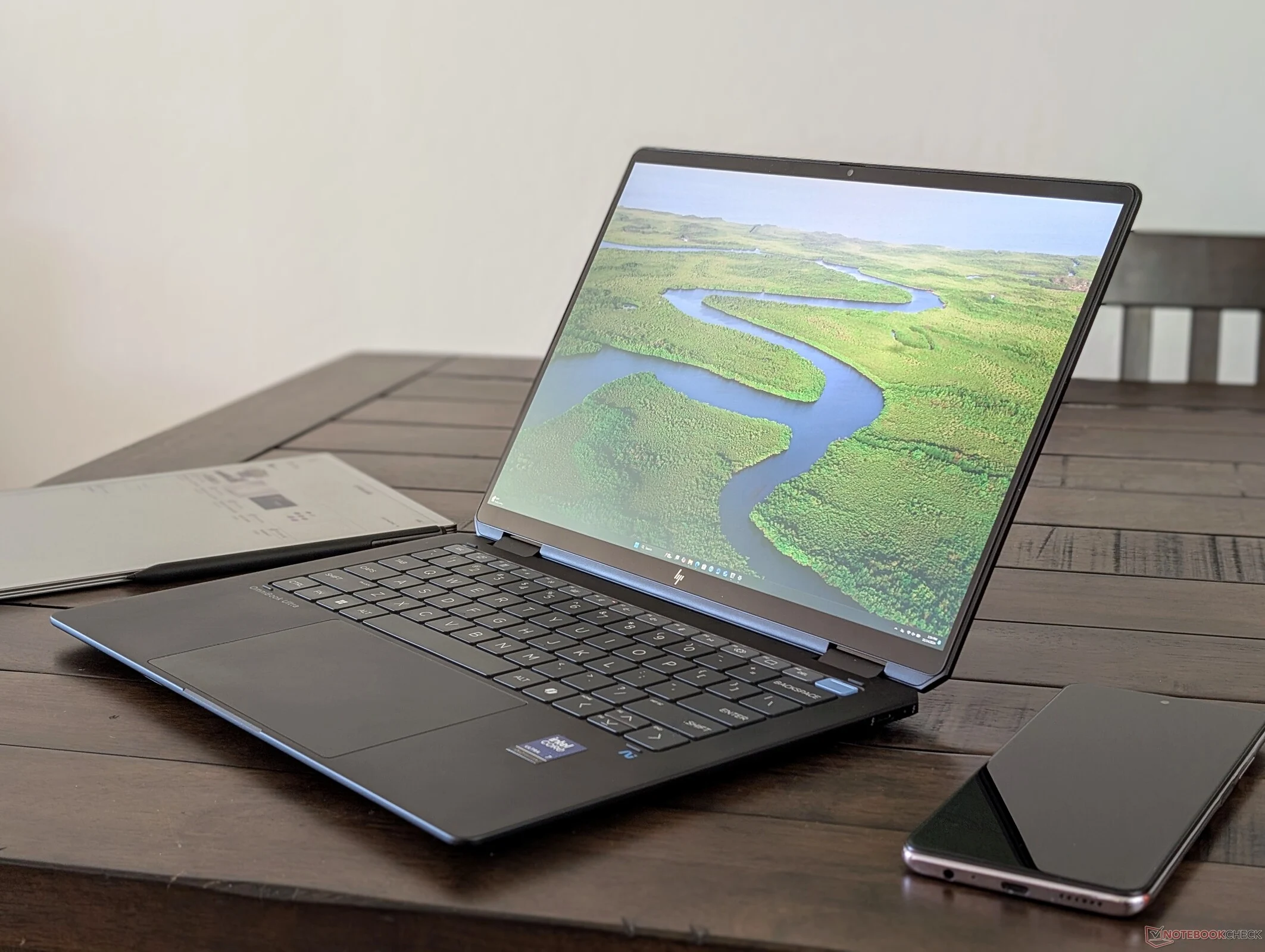
    After trailing significantly behind AMD during the Iris Xe and Arc 8 generations, the new Arc 130V, Arc 140V, and Arc 140T products have been performing impressively, now competing directly with AMD’s top integrated solutions. The Arc 140V is expected to become as prevalent as the Iris Xe 96 EUs, especially since it is standard in ULV Core Ultra 7 laptops. Our comparison charts below display the many individual models currently available at the time of this writing featuring Arc 140V graphics.

    Performance Insights

    One key point to note is that the performance differences among these models are quite slim compared to earlier generations. For instance, the fastest laptops equipped with the Iris Xe 96 EUs can sometimes be twice as fast as the slowest models also using the Iris Xe 96 EUs. In contrast, laptops featuring the Arc 140V are likely to deliver more consistent performance, largely due to the built-in VRAM throughout the series that effectively removes any sluggish single-channel options. Buyers looking for Arc 140V graphics typically won’t have to fret about unintentionally selecting a very slow model.

    Options for Enthusiasts

    Certainly, power users might still prefer to steer clear of the slowest choices or opt for the fastest models when they can. In this regard, the Dell Pro 13 Premium PA13250, Lenovo ThinkPad X9-15 Aura Edition, or MSI Claw 8 AI+ stand out as some of the quickest options for gaming, showing results that can be up to 10 percent quicker than the average. Conversely, the Asus Zenbook S 14 UX5406, Lenovo Yoga Slim 7 Aura 15ILL9, or Dell XPS 13 9350 are on the slower side, with performance that can be anywhere from 10 to 15 percent below the average depending on the game title.