
Key Takeaways
– Huawei launched the Atlas 950 SuperCluster, offering 524 FP8 ExaFLOPS for AI training and 1 FP4 ZettaFLOPS for inference tasks.
– The system features 64 Atlas SuperPoDs with 8,192 Ascend 950DT chips each, providing 20 times more processing units than the Atlas 900 A3 models.
– Atlas 950 outperforms competitors like Oracle’s OCI Supercluster and xAI’s Colossus cluster in terms of NPU count and computing capacity.
– Each SuperPoD requires around 1,000 square meters of space, leading to a total SuperCluster size of 64,000 square meters.
– The Atlas 950 SuperCluster is expected to launch in late 2026, followed by the 960 SuperCluster with over a million NPUs.
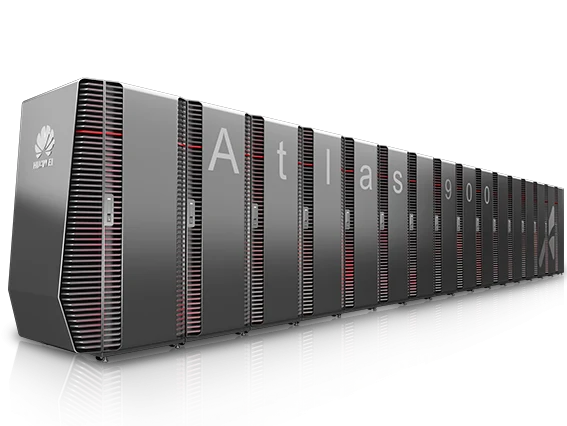
Huawei has unveiled the Atlas 950 SuperCluster at the Huawei Connect 2025 event, promising exascale capabilities with its 524 FP8 ExaFLOPS for AI training and 1 FP4 ZettaFLOPS for inference tasks. The system is set to directly rival Nvidia’s upcoming Rubin-based platforms, which are anticipated to launch in late 2026. The Atlas 950 is built with 524,288 Ascend 950DT neural processing units distributed across more than 10,240 cabinets.
Advanced Architecture
The system’s design features 64 Atlas SuperPoDs, each housing 8,192 Ascend 950DT chips. This setup provides 20 times the number of processing units compared to the earlier Atlas 900 A3 models. Additionally, the architecture supports both RoCE and Huawei’s unique UBoE (UnifiedBus over Ethernet) protocols, boasting an all-optical interconnect with a bandwidth of 16 PB/s and a latency of 2.1 microseconds.
Competitive Edge
In terms of performance, the Atlas 950 SuperCluster outperforms Oracle’s OCI Supercluster, which utilizes 131,072 B200 GPUs to achieve 2.4 FP4 ZettaFLOPS. It also surpasses xAI’s Colossus cluster by offering 2.5 times the number of NPUs and 1.3 times the computing capacity. Each SuperPoD is capable of delivering 8 FP8 ExaFLOPS, in contrast to Nvidia’s Vera Rubin NVL144, which provides only 1.2 FP8 ExaFLOPS. The SuperCluster is specifically designed to handle AI models that range from hundreds of billions to tens of trillions of parameters.
Space Requirements
Each SuperPoD occupies approximately 1,000 square meters, roughly equivalent to the size of two basketball courts, and requires 160 cabinets. Collectively, the SuperCluster covers 64,000 square meters, which is about the size of 150 basketball courts or nine soccer fields. Instead of using fewer, more powerful chips like those from Nvidia, Huawei opts for a greater number of accelerators, meaning the cluster necessitates more space for power, cooling, and support systems.
Huawei anticipates the Atlas 950 SuperCluster’s launch in late 2026, with the 960 SuperCluster expected to follow a year later. The 960 model will feature over a million NPUs and deliver between two to four ZettaFLOPS of computing power. Since Huawei’s chips are inherently less powerful, the company is focusing on creating larger systems overall. These SuperClusters are tailored for AI firms that require enormous computing resources for their cutting-edge models.
Source:
Link


Leave a Reply