
Key Takeaways
1. Biwin has introduced a new “Mini SSD” that combines NVMe-like performance with a compact size, measuring just 15 × 17 × 1.4 mm.
2. The Mini SSD achieves impressive speeds of up to 3,700 MB/s for reads and 3,400 MB/s for writes, with storage capacities of 512 GB, 1 TB, and 2 TB.
3. It features a SIM tray-style slot for easy swapping, making it more convenient than traditional M.2 SSDs.
4. The Mini SSD offers durability with IP68 dust and water resistance and can withstand drops from up to 3 meters.
5. Potential applications include laptops, tablets, smartphones, and gaming devices, with its performance and size making it a strong alternative to MicroSD cards and larger M.2 SSDs.
MicroSD cards have been a favored choice for removable storage in mobile devices for many years, but their speed limitations can be a drawback for high-performance uses. On the other hand, M.2 NVMe SSDs provide exceptional performance; however, they are larger and installed within devices, making quick swaps impossible. Now, a new storage format emerging from China aims to merge the benefits of both types and is already set to feature in two advanced gaming devices.
New Mini SSD from Biwin
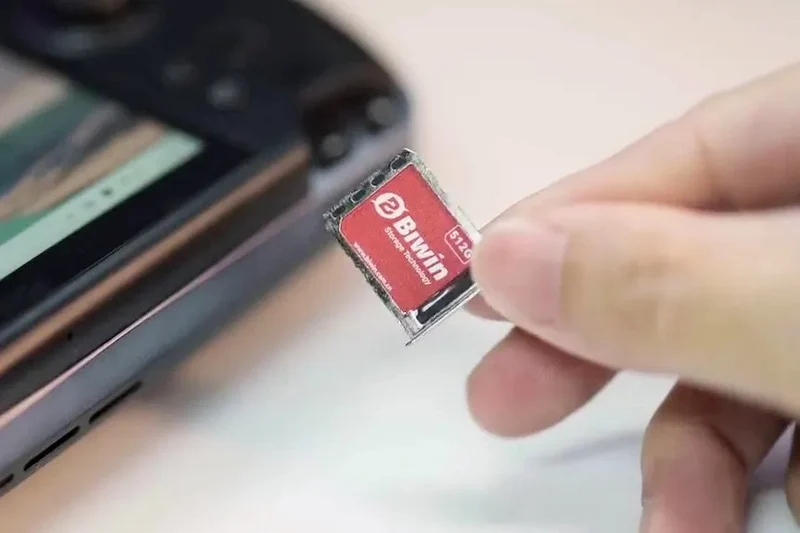
The Chinese company Biwin is unveiling the “Mini SSD” (sometimes referred to as “1517” based on its size), which promises NVMe-like performance in a compact form that’s barely larger than a MicroSD card. This Mini SSD measures 15 × 17 × 1.4 mm, which is smaller than a penny in the U.S. and only a tad larger than a MicroSD card. Despite its small size, Biwin claims it can achieve up to 3,700 MB/s in sequential reads and 3,400 MB/s in writes using a PCIe 4.0 x2 connection, with capacities of 512 GB, 1 TB, and 2 TB available.
Easy to Swap
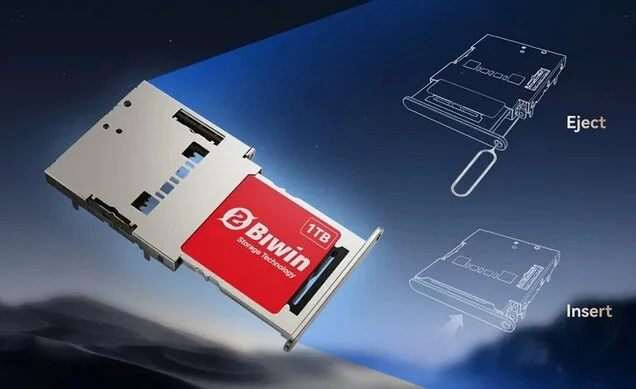
Unlike the usual M.2 screw mount, this Mini SSD utilizes a SIM tray-style slot. Users can easily use a pin to eject the tray, making it as convenient to swap as a SIM card. Durability is also a key selling point: Biwin asserts that it offers IP68 dust and water resistance along with protection against drops from 3 meters, features that could make it especially attractive for smartphones and cameras, in addition to mini-PCs and portable devices.
In theory, the Mini SSD outshines removable flash cards. MicroSD Express cards, such as those designed for the Nintendo Switch 2, can only reach a theoretical maximum of 985 MB/s, which is less than a third of Biwin’s stated read speed. While full-size SD Express cards might slightly surpass the Mini SSD at 3,940 MB/s, they are nearly double the size of Biwin’s offering. M.2 SSDs still hold the title for performance: M.2 2230 devices can theoretically achieve around 8,000 MB/s, and M.2 2280 drives can reach approximately 14,000 MB/s—but both are significantly larger and not intended for easy swapping without tools.
Broad Applications
Biwin’s marketing suggests a wide array of possible uses, which include laptops, tablets, smartphones, and cameras. The format isn’t merely a demonstration of technology. Two Chinese gaming handhelds have already shown support following the ChinaJoy event last week:
These are ideal devices that could benefit most from the new SSD format: compact gadgets that need fast internal storage without consuming M.2 space on the motherboard, thereby avoiding increased cooling costs, while also providing the ease of hot swapping.
The pricing and availability details remain a mystery—no public listings exist yet—and, as with any storage tech, actual performance will rely on controllers, firmware, thermal constraints, and host implementation. It’s also uncertain whether Biwin’s format will evolve into an open standard or stay proprietary. Nevertheless, its blend of size, speed, and durability could make it a fascinating new alternative in the removable storage arena.
Source:
Link
Leave a Reply