

Key Takeaways
1. Nvidia remains dominant in the AI hardware market, but competitors like d-Matrix are developing efficient alternatives.
2. d-Matrix gained attention with its Corsair C8 compute card and is set to launch a successor featuring innovative 3D DRAM.
3. The new 3D DRAM, called 3DIMC, was developed in partnership with AIchip and aims to improve AI infrastructure performance and reduce costs.
4. The upcoming Raptor inference accelerator will be the first product to utilize the 3D-stacked DRAM, promising up to 10 times faster inference speeds.
5. d-Matrix’s advancements in 3DIMC are expected to enhance AI performance while making it more affordable and sustainable at scale.
Nvidia continues to maintain a strong hold on the AI hardware market, but several companies are actively working to create efficient alternatives. A few years back, when Nvidia was unable to keep up with the rapidly growing demand for inference hardware, d-Matrix took advantage of the situation by establishing itself as a dependable generative AI hardware provider in the data center sector. Their initial compute card, the Corsair C8, received positive feedback. Now, the company is preparing to introduce a successor that will feature the world’s first mass-produced 3D DRAM.
Partnership for Innovation
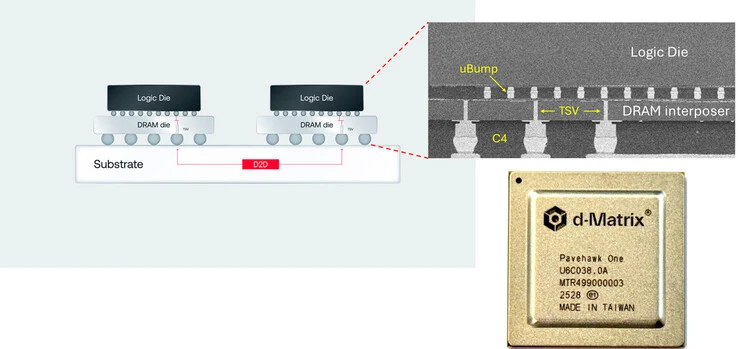
To create this 3D DRAM solution, d-Matrix partnered with AIchip, a Taiwan-based ASIC integrator specializing in high-performance AI infrastructure. This innovative RAM, called 3DIMC (3D stacked digital in-memory compute), is designed to “remove the performance and cost limitations that restrict today’s AI infrastructure.” Currently, this new RAM type is being tested with d-Matrix’s Pavehawk chips.
Future Prospects
The first product to showcase the 3D-stacked DRAM is anticipated to be d-Matrix’s Raptor inference accelerator, which will take the place of the existing Corsair models. d-Matrix predicts that the 3DIMC solution could achieve up to 10 times the inference speeds compared to the fastest HBM4-based accelerators available.
Sid Sheth, co-founder and CEO of d-Matrix, states that the 3D-stacked DRAM signifies “a breakthrough that enhances AI performance while also making it more affordable and sustainable at scale.” He adds that 3DIMC is the next logical advancement in their strategy to provide efficient inference architectures that can keep up with the rapid expansion of generative and agentic AI.
Source:
Link


Leave a Reply