
Key Takeaways
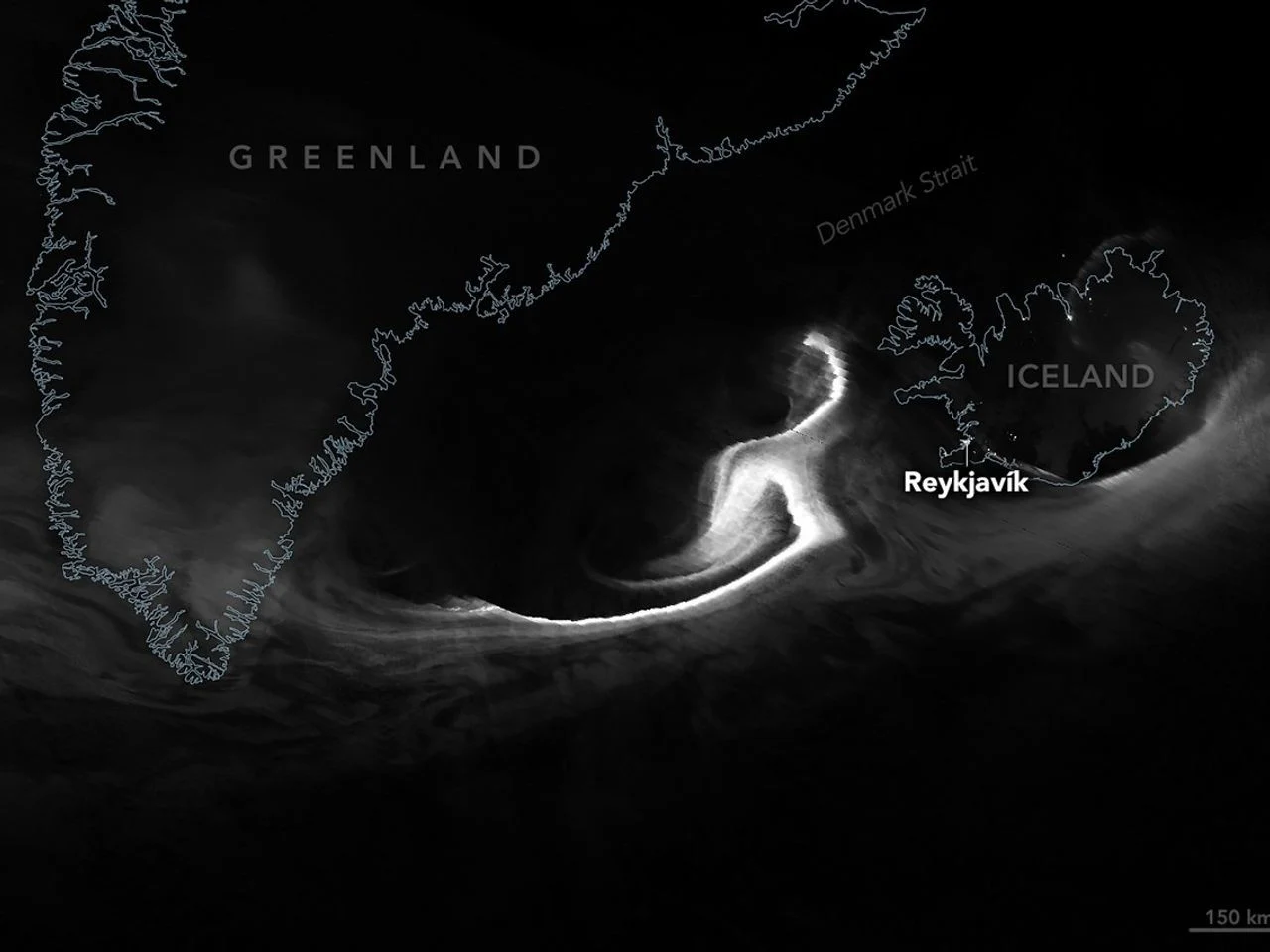
1. The VIIRS instrument on the Suomi NPP captured stunning auroras over the Denmark Strait, Iceland, and parts of Canada on February 16.
2. The instrument detects light across various wavelengths, revealing colorful auroras despite appearing in grayscale images.
3. The auroras were produced by a G1 geomagnetic storm, a minor storm that can still affect power grids and satellites.
4. The G1 storm associated with these auroras later intensified into a G2 storm.
5. NASA’s GNEISS mission seeks to enhance understanding of the electrical conditions that lead to auroras.
In the early morning of February 16, the VIIRS (Visible Infrared Imaging Radiometer Suite) aboard the Suomi NPP took photos depicting an auroral spectacle (known as aurora borealis or northern lights). The first image displays the lights above the Denmark Strait and Iceland at 4:45 UTC (which is 4:45 a.m. local time in Reykjavík). The subsequent image illustrates the lights swirling around the Canadian provinces of Québec and Newfoundland and Labrador at approximately 06:30 UTC (1:30 a.m. local time in Montreal).
Capturing Auroras
The instrument captures light across different wavelengths, from green to near-infrared. It employs filtering methods to identify signals like those from auroras. Even though this image looks grayscale, the auroras themselves are actually vibrant. They showcase a range of colors from green to purple.
Geomagnetic Storms and Their Impact
Just like all auroras, this one was generated by a geomagnetic storm, specifically classified as a G1 storm. A G1 storm is considered a minor geomagnetic storm. While it is not as intense as storms with higher classifications, G1 storms can still create electrical disturbances that lead to auroras. They might also cause minor interruptions in power grids and satellite functions. Interestingly, the G1 storm that caused this aurora later escalated into a G2 storm.
NASA’s GNEISS Mission
With the recent launch of the GNEISS (Geophysical Non-Equilibrium Ionospheric System Science) mission, NASA aims to obtain a better understanding of the electrical environment that generates auroras like the one captured in these images.
Source:
Link