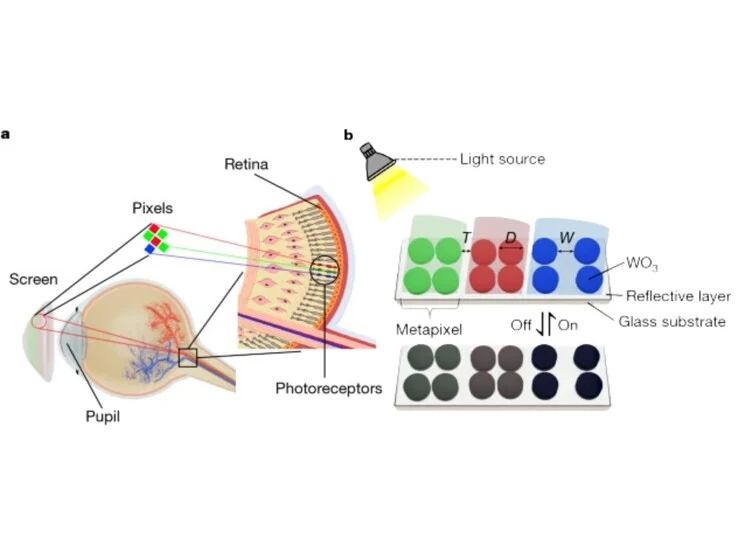
Key Takeaways
1. Innovative Display Technology: Retina E-Paper uses reflective nanostructures and does not require a backlight, enhancing image sharpness and energy efficiency.
2. Unique Mechanism: Instead of generating light like OLED and micro-LED displays, Retina E-Paper utilizes surrounding light, employing electrochromic nanopixels to control color.
3. High Pixel Density: Each pixel measures only 560 nanometers, resulting in a pixel density of over 25,000 PPI, exceeding the visual sharpness of the human eye.
4. Efficient Color Management: The display utilizes Mie scattering and grid modes for color mixing, achieving a contrast ratio of about 50% and reflecting up to 80% of ambient light.
5. Low Power Consumption: The Retina E-Paper operates at only 1.7 mW/cm² for video playback and 0.5 mW/cm² for still images, with a switching speed of 40 milliseconds for video at over 25 frames per second.
A research group from Chalmers University of Technology and Uppsala University in Sweden has created a revolutionary display that meets the visual limits of human eyesight – all without using a backlight. This innovation, known as Retina E-Paper, is detailed in the journal Nature. It employs reflective nanostructures to bypass the limitations of traditional displays, providing outstanding image sharpness and energy efficiency.
Unique Approach
Unlike OLED and micro-LED displays that encounter physical challenges when miniaturizing too much – such as diminished brightness, unstable colors, and increased power use – Retina E-Paper opts for a different method. Rather than generating light, it makes use of surrounding light. Its electrochromic nanopixels, composed of tungsten trioxide (WO₃) layered on a platinum-aluminum base, effectively reflect incoming light. By carefully inserting ions, the material alternates between insulating and metallic states, allowing for precise electrical control of color.
Incredible Pixel Density
Each pixel in the Retina E-Paper is only 560 nanometers in size – smaller than many viruses – which results in an astonishing pixel density of over 25,000 PPI. This surpasses the visual sharpness of the human eye, making images appear as detailed as they can be. For reference, typical OLED monitors like the ASUS ROG Strix OLED XG27AQDMG, which is priced around $690 on Amazon, have a pixel density of just 110 PPI at a resolution of 2560 × 1440 on a 27-inch display.
Efficient Color Mixing
Color management in the Retina E-Paper is accomplished through Mie scattering and grid modes, allowing for both additive (RGB) and subtractive (CMY) color blending. The display maintains a contrast ratio of about 50% and can reflect as much as 80% of ambient light. During tests, it achieved a switching speed of 40 milliseconds, enabling video playback at over 25 frames per second. Its power usage is remarkably low – roughly 1.7 mW/cm² while playing videos and just 0.5 mW/cm² for still images.
Currently, images of a demonstration unit or a working prototype with the Retina E-Paper as a full display have not been shared. The visuals published in Nature until now are limited to microscopic images of the nanopixel setup and sample images from lab testing environments.
Source:
Link