
Tag: Protoplanetary Disk

  • Webb Discovers First Clear Evidence Solving a Mind-Puzzling Mystery

    Webb Discovers First Clear Evidence Solving a Mind-Puzzling Mystery

    Key Takeaways

    1. Crystalline silicates have been found in comets located in cold regions like the Kuiper Belt and Oort Cloud.
    2. These silicates require high temperatures to form, raising questions about their presence in comets.
    3. Scientists used the Webb telescope’s Mid-Infrared Instrument (MIRI) to study a protostar called EC 53.
    4. The star undergoes a 100-day burst phase, consuming gas and dust while ejecting strong jets.
    5. These jets can carry crystalline silicates to the outer regions of the protoplanetary disk, where comets are found.


    Astronomers have identified crystalline silicates within comets. These comets are found in extremely cold areas such as the Kuiper Belt and the Oort Cloud. However, crystalline silicates need a lot of heat to develop. So, what explains their presence in comets? The recent Webb observation offers some answers.

    Observing the Protostar

    For this research, a group of scientists utilized Webb’s Mid-Infrared Instrument (MIRI) to study a protostar known as EC 53. They found that crystalline silicates originated from the hot inner section of the gas and dust disk that surrounds the star, which is known as a protoplanetary disk.

    The Star’s Activity

    The observations reveal that the star enters a dramatic 100-day burst phase. During this event, the young star consumes surrounding gas and dust while simultaneously ejecting strong jets and outflows. Webb detected that these powerful outflows can propel the crystalline silicates to the outer regions of the star’s protoplanetary disk. In relation to our solar system, this outer region is where comets are typically located.

    This finding supports the reasoning behind the presence of heat-created crystalline silicates in comets, which are often thought of as icy snowballs. The results of this study were shared in the journal Nature on January 21.

    Nature via NASA

    Source:
    Link


  • Hubble Discovers Turbulence in Largest Planet Birthplace

    Hubble Discovers Turbulence in Largest Planet Birthplace

    Key Takeaways

    1. Protoplanetary Disk: IRAS 23077+6707 is a protoplanetary disk surrounding a young star, where new planets are formed.

    2. Unique Shape and Nickname: The disk is viewed from the side, resembling a hamburger, and is nicknamed “Dracula’s Chivito,” after a popular Uruguayan sandwich.

    3. Location and Size: Located about 1,000 light-years away, the disk spans nearly 400 billion miles, which is 40 times the diameter of our solar system.

    4. Mass and Material: The disk contains 10 to 30 times the mass of Jupiter, suggesting it has enough material to potentially form several gas giants.

    5. Dynamic Characteristics: The disk exhibits uneven features, with one side having filaments and the other being smooth, indicating a chaotic environment for planet formation.


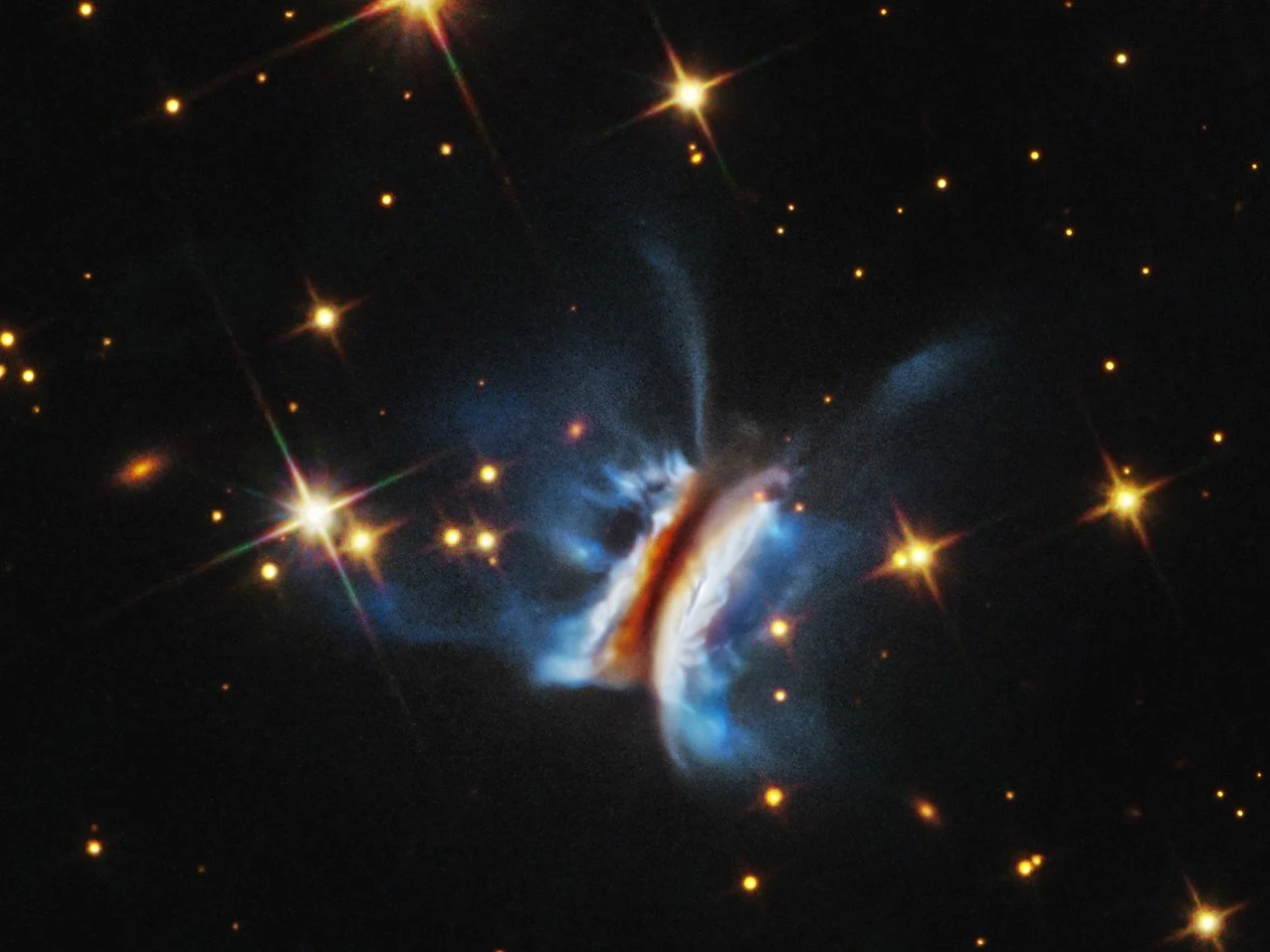
    A protoplanetary disk is the region where planets are born. This disk typically surrounds a young star. In this instance, the observed protoplanetary disk is known as IRAS 23077+6707. It is seen from the side, giving it a shape reminiscent of a hamburger. Because of this unique form, it has been nicknamed “Dracula’s Chivito,” with “Chivito” referring to Uruguay’s famous national sandwich.

    Location and Size

    IRAS 23077+6707 is situated roughly 1,000 light-years away from our planet. The disk itself is incredibly vast, stretching nearly 400 billion miles across. To put that in perspective, that’s 40 times the diameter of our own solar system, reaching out to the outer limits of the Kuiper belt. Astronomers believe that the disk of IRAS 23077+6707 holds about 10 to 30 times the mass of Jupiter. This indicates there’s plenty of material available to potentially create several gas giants.

    Observations and Mysteries

    However, one peculiar thing that astronomers noticed about IRAS 23077+6707 is its unevenness. One side of the disk has features that look like filaments, while the opposite side appears smooth. This imbalance could be a result of dust and gas accumulating into the disk or might be influenced by the surrounding environment. Additionally, the disk displays thin, wispy layers. The combination of the asymmetrical characteristics and these delicate layers implies that this area where planets are made is far more dynamic and chaotic than previously thought.

    Scientists haven’t observed anything quite like this in other similar systems. This discovery has raised more questions than it has answered. However, with more research, the data could shed light on how planets develop over time and how they form in various environments. These results were shared in the Astrophysical Journal.

    Source:
    Link