Tag: open-source AI

  • GuppyLM: Easy-to-Train Tiny AI for Everyone

    GuppyLM: Easy-to-Train Tiny AI for Everyone

    Key Takeaway

    1. GuppyLM is a small, open-source language model with 8.7 million parameters, designed to demonstrate that effective LLMs do not need to be large or opaque.
    2. It is trained on synthetic conversations from a fish perspective, making it highly limited but consistent in its responses.
    3. The model can be run locally or in a browser, and users can train their own mini LLM using accessible tools like Colab.
    4. Its training involves simple input-response pairs that teach the model how a fish might speak, focusing on straightforward, context-specific communication.

    Introducing GuppyLM: A Tiny Fish in the Sea of AI Models

    While many AI models are growing larger, far more costly and becoming harder to understand, GuppyLM chooses to go in a totally different route – intentionally simple. This open-source project features a language model with just about 8.7 million parameters, much smaller than the big flagship models we often hear about. It even refers to itself as a fish named Guppy, limited to a life inside an aquarium. Its aim isn’t to rival large models like ChatGPT but to demonstrate that an LLM can be transparent and easy to construct without needing specialized expert knowledge.

    Simplicity in Design and Purpose

    The main purpose behind GuppyLM is not to be sophisticated but to show that small scale models can be effective and understandable. It was trained using only around 60,000 synthetic conversation pairs. That means it’s very limited in what it knows but this simplicity actually helps make its behavior very consistent. Guppy responds in short, lowercase sentences and totally ignores complex human topics like politics, finances, or telephones. This clear fishy personality is deeply embedded in the model itself, keeping Guppy always at a fish’s perspective. Users can run the model locally or try it in a browser, thanks to options like Colab or a browser-based demo available on GitHub.

    Training Mechanics and Setup

    Training GuppyLM isn’t complicated at all. The process involves feeding it pairs of example conversations—inputs and suitable responses that cover simple topics like greetings, food, water, light, sleep, or even the meaning of life, all strictly seen from a fish’s viewpoint. The magic happens when the model learns which part of the text should come next. It does this by breaking down words into small pieces called tokens. During each training step, the model compares what it predicts with the actual correct answer and then tweaks its internal settings to improve. Over time, GuppyLM gets better at mimicking the way a fish might talk about its tiny underwater world.

    Using and Training Your Own Guppy

    • Access to a browser demo for quick testing
    • Run pretrained models with Google Colab or locally using Python code
    • Option to train your own small LLM with simple Colab notebooks

    For those interested in diving deeper, there’s a way to train your very own mini version of Guppy. The existing setup offers easy-to-follow tools in a browser environment, so even users with little experience can try creating a fishy language model of their own. The simplicity and accessibility of GuppyLM really makes it stand out among the increasingly complex world of AI language models, proving that sometimes, less really is more.
    Sources
  • DeepSeek Launches R1 Model with Enhanced AI and Reduced Hallucinations

    DeepSeek Launches R1 Model with Enhanced AI and Reduced Hallucinations

    Key Takeaways

    1. DeepSeek-R1-0528 outperforms its predecessor and rivals in cost-effectiveness and training speed.
    2. The model shows improvements in performance but only answers 17% correctly on the difficult Humanity’s Last Exam.
    3. Enhanced training periods and fine-tuning contribute to the model’s better results, rather than major technological breakthroughs.
    4. The new R1 model has fewer occurrences of AI hallucinations, providing more accurate information.
    5. An open-source version of the R1 model is available, requiring an Nvidia 4090 GPU with 24 GB of memory for use.


    DeepSeek has introduced the newest iteration of its innovative R1 AI large language model, named DeepSeek-R1-0528. The firm made its entrance into the AI sector with the releases of V3 and R1, both of which achieved top-ten performance in AI while being more cost-effective and quicker to train compared to rival models from companies like OpenAI and Google.

    Performance Tests

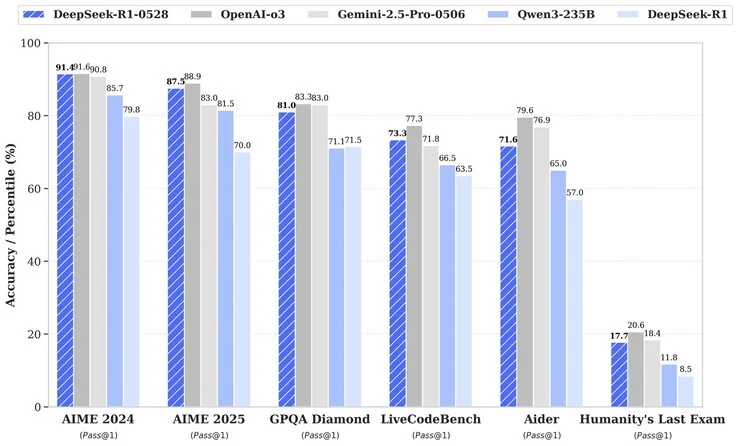
    The recent R1 model underwent evaluation using various AI benchmarks:

    When compared to the initial release of R1, DeepSeek-R1-0528 shows better performance across all tests, although it only manages to answer 17% of the questions correctly on the challenging Humanity’s Last Exam. Since its main competitors also struggle on this particular test, the improvements seen in the latest DeepSeek R1 version are likely a result of extended training periods and fine-tuning rather than any major advancements in AI technology. A key highlight of the new R1 is its reduced instances of AI hallucinations, making it less prone to providing incorrect or misleading information.

    Open-Source Availability

    For those interested in exploring the open-source R1 model, it is possible to run distilled versions with eight billion parameters using an Nvidia 4090 GPU that has 24 GB of memory.

    In summary, DeepSeek continues to push the boundaries of AI with its latest R1 model, making significant strides while maintaining affordability and efficiency. Users can find more about DeepSeek through its platforms, including DeepSeek news, DeepSeek Chat, and the DeepSeek R1 on GitHub.

    Source:
    Link


  • China’s DeepSeek: A Major Challenge to OpenAI’s ChatGPT

    China’s DeepSeek: A Major Challenge to OpenAI’s ChatGPT

    From November 2023, DeepSeek, a Chinese firm, has started to roll out its AI models as open-source. With the MIT license in place, anyone can utilize and modify the model for personal use. This openness promotes transparency and flexibility in how these models can be applied.

    Collaborative Development

    Moreover, the open-source nature fosters teamwork in development and helps save costs. Users have the ability to inspect the code, allowing them to comprehend the model’s operations. They can tailor the model to meet their unique needs and employ it across various scenarios. By embracing open-source, DeepSeek contributes to innovation and competition within the AI landscape.

    Company Background

    DeepSeek is a spin-off from Fire-Flyer, the deep-learning division of the Chinese hedge fund, High-Flyer. The primary aim was to enhance the understanding, interpretation, and prediction of financial data within the stock market. Since its establishment in 2023, DeepSeek has shifted its focus solely onto LLMs, which are AI models that can generate text.

    Major Breakthroughs

    The company appears to have made significant advances with the latest additions to the DeepSeek AI lineup. Based on popular AI benchmarks, DeepSeek-V3, DeepSeek-R1, and DeepSeek-R1-Zero frequently surpass rivals from Meta, OpenAI, and Google in their specific areas. Additionally, these services are notably cheaper than ChatGPT.

    Impact on Pricing

    This competitive pricing tactic could influence pricing trends across the AI market, making sophisticated AI technologies more accessible to a broader audience. DeepSeek is able to maintain these lower costs by investing much less in training its AI models compared to others. This is primarily achieved through more streamlined training processes and extensive automation.

    Efficiency in Reasoning Models

    Conversely, DeepSeek-R1 and DeepSeek-R1-Zero function as reasoning models. They begin by formulating a strategy to answer inquiries before proceeding in smaller increments. This method enhances result accuracy while requiring less computational power. Nevertheless, it does increase the demand for storage space.

    Accessibility of Models

    As an open-source AI, DeepSeek can operate directly on users’ computers. Users can access the necessary application data without cost, as the models are freely downloadable from Hugging Face. Tools like LM Studio simplify the process by automatically fetching and installing the full application code.

    Data Security and Privacy

    This setup ensures data privacy and security, as prompts, information, and responses remain on the user’s device. Furthermore, the model can function offline. While high-end hardware isn’t essential, ample memory and storage are necessary. For example, DeepSeek-R1-Distill-Qwen-32B needs approximately 20GB of disk space.

    Language Capabilities

    Per DeepSeek V3, the AI is capable of handling multiple languages, including Chinese and English, as well as German, French, and Spanish. In brief interactions, the various languages yielded satisfactory replies.

    Concerns Regarding Censorship

    However, there are lingering concerns about censorship in China. DeepSeek-R1 incorporates restrictions on certain politically sensitive subjects. Users attempting to inquire about specific historical events may receive no response or a “revised” reply. For instance, asking about the events at Tiananmen Square on June 3rd and 4th, 1989 may not yield clear information.

    Censorship in AI Models

    That said, DeepSeek R1 does acknowledge the student protests and a military operation. Yet, other AI systems also limit their responses to political inquiries. Google’s Gemini, for instance, outright avoids addressing questions that may pertain to politics. Thus, (self-imposed) censorship is a common trait found in various AI models.

    Source:
    Link