
Tag: Noctua fans

  • Noctua’s Quest for the Perfect Fan: Overcoming Design Limitations

    Noctua’s Quest for the Perfect Fan: Overcoming Design Limitations

    Key Takeaways

    1. Blade Angle and Angle of Attack: Blade angle (stagger angle) affects airflow; angle of attack influences air interaction, changing along the blade’s length.

    2. Impact of Blade Count on Noise: The number of blades affects fan noise frequency; fewer blades can create deeper sounds, but may lead to reduced pressure and stiffness.

    3. Trade-offs in Design: Reducing blade count may require larger blades or higher RPM to maintain performance, potentially negating noise benefits.

    4. Preferred Configurations: Noctua favors nine-blade designs for their 120mm fans, balancing airflow, pressure, durability, and sound.

    5. Importance of Understanding Fan Dynamics: Knowledge of blade angles and counts is essential for optimizing cooling solutions while minimizing noise.


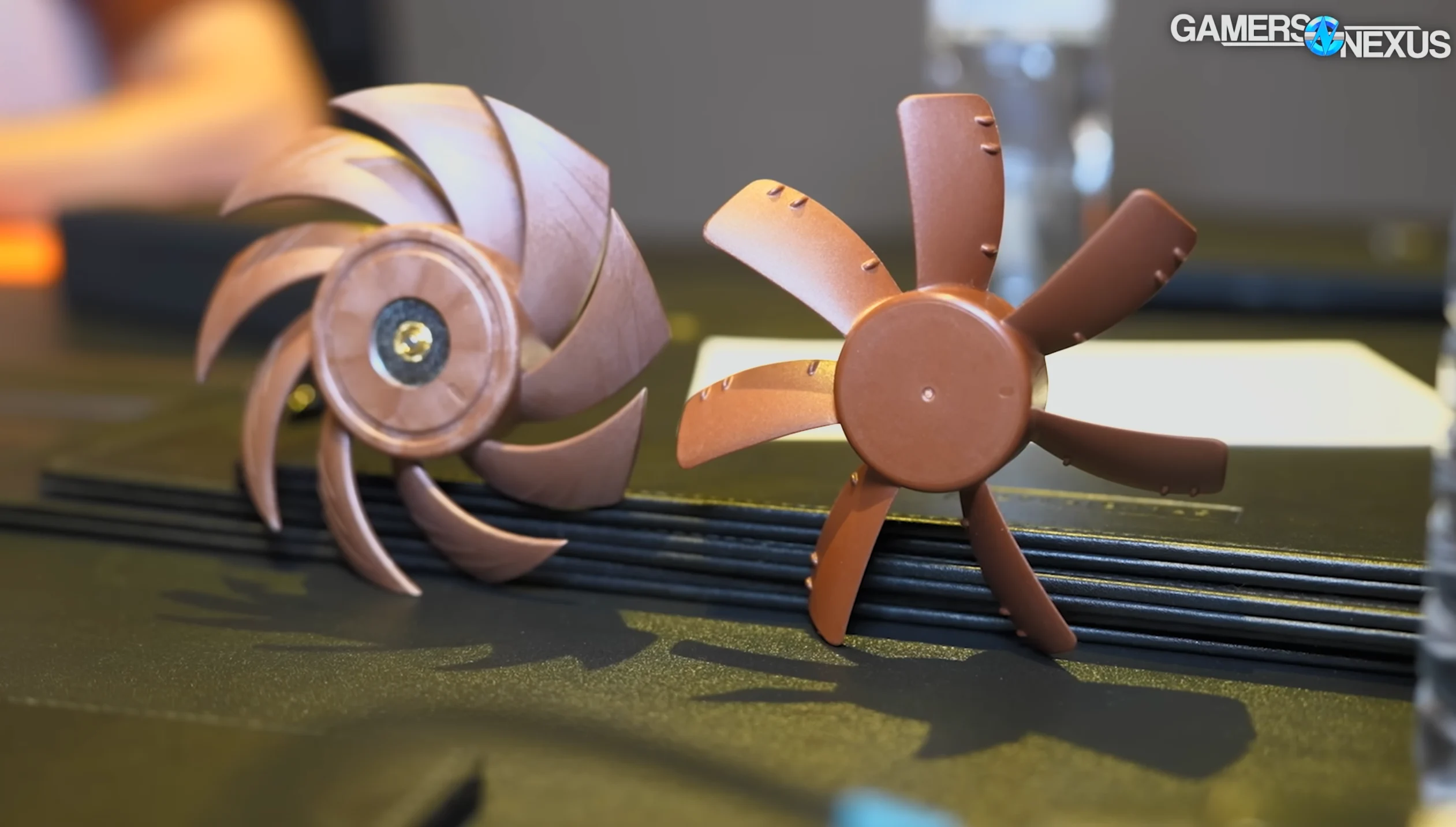
    Dellinger explains that “blade angle” (also known as stagger angle) is the tilt of the fan blade in relation to the rotation plane, while “angle of attack” refers to how the blade interacts with the air that comes towards it. These angles change along the length of the blade—steeper near the center and flatter toward the end—so they can align with how fast the fan spins. A bigger blade angle can boost airflow with each rotation, but it also risks stalling, which can cause flow separation and more noise. Even tiny changes in blade angle, like just 1°, can significantly affect airflow efficiency and noise levels.

    Impact of Blade Count

    The number of blades on a fan influences the blade passing frequency, which is linked to how people hear fan noise. For instance, a fan with seven blades turning at 2000RPM produces a deeper 233Hz sound compared to a nine-blade fan that generates a 300Hz tone. However, cutting down the blade count comes with drawbacks in terms of pressure creation and stiffness of the blades. Designers need to make up for this by using larger blades or increasing the RPM, which might cancel out the noise advantages. Noctua currently prefers nine-blade configurations for their 120mm fans, as they find them to strike a good balance between airflow, pressure, sturdiness, and sound.

    Insights from GamersNexus

    On their YouTube channel, GamersNexus discusses these aspects in detail, providing insights into fan designs and their performance characteristics. Their analysis highlights the importance of understanding how different angles and blade counts affect not only efficiency but also the noise that fans produce. This knowledge is crucial for anyone looking to optimize their cooling solutions without sacrificing peace and quiet.

    Source:
    Link


  • Sycom Unveils GeForce RTX 5080 LC Hydro with AIO Cooler and Fans

    Sycom Unveils GeForce RTX 5080 LC Hydro with AIO Cooler and Fans

    Key Takeaways

    1. Cooling System: The Sycom RTX 5080 LC Hydro features a complete water cooling system with two 120mm Noctua fans and a 240mm radiator, resulting in five fans for optimal cooling.

    2. Performance Boost: The graphics card boasts a 7% increase in boost clock speeds, reaching up to 2,820MHz, while maintaining temperatures below 64.9 degrees Celsius.

    3. Quiet Operation: The cooling system operates at a low noise level of 34.8dB under heavy loads, allowing for quieter gaming experiences.

    4. Maintenance-Free Design: The water cooling system is designed to be maintenance-free, minimizing the risk of leaks and corrosion through strict quality control.

    5. Availability: The Nvidia GeForce RTX 5080 Silent Master is only available in Japan as part of prebuilt systems and cannot be purchased separately.


    Sycom is merging a Manli GeForce RTX 5080 Nebula with a complete water cooling system that includes two 120mm Noctua fans and a 240mm radiator. In total, there are five fans providing cooling for the graphics card, which likely makes the RTX 5080 LC Hydro one of the coolest and quietest options among GeForce RTX 5080 models available today.

    Enhanced Performance

    The company highlights a 7% increase in boost clock speeds reaching up to 2,820MHz, while the GPU is anticipated to remain below 64.9 degrees Celsius. This allows users ample flexibility to either reduce the fan speed for quieter operation, even if it raises temperatures, or to push the GPU further with overclocking. According to Sycom’s published specs, the cooling system maintains a relatively low noise level of just 34.8dB under heavy loads.

    Maintenance-Free Cooling

    Sycom asserts that the water cooling system is maintenance-free due to rigorous quality control measures designed to avoid leaks and corrosion. In Japan, Sycom provides a selection of pre-built gaming PCs that utilize independent all-in-one water coolers for both the processor and the graphics card, equipped with three and two Noctua fans, respectively. This configuration is said to keep the overall noise level below 38.9dB during demanding tasks.

    The Nvidia GeForce RTX 5080 Silent Master is presently only available in Japan and exclusively as part of complete prebuilt systems. Thus, the graphics card cannot be purchased separately, not even through import channels.

    Source:
    Link