
Key Takeaways
1. Lenovo introduced two versions of its large mobile workstation: ThinkPad P16 Gen 3 with professional RTX PRO GPUs and ThinkPad T16g Gen 3 with consumer GeForce GPUs.
2. The ThinkPad T16g Gen 3 features a slimmer design, reduced weight, optional 5G connectivity, and a high-quality matte OLED touchscreen.
3. Performance is limited due to a maximum power input of 180 Watts, affecting CPU stability and restricting GPU performance to 105 Watts.
4. The cooling system is insufficient, leading to high noise levels of up to 57 dB(A), making it the loudest in its comparison group.
5. Overall, the ThinkPad T16g Gen 3 has mixed reviews, with feature-rich offerings overshadowed by performance and cooling concerns.
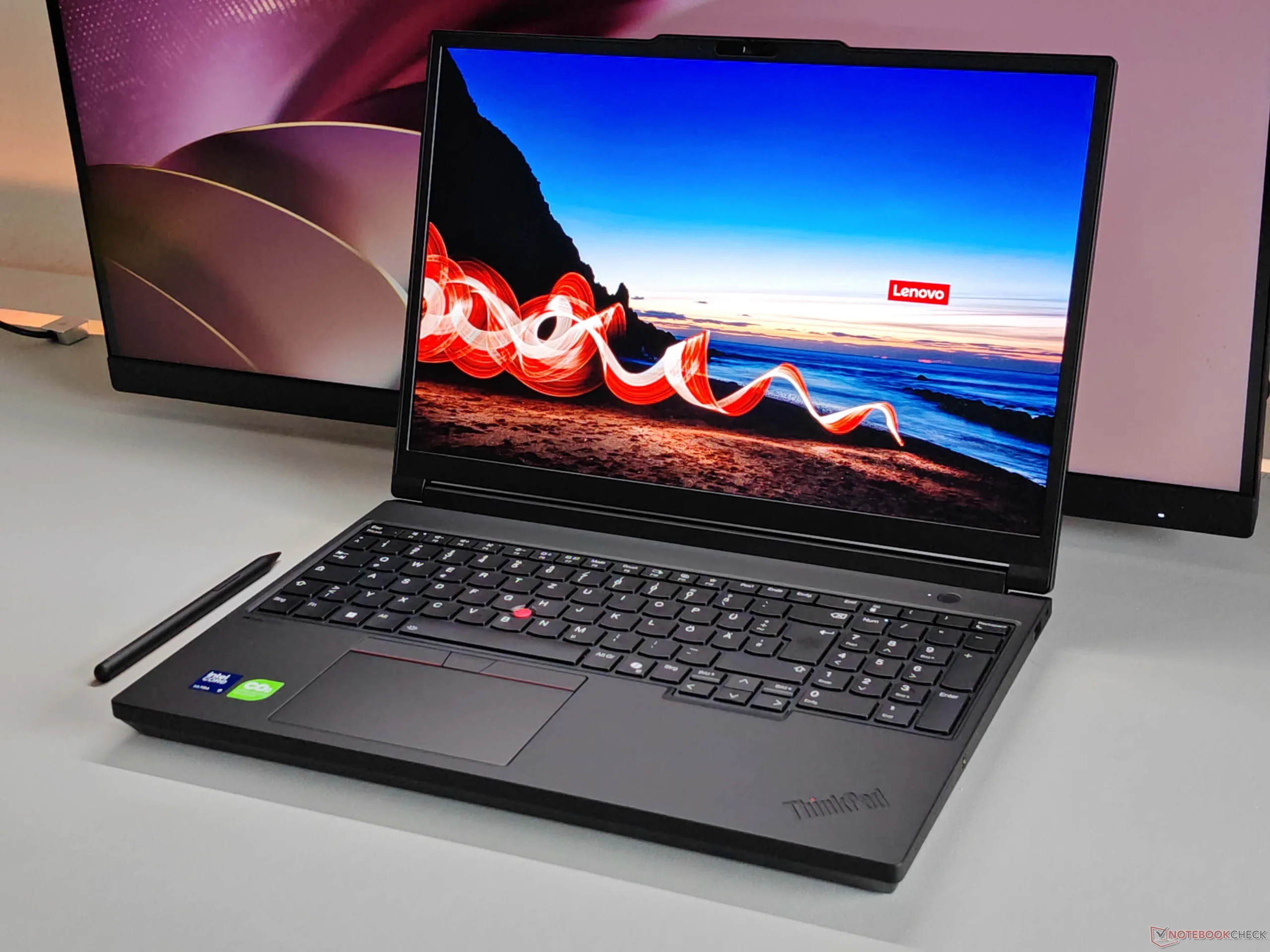
Lenovo has made significant updates to its large mobile workstation this year, now presenting two distinct versions. The ThinkPad P16 Gen 3 comes with professional RTX PRO GPUs from Nvidia, while the nearly identical ThinkPad T16g Gen 3 features consumer GeForce GPUs. We recently examined the ThinkPad T16g Gen 3, which includes the Intel Core Ultra 9 275HX, the mobile GeForce RTX 5080 Laptop, and a matte tandem OLED touchscreen, but our thoughts are somewhat mixed.
Design and Features
The latest model is slightly slimmer than its predecessor, and Lenovo has managed to reduce the weight by nearly 500 grams. Along with the smaller 180W power adapter, the overall travel weight is noticeably decreased. This mobile workstation boasts all the features one could desire, including optional 5G connectivity. It also provides two Thunderbolt 5 ports and excellent maintenance options (4x SO-DIMM, 3x SSD). The matte OLED touchscreen with 120 Hz delivers very nice image quality, despite the image appearing a tad grainy.
Performance Concerns
When it comes to performance, this large workstation is somewhat underwhelming, mainly due to the cooling design and limitations from the power adapter. Lenovo opted to remove the familiar SlimTip charging port in favor of USB-C entirely. However, the power input is capped at just 180 Watts, which clearly impacts the performance limits of the components.
The pure CU performance is decent during short load scenarios, as the processor can draw up to 160 Watts, but it falls to around 110 Watts after 30 seconds and further drops to merely 65-90 Watts after an additional 50 seconds. This indicates that CPU performance is far from stable. The GPU, a robust RTX 5080, has its maximum TGP restricted to just 105 Watts, making it the slowest version we’ve tested thus far. Even the RTX 4000 (which was based on the 4080) from the previous ThinkPad P16 Gen 2 running at 130 Watts offered nearly identical performance.
Noise Levels and Conclusion
When both components are stressed simultaneously, the GPU remains at 105 Watts, while the processor is reduced to a mere 25 Watts. The overall system consumption stays around 170 Watts, indicating an artificial limit. You might assume that the fans would be relatively quiet due to the lower performance, but that’s not the case. In fact, the ThinkPad T16g Gen 3 reaches up to 57 dB(A), making it the loudest device in our comparison group. It appears that the weight reduction primarily impacted the cooling system.
In conclusion, we have mixed feelings regarding the new ThinkPad T16g Gen 3 and its sibling, the ThinkPad P16 Gen 3, which share similar limitations. While these mobile workstations are packed with features, those in need of consistent and high performance may find themselves disappointed. For more detailed insights, please refer to our comprehensive review of the new ThinkPad T16g Gen 3.