
Key Takeaways
1. Astronomers have identified the HD 34282 system in the Chamaeleon constellation as a site where planets are being formed, located 400 light-years from Earth.
2. The star HD 34282 is surrounded by a transition disk, a thick ring of gas influenced by forming planets, showcasing signs of planet formation.
3. Detailed imaging revealed uneven patterns and brightness variations in the disk, indicating dust and gas are coalescing into planetary material.
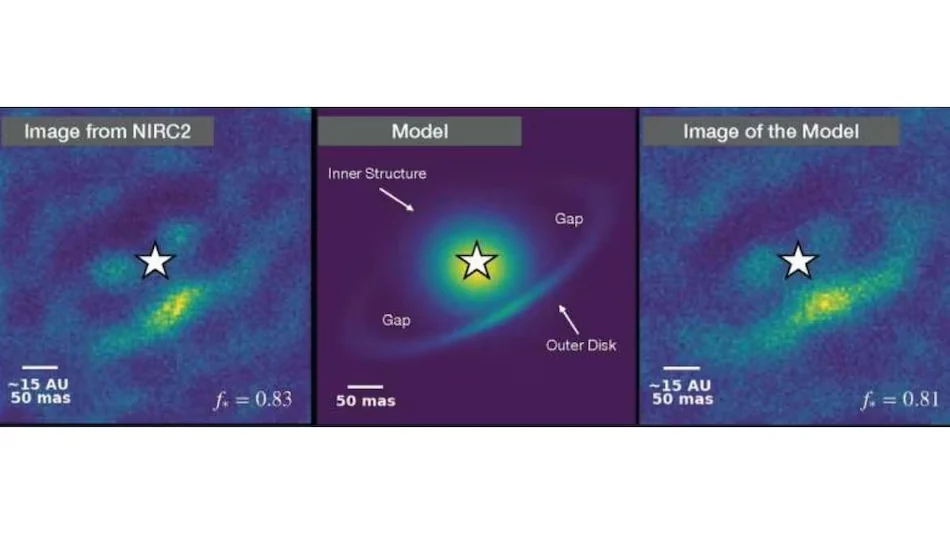
4. A gap of about 40 AU exists between the inner dusty envelope and outer disk, which is formed as a planet pulls in surrounding materials during its growth phase.
5. HD 34282 provides unique insights into planet formation, with researchers aiming to use advanced tools to further study this process and enhance our understanding of how planets like Earth are formed.
It can be difficult to imagine a planet as a baby in a nursery, yet astronomers have recently spotted one of the places where these heavenly bodies are created. A team of scientists utilized the impressive Keck Observatory to investigate a region known as the HD 34282 system, which is a star located in the Chamaeleon constellation, merely 400 light-years away from our planet.
Understanding HD 34282
The star HD 34282 is considered “young” and is surrounded by what indicates it’s a spot where planets are being born: a transition disk. This structure consists of a thick ring of gas that experts think is shaped and influenced by planets that are still in their formative stages.
With the aid of Keck’s NIRC2 infrared camera, researchers managed to create one of the most detailed images of the inner part of the disk that encircles the HD 34282 star. This image showed uneven patterns and variations in brightness within the disk, which are clear signs that dust and gas are coming together to form the basic elements of planets.
The Components of the Disk
As per the findings, the materials around HD 34282 can be divided into an inner dusty envelope and an outer disk. There is a gap between these two areas that measures about 40 AU, which is roughly the distance from the sun to Neptune.
The researchers noted that this gap typically occurs when a planet, while in its growth phase, pulls in materials from its surroundings, thus creating a path along its orbit around the star.
The bright clumpy designs and inconsistent textures seen on the disk indicate that a planet in its early stages might be actively drawing in material. This phenomenon, known as accretion, is recognized as the initial phase in the lifecycle of a planet.
The Challenge of Observing Planet Formation
Finding a planet that is actively forming is quite a challenge. In fact, only two planets (PDS 70 b and PDS 70 c) have been captured in images while still within their birth disks. The unique information provided by HD 34282 makes it particularly precious.
Other star systems like HL Tau also show similar disks, suggesting they could be sites for planet creation. Nevertheless, HD 34282 may offer the clearest live views of planet formation that we have witnessed, even though no actual planets have been directly observed.
The scientists express their intent to keep studying HD 34282 using even more advanced tools, such as the soon-to-be-released Keck SCALES imager. They aspire to follow the full journey of planet formation, which could help us gain a deeper understanding of how worlds like Earth came to be.
Source:
Link