
Key Takeaways
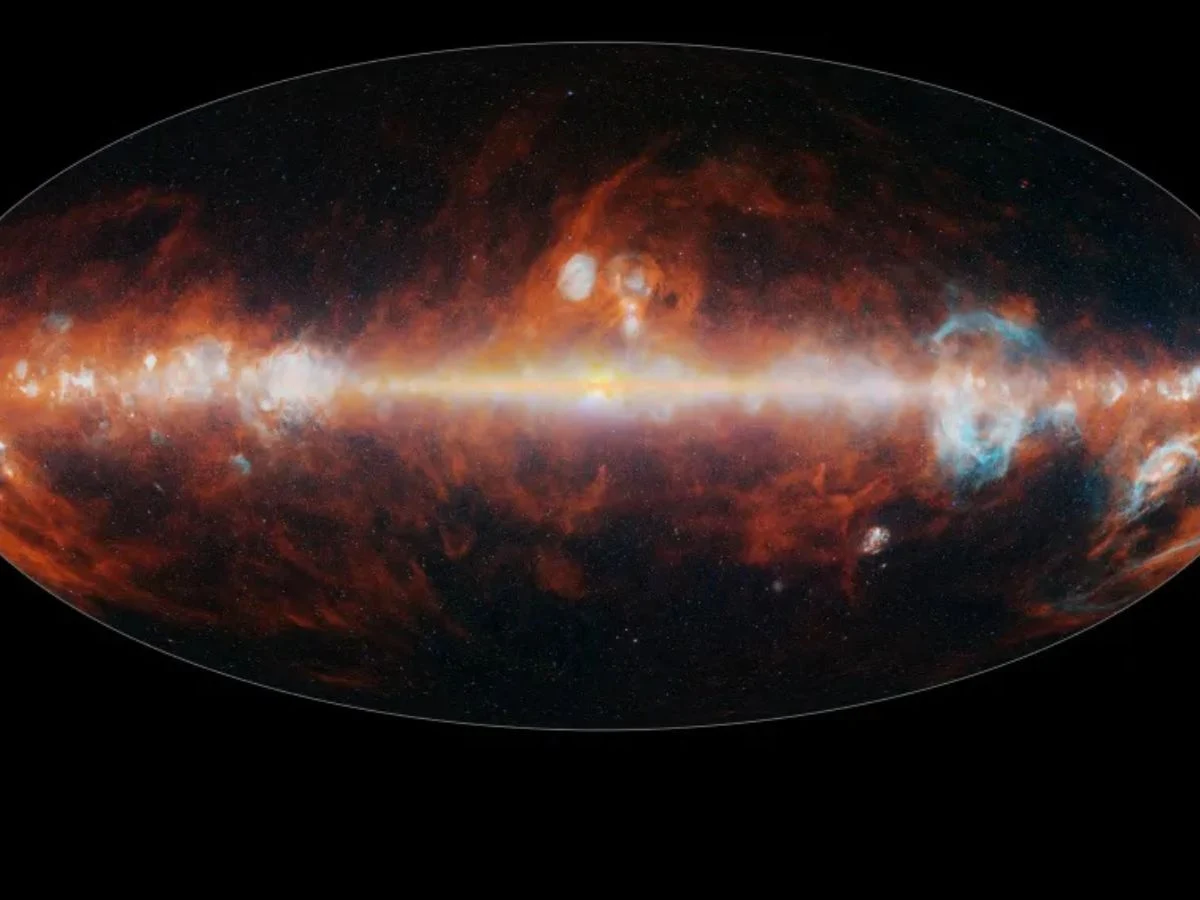
1. SPHEREx was launched in March 2023 and has scanned the entire sky in 102 distinct infrared wavelengths within six months.
2. The data from SPHEREx will help researchers understand the inflation period just after the Big Bang, which is vital for studying the universe’s timeline.
3. SPHEREx will create a 3D map of the universe by determining distances to hundreds of millions of galaxies using its array of colors.
4. The telescope’s unique design allows it to capture images in 102 colors, significantly surpassing other observatories.
5. SPHEREx orbits the Earth 14.5 times a day, capturing about 3,600 images daily, with a primary mission planned for two years to produce additional maps.
SPHEREx (Spectro-Photometer for the History of the Universe, Epoch of Reionization, and Ices Explorer) was launched in March this year. In merely six months, it has scanned the whole sky in 102 distinct infrared wavelengths. The remarkable part is that each wavelength holds information about various elements of the sky. Stars, hot hydrogen gas, cosmic dust — all these factors are included in SPHEREx’s map.
Insights from SPHEREx Data
With the data from SPHEREx, researchers will understand one of the most crucial periods in the universe’s timeline — inflation. This event happened just after the Big Bang when the universe expanded at an incredible speed.
Creating a 3D Map
The array of colors that SPHEREx provides will help in determining the distances to hundreds of millions of galaxies. This will allow for the creation of a 3D representation of the universe. All this data is essential for examining how the universe has developed over its nearly 14 billion years of life.
Unique Mapping Capabilities
Although many other observatories have mapped the sky, none have achieved it with nearly as many colors as SPHEREx. This is due to the telescope’s unique configuration. It features six detectors, each paired with a specially crafted filter that contains a gradient of 17 colors. Consequently, for every image, the telescope generates six times 17 colors — totaling 102.
SPHEREx orbits the Earth about 14.5 times a day. Each day, it captures roughly 3,600 images that cover one circular segment of the sky. Its wide field of view, combined with these elements, has enabled it to survey the entire sky within six months. As SPHEREx has a primary mission set for two years, it is anticipated to produce three more maps of this kind.
Source:
Link