Key Takeaways
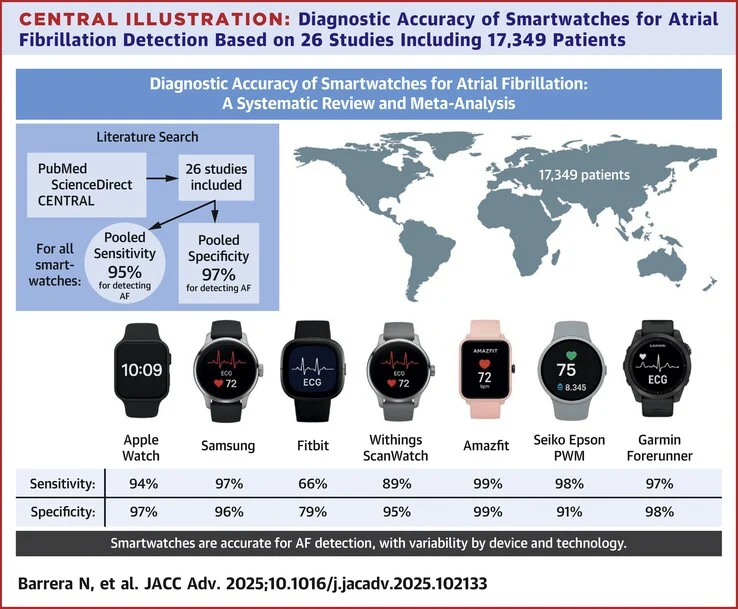
1. Smartwatches from various brands are generally effective in detecting atrial fibrillation, with overall sensitivity at 95% and specificity at 97%.
2. There are significant differences in detection capabilities among brands, with Garmin and Samsung performing best, while Fitbit lags behind.
3. Sensitivity (ability to identify disease) and specificity (ability to identify healthy individuals) are key metrics in evaluating smartwatch performance for atrial fibrillation detection.
4. The study is a systematic review, analyzing existing research rather than conducting new measurements, which allows for a broader evaluation of multiple devices.
5. The research is in preprint and has not yet undergone peer review, indicating that findings may evolve with future studies and new device introductions.
A fresh meta-analysis and systematic review, which is currently in preprint, indicates that smartwatches from different brands can effectively detect atrial fibrillation overall. We will delve into the background of this study type and the specific technical terms later. This open-access meta-analysis by Barrera et al. assessed studies with a total of 17,349 participants. The researchers measured sensitivity, specificity, and the area under the curve (AUC). The findings reveal that while there are variations in the ability to detect atrial fibrillation, the technology is generally dependable across multiple manufacturers. The sensitivity across all devices tested was 95%, and the specificity was 97%.
Variations Among Manufacturers
There are distinctions among different brands. For instance, Garmin Forerunner models with the relevant function report a sensitivity of 97% and a specificity of 98%, while the Apple Watch has sensitivity and specificity values of 94% and 97%, respectively. On the other hand, Fitbit is noticeably behind, with a sensitivity of 66% and a specificity of 79%. The smartwatch that offers the most precise diagnostics can be determined best by looking at the area under the curve (AUC) of the SROC (Summary Receiver Operating Characteristic), with Samsung ranking highest. However, we should not interpret the findings of this study, particularly for devices boasting sensitivity and specificity well over 90%, as a strict hierarchy that should directly guide consumer choices. Additionally, it’s not always guaranteed that both electrocardiographs and optical sensors can reliably detect atrial fibrillation, even though PPG-based systems allow for more regular or continuous monitoring.
Understanding Sensitivity and Specificity
Some background information might be required for interpretation and classification, along with explanations of technical jargon. In a medical-diagnostic setting, sensitivity refers to the percentage of diseases or “abnormalities” that are identified, whereas specificity denotes the proportion of healthy individuals accurately recognized as healthy. As we explained in our analysis of the Apple Watch’s blood pressure function, these two metrics are interconnected. Diagnostic techniques can be adjusted for higher sensitivity or specificity within certain boundaries, assuming the method is fundamentally appropriate. In screening procedures like atrial fibrillation detection, high sensitivity should be prioritized from the individual patient’s viewpoint. While a false-positive result could lead to unnecessary waiting at the doctor’s office and an unwarranted ECG, this is certainly a far lesser concern than the heightened mortality risk tied to undetected atrial fibrillation.
Nature of the Study
The study is classified as a systematic review, which means that Barrera N et al. did not conduct any measurements themselves, but rather analyzed existing studies and included them in their evaluation (or excluded them). The benefits of such studies are that they gather a considerable number of participants and assess a wider range of brands/devices. It’s important to note that this review includes various specific model versions from different manufacturers, and the number of test subjects for each specific device can vary widely. Moreover, the measurement techniques employed in the individual studies are not always consistent. The study by Barrera N et al. is still in the preprint phase and has not yet undergone peer review. Finally, the research landscape may evolve, particularly if new devices are introduced to the market.
Source:
Link